Showing posts with label swords & wizardry. Show all posts

Saturday, February 21, 2026

Cataloging the Indie RPG by Style and Genre

 As I sit here, I am supposed to be studying for some rather onerous testing exams for licensing (work stuff), but it's taking dozens of hours to get through the study process, a thing I have not had to do in some time now, and at my age its just damned tedious. So I am taking a few minutes' break to clear my mind and chill a bit. In doing so I am staring at a giant stack of various indie RPGs, loads of which are pamphlet sized, and almost all of which are 5X9 format in some form or another. 

My plan to write about this in February has been curtailed so it will bleed in to March now, and maybe even April if my busy non-fun RL schedule keeps up. But I can say this: indie RPGs really do seem to fall into a few distinct style categories, and those categories have some characteristics worth noting if you're trying to figure out what style suits your taste. 

The first style category I'll call "utility," which is to say: the book's author(s) value utility and function over everything else. Both Shadowdark and Old-School Essentials are excellent examples of this category. Some other games manage to fit this bill as well, though it may not be so obvious. Old Skull's publications (such as Screams Amongst the Stars and Running Out of Time) are also very utility driven, with the goal being to get the most useful content to you in the limited pages available. Less indie but definitely worthy of mention for this category is Savage Worlds.

Main Traits of Utility Games: ease of use; clear and concise rules; no authorial overtone or assumptions about expected behavior in play

Best Example of A Utility Game: As I wrote a few weeks back, Old-School Essentials is just amazing for its pragmatic, utilitarian approach to codifying the definitive OSR experience. A close runner up deserves to be given to the insanely no-nonsense Shadowdark. 

The second style category I'll call "Atmosphere;" this means the game is focused heavily on conveying its world, thematics or genre to you, and the rules are focused on conveying the atmosphere with as much energy and effort as can be afforded. Such systems are usually loaded with mechanics designed to build out on a specific style of genre. Mothership is a quintessential example, with its atmosphere being SciFi Horror, usually on haunted ships and space stations. Mork Borg is eschatonic fantasy steeped in the graphical interface of Swedish death metal. Orbital Blues is all about replicating a highly distinct blend of Firefly meets 1970's aesthetic style science fiction. Death in Space is about a collapsing spacefaring society that is grimy, dirty and maybe also facing an eschatonic end times. Heroes of Cerulea is about an NES 1988 era fantasy world ripped straight from the earliest era of JRPGS. 

Main Traits of Atmospheric Games: rules built to enforce the rules of the game's universe/genre; thematics designed to enhance and promote the tropes and expectations of the setting

Best Example of an Atmospheric Game: Mothership, of course! With Orbital Blues coming in a close second.

The third style category is a big one, and I will call it, "experiential;" for lack of a better word. These games are providing you with a set of rules and a setting, often closely tied together, with the intent of providing you a unique experience or take on otherwise well-trod genres. Such games are noteworthy for diving in to corners of fantasy or weirdness, often going a bit off the rails, and it can be clear at times that the gameplay loop involves heavy improvisation on the part of both the player and GM (if the game even supports a GM!) Land of Eem, Into the Odd, Outcast Silver Raiders, Troika!, Ultraviolet Grasslands, maybe Liminal Horror and Cairn, can all be said to fit this category. Such games might feel a bit like roller-coasters riding through strange worlds. Some are settings only, such as the Painted Wastelands, Ronin or Vast Grimm which hack other systems into their own weird universes.

Main Traits of Experiential Games: a strong focus on the weird/unusual, emphasis on random generation and improvised play; often focused on very niche and sometimes cartoonish imaginings of their universes

Best Example of an Experiential Game: So many choices, but I feel I have to give this to Troika!, a game which defies easy interpretation for many, while still being so interesting I can't stop trying to figure it out. Runner up could go to any, but I feel the Painted Wasteland (my current favorite OSE setting) has earned it.

The final style I will label "Graphical;" any game in which it appears that the artist is as important to the process as the author or anyone else. Indeed, you might find that the game itself is less of the point than purchasing the cool book full of neat art. Not quite indie, but sort of in this ballpark I feel you could put The Electric State, along with some noteworthy titles like Ultraviolet Grasslands, the Painted Wastelands, CBR*PNK, Cy-Borg, Mork Borg for sure and all its other spin-offs, and amazingly weird and difficult to parse out products like Ballads of Oread. If Exalted Funeral published it, then it might have some lineage in this department. Don't confuse, "Looks cool," for being in this category, though; I would suggest a key component of games in this category is that you might better imagine them as coffee table books than something you can actually figure out how to play!

Main Traits of Graphical Games: they are really interesting tomes to look at (assuming they come in a conventional book format); they are often hard to decipher, or you can tell that the author was playing second fiddle to the artist

Best Example of a Graphical Game: Mork Borg!!! It's a puzzle to decipher for many. Runner up: Ultraviolet Grasslands

Okay! So with all that out of the way, time to get back to some real work. I'll finally (hopefully) talk about some of the newer games I've picked up here in the next few weeks soon.


Friday, January 16, 2026

Blog Retrospective: A Look Back to February 2011

 So here's how this concept for posts started: while writing the prior blog on Resident Evil Village I did a link on the search bar to prior posts that spoke about Resident Evil. While perusing those posts I was more than a little surprised and entertained to see that many of them are so old now that they talk about situations and perspective that feel like ancient history to me. There was a time, for example, when you couldn't get the original Resident Evil games from the PS1 era on GOG.com, or to play Resident Evil Revelations you needed access to a Nintendo 3DS. Hell, some of those posts are written before Resident Evil 6 came out and caused Capcom to rethink their approach to the series! Other posts were me writing about the batshit crazy multiple-character scenarios of RE6. 

Bottom line is.....my blog started in February 2011 and spun out of a time when I had more free time and less to worry about (also, less money, meaning more to worry about in a different sense), I was involved a lot in learning how to self-publish online and my then fairly new marriage hadn't yet even spawned our first child. So when I started this blog I was recently married to my third (and final) wife, did not have a child, was using online publishing and POD as a source of income (mainly to get more money for games) along with my then accounting job, I ran RPGs Wednesday and Saturday nights, and my video game time was centered around MMOs on the PC and the Xbox 360, my exclusive console of choice back then. I also note an old air of pragmatism that I think I should try to re-adopt, as I tended to have one thing (say, one console, one e-reader or one MMO I was obsessed with) that I was thoroughly focused on. Meanwhile I lived in an apartment up near the mountains in our local city that was small but very cozy for my wife and I. We had a lot of cats.

To contrast today, my wife and I passed our 16th anniversary last September, my son is 14 years old and asking me for advice about his sundry girlfriends, I am still gaming on Wednesday nights though not Saturdays anymore, I haven't touched an MMO at all except to occasionally pop into Guild Wars 2 just to see what's up only to play an hour then log out for another six months, and I don't have a single console....I have ALL the consoles and I have a real problem with handheld PCs, too (and tablets). In fact I have a problem with collecting and hoarding gadgets and I really, really need to stop doing that. Meanwhile I no longer put any effort into self-publishing online outside of the blog, mainly because the long term reward-to-effort value simply wasn't there; I get more fun doing the blog for fun, and while I still write a lot, its mainly for the home campaigns and the entertainment of my player group. I am no longer an accountant, and am instead a business owner who hires accountants to do that work for me. I am, ironically, still working in the exact same building as I did in 2011, but its by coincidence a completely different company that I have ownership in. Oh, and I own a house which is a 30 minute highway commute away. And we have even more cats than we used to, though only one of the cats from 2011 is still with us (he is 17 years old now).

I only had three blog posts in 2011: an introductory blog post, one which talked about our experiments in Swords & Wizardry, and a third one which talked about The Rising Dark, a book on the lands of Agraphar, a setting I published for Swords & Wizardry and had also adapted to D&D 4E (holy cow, that was the edition of 2011....yikes...). The Lands of Agraphar is still available in print at Lulu, I think....PDF probably at Drivethrurpg. I never used it as written; I ended up modifying and adapting its scenario concepts to other systems and settings, notably D&D and my Lingusia setting. You know....I have this book on my shelf even today, in my S&W section. I should pull it out and run the thing as originally intended at some point, it would be a fun exercise.

Apparently I played and was only mildly impressed with the game Singularity in Feb 2011, commenting on how it was good enough to finish but also not good enough to feel good about finishing. Weird, as over the years I have replayed that game a couple times and liked it more on a new playthrough. I recently tried getting it to work on the handhelds but it is difficult to get Singularity to play nice with modern controller schemes, unfortunately....and then I thought, "I should really play some of the new games I have stacked up, like RE Village." So that went away.

I also talked about being into the early adopters of the free-to-play model of MMOs: Champions Online and D&D Online. I really did love those two games, but eventually the interest petered out. Both games were fairly decent at least early on in their F2P models, with the goal being to sell actual content such as scenario packs and classes and stuff. They would eventually turn this approach into a far too expensive proposition, and as we all know, F2P models have turned into predatory nightmares that are so bad now I simply won't give a F2P game any effort or energy, noting that rare exceptions remain those which sell you actual content even if their base game remains free (so "free to try") like Guild Wars 2 or Destiny 2.

Okay! This might be a fun exercise, periodically digging through the ancient archives and revisiting long lost eras of this blog. Maybe there will be more of this. 


Tuesday, November 25, 2025

The Sixth Weird Thing: Chilopteroids


The Sixth Weird Thing: Chilopteroids of Gleison

This is OSR friendly! Originally part of a White Star campaign I ran. 

The Chilopteroids are six to eight feet tall, and resemble humanoid bats, with membranous glider-folds between body and limbs. They are native to a bleak, windswept world called Gleison, where they have spent ten thousand years slowly developing an elaborate society built on slavery. The chilopteroids developed space travel thousands of years ago, and initial slow FTL ships migrated chilopteroids to other colonies, most of which failed. In time they discovered transitional drives and their later ships migrated into the stars, but this time with a different intent: to conquer and enslave.

Today chilopteroids are a decadent society that harvests slaves from other civilizations and drains them of life force using a technology called blood crystals, organically grown crystalline devices that bond to their slaves and drain them of vital psychic energy, feeding it to the chilopteroid master, allowing him regenerative abilities and near-immortality. The predatory nature of the chilopteroids means that they favor pre-FTL societies, or civilizations with low tech in general, for they are usually ill equipped to deal with the “space vampires.”

Each chilopteroid is equipped with an impressive photosensitive epidermis which is adapted to perfectly mimic light sources around them; this allows them to defeat attempts to see them through a normal spectrum as if they had used the invisibility meditation, but it fails when they move at full speed (they can maintain it at half speed) or if they engage in sudden movement. The invisibility camouflage does not work well against motion detectors or infrared detection, and is utterly useless against extrasensory perception.

Despite their similarity to Terran bats, chilopteroids do not use sonar and actually have incredibly well-developed vision, which aids them in detecting their own kind when camouflaged.

Chilopteran Statistics:

Armor Class 8 [13]

Hit Dice 3 (11 hit points)

Total Hit Bonus +3

Attacks claws (1D4) or laser pistol (1D6+2)

Saving Throw 16

Special natural camouflage (limited invisibility); blood crystals

Movement 12 (15 flying; in 1G or lower only)

HDE 3/60

Blood crystal Implant: A chilopteroid with its blood crystal receptor will regenerate 1 hit point per turn, and leaving a body around will let it come back to life eventually; only destroying the body will stop the regeneration.

Chilopteroid Blood Crystals: these crystals have a “collector” type and a “receiver” type. They drain psychic energy, draining 1 point of INT and WIS per day to a target that fails a saving throw. When the target reaches 0 in either score it becomes brain dead and dies; the crystal has an emergency cutoff point, however; chilopteroids don't like to lose hosts. If a host is about to perish, the crystal will go dormant and allow the host time to recover (see below) before reactivating. Such hosts are in a deathly state described as "torpor," recovering 1 INT and WIS per day. When the host is healed, the crystal resumes draining.

During the draining cycle the target suffers madness and delusions, and develops a cult-like belief in the divinity of the chilopteroid or entity with the receiver crystal installed. The receiver crystal will regenerate 1 hit point of damage or remove one deadly condition per turn to the bearer so long as at least one collector crystal is in a living host. The chilopteroid will also be ageless and immortal. 

The crystals require a minor surgery to install but quickly bind to the nervous system. Removing one from a living host requires medical expertise and the target must have a saving throw or take 4D6 damage from the process. A target freed of the crystal can make a Save to recover, and on a success will recover 1 INT and 1 WIS per day until restored. If a natural 1 is rolled on the save then the target loses 1D4 of each, and could die if reduced to zero.

Other species have been able to use the blood crystals with mixed success; non-chilopteroids must make one save for each week that a receiver crystal is implanted, or develop debilitating, cancerous growths, as the crystal rejects the alien organism. This process causes a loss of 1D4 hit points per day until surgical removal of the crystal. 


Edit: I keep copying from DOCs I have nd discovring weird formatting/color issues. Hmmm.

Thursday, June 26, 2025

As the Werewolf Changes

 During last night's game I was surprised to notice that Jackalweres no longer have a problem with silver in the 2025 Monster Manual. So in checking out the other lycanthropes I discovered that hey, it turns out in D&D 5.5 you can harm werewolves with anything, normally, now. They get a few extra HP and a slight AC boost but lose all the mythological flavor of the thing they used to be.

This got me to thinking about how they looked in other systems, so I thought I'd plunge down that rabbit hole a bit to see:

AD&D 1E/2E: Can only be harmed by silver or +1 weapons. So at this stage in the game, low level PCs who have trouble finding magic weapons really need to carry a silvered weapon with them just in case.... In rereading their entries I assume they transform as an action but maybe it was as part of their movement. I seem to recall running AD&D where they could move, transform and attack all in the same combat round, which makes sense in the longer 1E turn cycles.

D&D 3.5: Gain damage reduction 10/silver but only in hybrid and wolf form, interestingly! Shapeshift is an action. Looking at the old format for D&D 3.5 stat blocks on monsters reminded me of how convoluted and information dense they were; how interesting to see that the 2025 MM swung so far to the opposite direction that the current stat blocks feel anemic and drained of all color and flavor.

Pathfinder 1E: Have resistance 10 to all attacks except silvered weapons! Change shape is a move equivalent action, and they induce lycanthropy on a failed saving roll following a bite.

Pathfinder 2E: They have shapeshift as an action, and are vulnerable 5 to silvered weapons. Lycanthropy is induced on a failed save.

D&D 4E: they have regeneration 5, but silver stops their regeneration. They shapshift as a minor action, and they do extra damage against bloodied opponents. Instead of imparting lycnathropy as a disease they induce moon frenzy, which behaves a bit like the confusion spell (but does not end with the inflicted turning into a lycanthrope, interestingly). Diseases and curses in 4E were notoriously weak and ineffectual.

D&D 5E (2014): resistant to nonmagical or silvered weapons, but shapeshift as a standard action. Still have some flavor text that leans into making werewolves interesting in a traditional way. If bitten, on a failed save you just have lycanthropy now.

D&D 2024 (5.5): They gain 13 hit points and get a better AC, but lose any special resistance to ordinary damage, and silver is not even mentioned. They can shapeshift as a bonus action. Lycanthropy if bitten, but you have to reach zero hit points for it to take effect.

Tales of the Valiant: Werewolves are resistant to non-magical damage (silver is not mentioned here either). They induce lycanthropy as a curse after biting someone who fails a save.  

How about some of the other games out there? Let's see:

Swords & Wizardry Complete: mirrors AD&D 1E; so they can probably shapeshift as part of their turn, and are immune to nonmagical, non silvered attacks. Lycanthropy is automatic in an opponent reduced to 50% of their hit points by the werewolf.

Dragonbane: Werewolves hate silver as it deals full damage (along with fire) and messes with their senses. They take half damage from non-magical weapons. taking even 1 point of damage from the werewolf induces both paralysis (potency 9) and lycanthropy, and can only be cured with powerful magic or wolvesbane. And on its monster attacks a 6 induces a berserker frenzy in which your party probably dies!

Basic Roleplaying/Call of Cthulhu: They have regeneration, are immune to most damage (silvered weapons will do full damage and kill them on a serious wound, though), and taking any damage from a bite induces lycanthropy, which can maybe be avoided on a luck role if the bite also severs the limb that was bitten. Nice! The BRP statblock addresses magic and fire doing full damage as well.

Cypher System: they are level 4 creatures, which normally would mean 12 health but they have 24 health. They can cause lycanthropy if you are sufficiently injured to be reduced on the damage track. They take a long time (1D6 rounds) to shapeshift if caught in the act.

Dungeon Fantasy RPG (GURPS): These things are terrifying with damage resistance 15 against all attacks except silver (which does double damage and ignores the DR), and they regenerate 1 HP per second (GURPS combat rounds are 1 second long, so for D&D purposes that's 6 HPs of regeneration for a D&D round). Interestingly Dungeon Fantasy punts on the lycanthropy as a bite-induced curse with some flavor text about how the local temples try to keep that under control, and the rest of the statblock ignores it. GURPS Werewolves from the 3rd edition sourcebook of course does a lot more that I won't belabor here.

Fantasy AGE: They show up in the Bestiary sourcebook, and can induce the lycanthropy curse on a stunt, with the difficulty being based on how many stunt points are applied. The inflicted makes checks each night until the full moon; if they don't kick it before the full moon they go full lycanthrope. There's a section on lycanthrope vulnerabilities, but silver is mentioned as only one possibility, with the GM encouraged to customize for the campaign.

Mythras: Mythras punts on this one terribly and you need to go dig in the wolf section to get a sense of it. Ostensibly they are emulating older, more archaic notions of shapeshifters rather than more modern takes on lycanthropy, I guess? 

Mork Borg: It's actually a character class, the Cursed Skinwalker (in Feretory). You die, and your body is possessed by an animalistic presence, returning you to life as a cursed skinwalker. a bloody, skinless wolf is only one of your options. Tangentially werewolfish, but it wouldn't be Mork Borg if it was conventional now, would it? 

Okay, it was at this point that I ran out of energy (I was looking at The Fantasy Trip's take, which is to lump werewolves and vampires together as cursed/diseased species when mental fatigue just overwhelmed me). I have to say, if you want a werewolf to be scary, then there are two games that do this exceedingly well: Call of Cthulhu/BRP and Dragonbane (with honorable mention to GURPS/Dungeon Fantasy). The least scary edition of the the werewolf can be found in the current D&D Monster Manual for 2025, which is a real shame; it really lacks any of the color and vibrancy of the mythology it derives from. Curiously, they have done a better job with some other monsters in the book (medusa got a slight improvement imo, for example) so it is a shame to see them drop the ball here just because, apparently, someone might not want to be bothered with finding a silvered weapon? Weird. Very weird. Aside from D&D 2024, the next worst take on werewolves is (imo) Mythras, which puts the least amount of effort into the concept, delegating lycanthropy to a paragraph in the wolf statblock section.

This is making me want to consider Dragonbane for gaming in the very near future now, though. 


Tuesday, January 28, 2020

Swords & Wizardry Boxed Set on Kickstarter!


Not just any old Swords & Wizardry edition....it looks like Frog God Games is offering up a four-volume boxed set edition of S&W Complete, with some extras such as a GM screen, monster book and stretch goals. S&W Complete snagged me as my preferred retroclone OSR edition of D&D a long time ago, and the look of this boxed set is too cool to pass up, so count me in!

Kickstarter Page Here!

Friday, September 14, 2018

Class Restrictions, Race Restrictions - Critical to OSR?

Every time I think about firing up an OSR game I run in to a wall with the tradition of restricting races to certain class level limits, excluding them from certain classes, and of course the old school limitations on multiclassing.

Back in the 80's I ran a looser version of D&D, sticking to class/mutliclass restrictions, but ignoring level limits for the most part. When 2nd Edition AD&D arrived it provided rules for ways to alleviate restrictions on demihuman leveling past the "cap," usually by increasing XP. D&D Encyclopedia somehow ignored the issue by adding a letter-based weapon class advancement in. In retrospect it seems amusingly ad hoc and reflective of a determination to stick with tradition by finding weird optional work-arounds for a problem that was inherently arbitrary. By the time D&D 3.0 arrived on scene, the reality of just how arbitrary it all was became blindingly evident.

As I was parsing out Swords & Wizardry Complete for considering an OSR game once more, I was reminded of this problem. Faced with the reality of traditional old school approaches, I was left with the following problem:

--Do I run the OSR game with my modern sensibilities and simply sweep aside racial/class/level restrictions? Would that really be very OSR if I did?

Or....

--Do I adhere to them strictly, and design a setting that expects and enforces them? No elven paladins, no multiclass humans, no 20th level halfling fighters.

Option 2 would make for some fun and highly specific world building....for a bit. But the arbitrary nature of the distinctions in classic AD&D not only don't jive with my world building interests now, I have to remind myself that they didn't back in the 80's, either; these are rules from the original game which I had to houserule out, and as such for me they were never very OSR; I never liked them then, and find it hard to like them now.

But....if I do option one above, then I am faced once more with a different conundrum....why not just run a more modern iteration of the game? And if it's D&D 5E, why not just use the optional gritty mechanics in the DMG to simulate the more restrictive magic elements?

So now I'm back to thinking about ways to use 5E to run the kind of game I want again. Or, of course, Cypher System....the game which caters most closely to my GM style these days, and a system which inherently rewards players with ingenious descriptor/type/focus combinations in a way that a traditional OSR game can't even conceive of.

Thursday, December 28, 2017

Reviewing the 2017 Gaming Predictions

Back in December 29 of last year I made some gaming predictions/analysis about where things ought to go for 2017....so how did it stack up?

1. A Companion Book for Fantasy AGE

--NOPE!!!

As it turns out, Green Ronin got Blue Rose out this year, announced a Modern AGE (though that will probably not come out until sometime in 2018) and that was about it.

2. WotC Releases a Player's Tome for D&D 5E

--YEP!!!!

Sure enough, the did it: Xanathar's Tome is also for DMs, but contains plenty of new archetypes for players, new background details, and loads of little bits that D&D 5E needed. I wish they'd do this every year, but understand that the game's focus is on less splat...so maybe 2018 will give us a new monster book, instead.

3. Starfinder support for straight SF

--NOPE!!!!

Starfinder is fun, but it's pure fantasy space opera of the Nth order. I still contend it needed to be a broader toolkit, but for what it does set out to do, it does very well. So I suppose this is a wash. Given how saturated the market has become with SF game options, though, I would suggest that Starfinder probably is doing fine by distinguishing itself with its fantasy-based Pact Worlds universe and this was probably a smarter move on their part than directly competing with Star Wars, Star Trek, FrontierSpace, a re-release of Star Frontiers in POD, Traveller, Coriolis, and probably two dozen others I haven't mentioned, never mind all the generic systems with SF support. So yeah.

4. Swords & Wizardry goes mainstream

--NOPE!!!

The new edition came out but it doesn't appear to have changed S&W's saturation in the market. If anything the OSR seems to be dominated by the more innovative titles which are better described as "inspired by" as well as a slew of weird "we are going to repurpose the fuck out of B/X D&D" releases on rpgnow that are all over the place. So no mainstream OSR title.

5. GURPS Returns

--YEP!!!

Hell yeah it did. Dungeon Fantasy has re-energized GURPS, and then Steve Jackson Games got GURPS on to rpgnow which was a bold decision on their part, but brings it back in to the "view" of most gamers who don't frequent e23. They are looking to a future of new stand-alone, Kickstarter-funder releases similar to Dungeon Fantasy, and lastly Steve Jackson also regained control of his content for The Fantasy Trip, which was GURPS's predecessor, which based on his comments on the GURPS forums he plans to re-release as-is, meaning a very "lite" version of the system which inspired GURPS will be available again soon.

SJG could move too slowly on future plans, but for 2017 at least GURPS got some much needed love and attention.

6. Pathfinder 2.0 

--NOPE!!!

They could be quietly working on this, but they didn't announce it. There are lots of streamlined design decisions in Starfinder, but I feel many of those are designed to suit the space fantasy laser gun elements of the setting and may not be so ideal for straight fantasy gaming. There's a planned release schedule that suggests no 2.0 announcement for 2018, either....and judging from the diehard dislike of the Wilderness Adventures book's shifter class, the Pathfinder core will not be happy with anything that isn't fully public in playtest, so I suspect no 2.0 is in the works right now, or the foreseeable future.

So...2 out of 6! About par for the course with any good fortune teller, in other words....

Wednesday, September 13, 2017

The OSR Survival Kit

Any fan of the OSR knows that one of the cool things about our corner of the hobby is just how portable it is. Sure, you can just load up all the PDFs you want on a tablet, but most old schoolers prefer actual books in hand....

For example, my default "OSR Pack and Go" looks like this, depending on which flavor of RPG I feel like dabbling in:

One copy of the White Box Fantastical Medieval Adventures RPG
One copy of Beasties - Manual of Monsters (or insert other preferred monster book here; I like this one because it's digest format and has very cool, illustrated monsters Night Owl Worskshop style)
A copy of the White Box Omnibus (or alternatively White Box Gothic if you're looking for that)
One or both copies of Dyson's Delves (the best OSR dungeon resource hands down)

Those five books still take up half as much space as a single core rulebook for D&D or Pathfinder.

If I'm in the SF mood, then the adjustment is obvious and easy:

One copy of White Star Core Rules
One copy of the White Star Companion
Throw in a copy of the Hyperspace Messenger Compendium
Optionally you can add Between Star & Void and Tools of the Worldshapers

And just like as above, the five books for White Star still take up less space than Starfinder Core or Traveller core. Add in some dice, a notepad and pencil and you've got yourself a game!

What sort of OSR Surival Kits do you like to drag along? I could easily see one which covers The Black Hack (the most emminently portable OSR-derived game out there), or pretty much any of the Night Owl Workshop games (which are all utterly amazing). I've got a serious preference for digest books, and if I ever saw --say, Goblinoid Games-- produce a thick and portable version of Labyrinth Lord I'd totally snag that sucker.


Wednesday, August 23, 2017

Some Combat House Rules for The Hero's Journey

After messing around with The Hero's Journey, in thinking about how combat is handled with a mixture of deflective (AC) and reductive (reduction value). The book includes some optional rules for GMs who find reduction value gets in the way of conflict resolution, but I felt you could do this with a bit more nuance. Here's three rules I would suggest to improve the combat experience in THJ:


Critical Hits

If a PC or foe roll a natural 20 on their attack roll, they get a critical hit. They may do one of the following with a critical hit:

Deal damage directly, bypassing armor
Deal 1 point of damage directly to the armor (permanently reducing it; armor with a RV reaching 0 is useless)
Automatically deal maximum damage with their roll

This option lets foes damage armor, bypass armor and also choose maximum damage against unarmored opponents. Just remember that they only get one option!

Parrying

If you can absorb damage with armor in THJ, then why not also parry attacks? If you are wielding a weapon and you want to parry, then make an attack roll against the target number your foe rolled. If you roll higher than the final attack roll (with modifiers) then you may roll the damage value of your weapon, convert it to reduction value, and reduce the total by that amount.

Under this system, while using the crit rule above, you can damage weapons used to block you or bypass them on the crit. If you deal damage to a weapon, it loses 1 point of RV, which is equal to the average of it's damage roll, rounded up. So a two-handed sword, with 2D6 damage, has a RV of 7 for purposes of damage dealt to the weapon. You record this as a "-1" and each time you try parrying again with the weapon you roll the parry value and subtract this total. If the damage on the weapon increases, note it as -2, -3, etc. until it reaches the maximum RV based on the average roll, at which time the weapon breaks.

Daggers under this system have a special deflection property: they roll 1D6+1 for determining RV rather than the actual damage roll of 1D6-1.

You could also treat shields like this. Give bucklers a RV 1, regular small shields an RV 3 and larger shields an RV 5. You have to choose to parry with the shield if you so choose, and like weapons they can be targeted and damaged.

Sundering

Sundering becomes a specific option under these rules. You can elect to bypass attacking your opponent and aim for his shield, armor or weapon. In these cases the attack roll is aimed at sundering the protection of the defender. Sundering attacks are always at a -2 penalty. A normal success that is not parried will result in the attacker rolling damage against the armor, shield or weapon.If the total damage is higher than the RV of the targeted piece of gear, it's RV is reduced by 1.  So an orc with a 2D6 two-handed sword decided to sunder the paladin in plate, targets the armor, and deals 12 damage. The paladin fails to parry and is hit....7 points are aimed at the armor, and the plate armor goes from RV 5 to RV 4.

Sundering is a declared attack, and because it targets gear it does not deal HP damage to the target.

Fumbles

On a natural "1" on the roll, a critical failure, the GM can rule that one possibility of the fumble is that the RV of a parrying or attacking weapon is reduced by 1.

Repairing Armor

It costs 10 GP per RV and 1D6 hours for a blacksmith to hammer out and repair armor, weapons and shields to reduce damage. Bows, wooden shields and leather armor may require different specialists to repair, and may not be worth the cost.

Damaging Magical Armor and Weapons

GMs can rule that magical arms and armor cannot be damaged, but a more realistic method is to declare that they get a saving throw. Anytime a piece of armor, shield or weapon would take damage, and it is magical, it adds its magical modifier to a saving throw, with a target number of 10. If the magical gear rolls 10 or better then it is undamaged. Repairing magical armor requires special skills and typically is 100 GP per RV fixed, and takes 2D6 hours.

Creatures with Natural or Magical Armor 

If the GM rules that the natural armor is the source of the RV, then the RV cannot be reduced. Alternatively, RV can be reduced but all extra damage rolled is delivered to the target. Magically granted RV should not be possible to reduce (due to spell or nature of supernatural entity) in most cases. A lycanthrope, for example, is naturally resistant to damage but also does not take any damage from unsilvered weapons. In this case, I would rule that the RV of the werewolf can't be reduced.....unless a silvered weapon is used to sunder.

Monday, August 21, 2017

The Hero's Journey: A Look at Character Creation and Rules Differences


Last year James Spahn produced his own OSR fantasy game, "The Hero's Journey." It was a really nice looking book with an evocative cover designed to remind older gamers of those classic Tolkien novel covers, with a simple, stylized depiction of a pastoral fantasy realm, each layer of the image suggesting more mystery and adventure just over the horizon.

Since then I have been waiting for more of "The Hero's Journey" content but James is only one man, and he's got lots on his plate. I thought I'd take some time to explore this game, which has some very interesting twists to it. I figured exploring character generation might be one good way to talk about this system, so here goes....


I decided to roll up a random PC and ended up with a half-elven wizard. I’ll talk system after the stat block…

Name: Cahrain Desmedre
Race: Half-Elf male
Class: Wizard; Level 1; XP 0
Profession: forester; Alignment: neutral
Strength 14
Dexterity 15 (+1)(improves AAC)
Constitution 9
Intelligence 15 (+1) (5 bonus languages; extra 1st level spell slot)
Willpower 16 (+1)
Charisma 13
Appearance 9
Luck 10
HP: 6, HD 1; BHB +0; ST 15; AAC 11
Half-Elven Traits: martial amateur (long sword), Arcane Dabbler (charm person 3/day), fast learner (+5% XP), star sight
Wizard Abilities: magical awareness (detect magic at will); spell casting (2 1st level slots/day), +2 save vs. magic
Languages: common (Middle Tongue), elvish, orcish, Southron Tongue, Old Tongue, deep speech
Spell Book: read magic, arcane dart
Gear: simple clothes, backpack, 60 GP, long sword (1D6 dmg),

Notes on Character Generation:

Stats: THJ has eight stats, renames wisdom as willpower, then adds appearance and luck. The luck stat has some interesting extra mechanics….if you are lucky, that is! Stat generation is not based on D&D conventions and in fact each race has a different range of dice to roll. In our half elf example, above, each stat was 3D6 except for charisma and appearance which were 2D6+6. (Yes, I rolled poorly.)

Professions: THJ adds in professions, which are not unlike a more detailed version of the background trade from AD&D 1E. You roll, get a short list of things you can do with it, and your starting gear. This is a nice touch and something I’d be tempted to port over for use in any OSR game.

Classes:  I went for a conventional class, but THJ has a dozen interesting options including some weird ones like jester, duelist, cavalier and acrobat. These are all reminiscent of older AD&D classes from the early eighties, introduced in Dragon Magazine, but their versions here cleanly reskin them for the more basic conceptual turf of S&W.

Tweaks in Hit Die and AC Mechanics: THJ does interesting things with hit dice, hit point caps and armor. Armor now has a reduction value, which does not improve your AC (or AAC if you prefer ascending AC), but instead is a damage reduction value….so plate mail, for example, reduces attacks by 5 points. Armor class is still improved by shields, though, which grant an AC bonus (as a deflection bonus). This is an impressive -2 for a buckler and a whopping -8 for a large shield. By simply virtue of mechanical integrity it strongly enforces the idea that all fighters in THJ will be sword-and-board guys hiding behind large shields.

Hit points now only roll for the first three levels and starting at level 4 all advancement is a small static number (typically +1 or +2). For our sample young wizard above, that means he could at most hope for 17 hit points by level 7 (the cap for half elves)….as wizards only get +1 HP at level 2 and +1D6 at level 3, then it’s +1 per level after that. A fighter’s top bonus, assuming a CON of 18, could be a max of 39, however, so the wizard doesn’t seem too poorly off here.

The hit point thing seems interesting because it doesn’t look like the monsters took much of a hit on their hit dice, with most having plenty of dice to roll. This is S&W White Box inspired however, so monster hit dice are rolled on D6s, but a hill giant with 8 hit dice is still going to average 28 hit points.

Level Caps: THJ keeps level caps in place. Each race has a listing of what level caps and allowances are available….the system is designed to go only to tenth level however, so many of these limits aren’t so bad. The level caps did make more sense in AD&D where the non-human races at least had the option of multi-classing, something not discussed here.

Oddities: when rolling up the sample PC I opted for wizard because the minimum intelligence to be a wizard is 15, which seemed like a squandered opportunity if I didn’t go for it. That said, the wizard’s starting allotment of spells and spell slots is a little vague in detail. I assume that the spells per level on the wizard chart is how many slots he gets, since that info must be listed somewhere, right? But then that means he gains….how many spells at first level? From the text I am unable to determine this. It’s almost like adhering to tradition, as I recall in AD&D 1E and 2E both finding out how many spells your magic-user started with was never in the section (or book) you’d expect it to be.

Although I like the concept of armor which absorbs damage, I think the system doesn’t go far enough….what about parrying rules, or deflection rules? If you are going to add in this distinction, then it is worth considering what it means for other components of the game. That said, just getting plate (which absorbs 5 damage points) makes your fighter terrifying against most foes if they roll a typical 1D6 for attack damage. Sidebar rules offer some options for GMs who experience trouble here.

I’m still trying to decide if a fighter under this system would benefit more from the extra die of damage a two-handed sword does (2D6) vs. just taking a long sword and large shield (1D6 damage but you gain a whopping AAC 18).

Alignment: THJ focuses on the law/neutrality/axis order of 0E D&D/S&W. There are a few paragraphs on this which after reading over a bit I felt were saying, “most people are neutral, but a few aren’t.”

So as you can see, from looking at the character generation side of THJ there are a lot of quirks and tweaks that would strip the title of “retroclone” from THJ but keep it squarely in the “OSR camp” anyway. I like a lot of the ideas presented here, and think that the most interesting ideas include the luck stat, the damage reduction value of armor and the weird but clever way of restricting character hit points. I am not sure how it would play out yet….my gut tells me the weak HP structure for PCs coupled with the boundless changes for the monsters would make the game feel both deadlier and more difficult, but this may be a desired result.


The book is a pretty complete package, with over 120 monsters and a robust array of magic items on offer, and just enough GM advice not to feel anemic. I am not sure if I would grab it up and run it over, say, S&W White Box, but there is definitely a lot more flavor and many more options in TSJ than there is in its predecessors. It states it's S&W White Box compatible, too....and for the most part it definitely is (you could use monsters and modules with ease).

If James produces more for THJ down the road I will be intrigued to see where he takes it. I'd like to see something with rules for multi-classing options for humanoids, parrying options for weapons, and more depth of design similar to the professions option in character generation.

Thursday, December 29, 2016

Predictions for RPGs in 2017


I'll venture forth to make a few predictions for the coming year.....maybe wishes or suggestions are more of what these are? Here we go.....

1. Green Ronin needs to produce a Companion Book to Fantasy AGE

My players have one complaint with Fantasy AGE which has blocked my ability to get buy-in on playing the game: it's too skimpy. The core rules give you three classes and twelve archetypes, but it really doesn't give you enough to simulate nearly as many characters as they would like. It's not that my players are that special....but it's that they are used to more robust systems with a range of options, and Fantasy AGE's basic rules are indeed very....basic. They need to release a follow-up book with more archetypes/subclasses, more spells, and more stuff.

2. Wizards of the Coast needs to release at least 1 new rules tome this year, and it better be for players

We've had D&D 5E for three years now, give or take, and the closest we've gotten to a player's companion is in the back of the Sword Coast book. What they need is a formal sequel to the Player's Handbook. I think they are expecting the need for this, as Unearthed Arcana articles have ramped up to a weekly(ish) status with a focus on player options. The latest tome....Volo's Guide to Monsters....was a great book and if I had my way they'd release one of those every year (but I'd be happy with one every other year), but the game is past due for more player content. Same problem as with #1 above, and the longer WotC goes without fulfilling this need, the more likely it is I'll hear quiet dissent and suggestions that there's always Pathfinder to play....and no, I do not want to go back to Pathfinder. Must....resist....

3. Starfinder really needs some straight SF options when it releases

Okay, it may have these planned, but I will wait for the final product before believing it. Right now all information released on this book suggests it's "Golarion....IN...SPAAAACE" but maybe with Golarion missing or something. It sounds cool for what it intends to do, but there's a viable market of SF gamers who are like me: they want a OGL sci fi RPG which is robust and supported, and do not want to mix their fantasy with their SF (and if we do, it's gonna be appropriately gonzo like Spelljammer). Fingers crossed that even if Paizo doesn't do it, some 3PP will take advantage of the hype to do a streamlined "fantasy free" edition.

4. Swords & Wizardry goes mainstream

Between all the different iterations of Swords & Wizardry one could argue this is already a game that's dragged itself out of the niche corner of the OSR and into the "mainstream" of gaming, at least insofar as I bet there are a lot more people playing S&W now than, say, most FATE based games (not all FATE collectively, but any single FATE title is probably carrying a fanbase smaller than S&W does). With Erik Tenkar's S&W Lite, the new 3rd edition Swords & Wizardry Complete and it's art revamp, and a variety of other independent projects like White Box going on....I suspect S&W's gone mainstream and 2017 will show off just how much.

5. GURPS "Returns" 

Stave Jackson Games had a very successful Kickstarter for the new Dungeon Fantasy boxed set, which will be a stand-alone product that you can purchase and play without ever needing the other GURPS books. It's a great proof-of-concept for SJG and especially fans (like me) who've been saying that GURPS would be perfectly viable if they could do a streamlined version that is genre-specific, books which aren't so formidable in their scope that players are either scared away or crippled with decision paralysis. I've just recently started running GURPS again with the After the End sourcebooks as the basis, and my group is rapidly learning how great GURPS is, but the thought that I'll have an accessible rendiiton of Dungeon Fantasy next year is quite exciting. Once SJG has that out, we need a boxed set for GURPS SF Adventures next....a version which walks the line between the hardcore hyper-realism of GURPS Space and the more accessible "roll up some cool planets to explore" of other RPGs like White Star and Traveller. Then GURPS Action Heroes Boxed Set, GURPS Monster Hunters boxed set......sky's the limit!

6. Pathfinder 2.0 Should Start Development

My guess: Starfinder will include some bold and new innovations in game design (by 3rd edition D&D OGL standards) as a way of testing the waters for change. If they fly, Paizo may announce a 2.0 edition of Pathfinder to go in to development and playtesting before the year's end. This could be a good thing, if only because I think Pathfinder's core conceit (a complex, robust mechanically intense system for playing not-D&D) can remain intact while still fixing key issues (which of course is the problem: namely, no one can quite agree on what the key issues are). But they probably can tweak a few specific areas of the system and then clean it up for a very nice revised edition that looks similar to the formatting seen in books such as the Strategy Guide and the Beginner's Boxed Set. Sometimes even just a "cooler, newer look" is enough to make a game stand out.....and as Call of Cthulhu 7th Edition proves, you can make just a few tweaks and that will feel like a lot of change to many people, but a measured improvement in the look, feel and accessibility of a new edition can be accomplished through smart graphic design as well. Pathfinder is a surprisingly robust book as it stands.....but I think it could benefit (greatly) from a revision that improves accessibility and adds in some rules for non-miniatures-based combat, which will at least get it in to the design ethos of the 2010's.

Sunday, September 25, 2016

White Box!!!!! S&W Redux

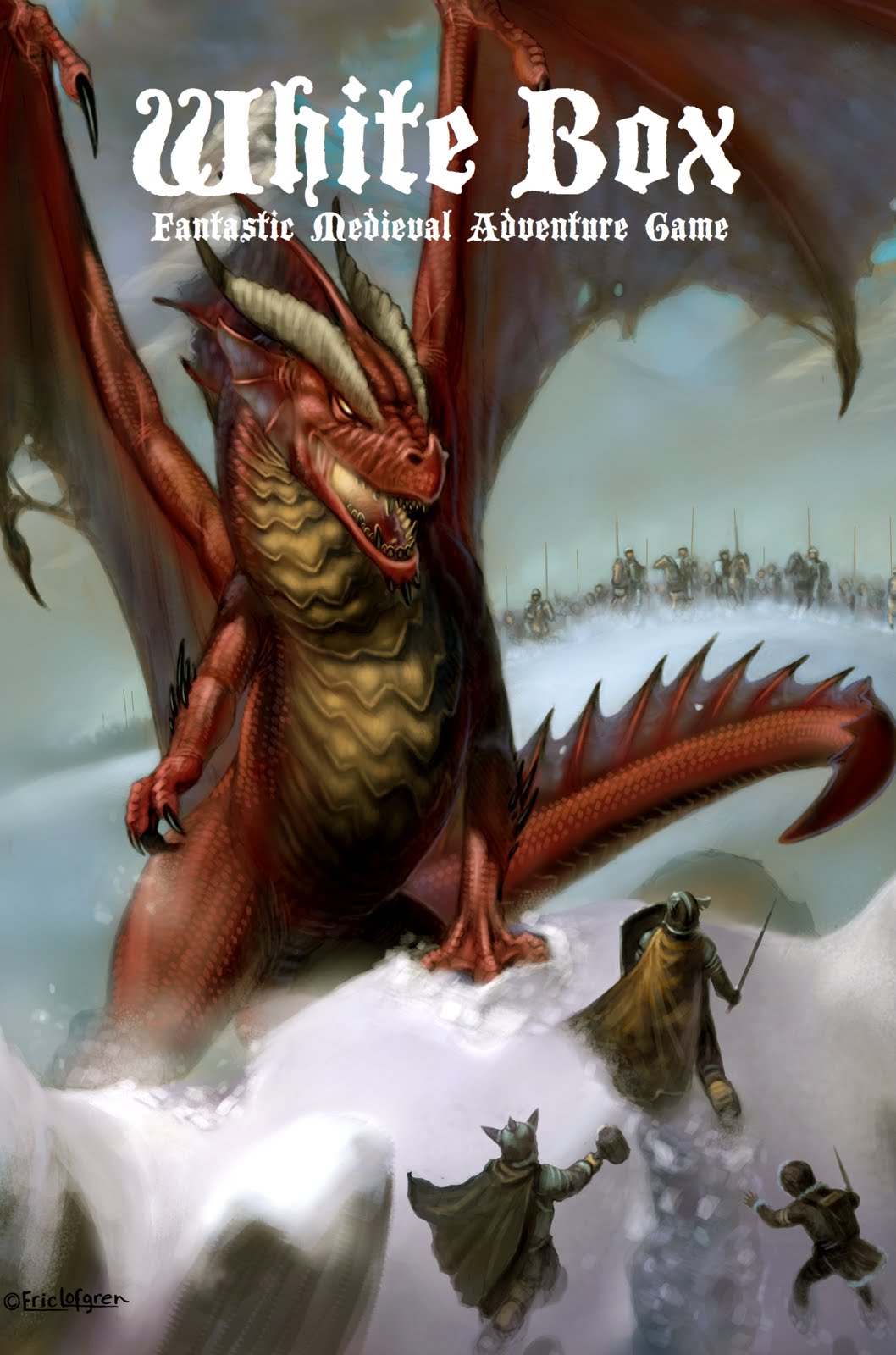
Charlie Mason at the White Box blog recently released a cleaned-up, fancy version of Swords & Wizardry White Box titled (of course) plain old "White Box." It's not just a reprint with better layout and art: it includes a sort of redux edition of the cooler bits that many people (such as I) consider essential to our classic D&D experience. A few bits in White Box that are not in S&WWB Core include thieves, the elven fighter-mage spellcaster option, demons, dark elves, and other juicy bits that you had to collect from various other resources to make other versions of S&W complete.

I've got a print copy on the way and will comment more then, but if you're a fan of A: Swords & Wizardry, B: collecting every edition of S&W out there, and C: like your S&W full of thieves, elven warrior-ages an demons, then I suggest you grab White Box. Before you do, look at Charlie's blog first, as he has several versions available. I got the red dragon cover on the way in soft cover, but the blue cover is kinda neat, too.


Anyway.....White Box might meet the "minimum standard" I need in my White Box experience (ahem). Will I ever convince my players to go Back to Basics and try it out? Who knows....but sooner or later, my kid's going to be old enough to play D&D with*, and when that time comes, I plan on having this book handy!


*We've tried "No Thank You, Evil!" from Monte Cook Games and we sorta had fun but were making up a lot of rules as we did. As he's developing, I think five is going to be the "big age" when he starts showing a lot of comprehension for RPGs, based on where he's at now. We'll see...I can say this much, NTYE is good, clean kid-focused fun, but I suspect in the end it's no substitute for straight up classic D&D. But hey, Dad is biased!

Tuesday, July 5, 2016

Review: Stark Space for White Star


Stark Space ($5.49 in print or $2.49 PDF from Magic Pic Media)

If you like White Star then you should be familiar with --or want-- Stark Space, a White Star sourcebook that adds low-tech hard SF cyberpunk thematics in to the system with three new classes, a range of racial options suited to a transhuman cyberpunk future, new equipment, cyberware, and other useful stuff. As it turns out Stark Space is available in POD now at Lulu (right here) or print (here).

Stark Space is a resource expansion for White Star....it doesn't change anything, instead adding a range of new options that you can use by itself or in conjunction with whatever other elements of White Star you want to use to customize your own setting. It stands well on it's own, however, giving you enough material for some decent cyberpunk gaming.

Stark Space breaks down as follows:

Life in Stark Space: a short overview of the setting. This is less a primer on the universe of Stark Space and more a set of implied assumptions; the universe of Stark Space is our are of the galactic rim, colonized in the not too distant future in a universe where interplanetary travel is slow and costly. No one's met sentient species yet, megacorporations and organized crime call the shots, and technology is not too crazy; this is a setting which can handle the universes of Alien, Firefly, Event Horizon, Blade Runner, Akira and other "realistic future tech SF" settings.

Classes: the system uses character "strengths" to reflect class types. Thus we get the Brains, the Face and the Muscle. Each class provides a robust range of abilities, and could function nicely in a "three class" system. That said, you can mix and match other White Star classes easily enough....I'd probably let the mercenary, pilot, robot and an engineer and medic option in as well, but if you stuck to core three I think you'd be fine.

Skills: Despite being S&W White Box-based, it's popular to strap on a skill system to White Star since SF games tend to need it, and Stark Space adds a decent skill system for your use. Twelve skills plus languages let you modify classes to suit to taste. The mechanic is 2D6-based (no shades of Traveller here, nope), in which you roll equal to or under a score derived from 2 stats added together and divided by three.

Races: since this supports a near-future cyberpunk/transhuman/humanocentric SF style, Stark Space offers some racial options: straight humans, max-genes  (genetically modified humans), Simulants (androids from Alien or Blade Runner style simulants), and Psis (humans who developed psionic potential). Of these, the last one may or may not work well for your intended style of near-future SF, but if you're creating a setting that pulls from the full range of resources for this near-future genre then having all four is useful. Missing from this is hardcore transmhuman concepts, but I suppose that would make for an --ah-- interesting challenge in how to model such in an OSR system.

Weapons & Equipment: favoring lower-tech gear (i.e. no zap guns or particle beam weapons) Stark Space offers up 8 slug thrower options, 4 heavy weapons, 6 melee weapons and discussion on armor types. The cyberwear section includes a saving throw mechanic for what happens when adding new cyberwear goes wrong, and is focused mainly on old-school cybernetic enhancements, with ten new options. Following that is a section on drugs, with 9 funky drug types and a random overdose/side-effect table. Other equipment concludes this section with a resuscitation pack, nano-disguise kit and info on buying simulants. The resuscitation pack is kind of neat, allowing the dead to come back...but with some permanent results of their close encounter with the crumpled character sheet effect.

Overall it's a good range of equipment for the genre (supplementing the core rules), but the lack of transhuman "wetware" seems like an oversight to me. You can easily just reskin the cyberwear, though....but with tales of CRISPR rolling around today, I think any effort at near-future SF that ignores the reality of wetware in the future is either a foolish oversight or deliberate effort at retro SF kitsch.

Optional Combat Rules: you don't need many in White Box games, but situations do like to rear their heads at time. We get one whole page here, but it covers some useful new info on adjudicating hand-to-hand combat and gun fights involving spray-and-pray combat. Nothing offensive here, just useful moderation in the White Box style.

Antagonists: This section adds a range of foes (totaling 19 stat blocks) for you to use in your Stark Space campaign. All of the foes are "genre appropriate" so if you want weird stuff other White Star books may suit your needs. The only "weird" foes in the list is a viral zombie; the game studiously avoids offering up its own take on the alien xenoform, amazingly.

Stark space wraps up with a serviceable character sheet. For those interested, the art in the book is mostly from royalty-free art packages, and is a nice genre-appropriate selection, nothing exciting but no eye-sores, either (only the cover comes off as a bit bland, but also inoffensive).

Coming in at 38 pages (with the last page as OGL) it's a compact 8.5X11 inch tome which will work well for you if your goal is to do a more contemporary "near future" or "hard SF" campaign. I can't recommend it enough.

Tuesday, June 7, 2016

The Lost Lands: Bard's Gate Kickstarter

With a few weeks to go the Lost Lands: Bard's Gate Kickstarter is the latest mega-manual to come out of the Frog God Lair. Check it out:


I'm in for the $100 level for a 5E edition. I waffled on The Lost Lands: Borderland Provinces Kickstarter and regret it (when I finally landed my book copies through retail I was incredibly impressed). The Kickstarter is covering 5E, S&W and Pathfinder editions, this time cleaning up the process by letting you elect your preferred edition in the backerkit section. I've cancelled other KS's to make room for it, in fact.

I'm sincerely hoping 5E dominates as a request; I'd love to see older Lost Lands tomes converted to 5E (though converting the S&W versions is easy enough). In fact I'd really love to see Razor Coast converted to 5E although based on the history of that particular production I'll assume such a conversion is likely a pipe dream for now!

Monday, June 6, 2016

White Star: Quinlon Disruptor Tech

Quinlons have played a role in both campaigns I've run so far. In the Dark Stars setting they are a fringe group with little organization, working as pirates, scavengers and traders in Netherspace Sector, with their militarized coalition trying to make a bit of headway. In the new Regency Campaign, the Quinlons are a major force, and are basically imperial fascists who have allied with the Order of Typhon to indirectly aid the Vegan Empire by siezing control of the Independent Sectors that lie between the Vegan territories and the Regency, allowing the Vegan naval supply lines uninterrupted access to attack their enemies.

In both setting I've described the quinlons the same way: large humanoids, looking vaguely like Predators which cross-bred with Reavers from Firefly and then adopted the aesthetic look of the guys from Mad Max: Fury Road. They have a penchant for decorating themselves heavily with metal piercings and tattoos, and despite vertical mouths they have eerie, human-like eyes. Sure, quinlons are technically White Star's "not-klingons" but in many ways they fill a great niche for "space orcs and/or other prominent foe" as well, so why not spice them up a bit!

Anyway, quinlons are known for dangerous but effective technology. Here's some of what I've developed for them in my campaigns so far:


Quinlon Disruptors

Quinlon disruptors come in pistol and rifle varieties. They are notorious for their unreliability; any time a disruptor rolls a "1" on an attack roll, roll a D20 again: on a 1-2 or 19-20 the disruptor explodes, dealing 2D8 damage to the target and anyone within five feet of the explosion. On a 3-4 or 17-18 it jams and the user has to eject the energy clip and replace it that round.

Disruptors are notorious for dealing severe damage. When a target takes enough damage to drop to zero hit points, it must make a saving throw (modifiers to saves for explosive or death effects apply). If the target fails, it is disintegrated.

Quinlon disruptors come in several varieties: the standard disruptors are mass-produced and handed out to shock troops for quick use. Antique disruptors are more reliable (they only blow up on a 1 or 20) but also require 1D6 hours maintenance per week after being used or the reliability goes back to normal. Outsourced disruptors are also possible. In the Regency Campaign, the Vegan Empire strikes a deal with the quinlons and supplies them with mass-produced disruptors that include a non-lethal stun setting. These disruptors can be set to deal non-lethal damage to targets, knocking them out; in reality, any one reduced to zero hit points when hit by a modifed disruptor at stun still have to make a saving throw, or the damage is treated as lethal (but they are not disintegrated).

Disruptor types include:

Antique Disruptor Pistol (1D8+2 damage; Range 100; ROF 2; Clip 20; failure risk; disintegration risk)
Antique Disruptor Rifle (2D8 damage; range 200; ROF 2; Clip 20; failure risk; disintegration risk)
Modern Disruptor Pistol (1D8+2 damage; Range 100; ROF 2; Clip 20; higher chance of failure)
Modern Disruptor Rifle (2D8 damage; range 200; ROF 2; Clip 20; higher chance of failure)
Disruptor Pistol with Stun (as regular pistol above, but "stun" option built in)
Disruptor Rifle with Stun (as regular pistol above, but "stun" option built in)

Purchase Costs: 

Disruptors are illegal in most areas of space, so the costs below reflect "cost in Quinlon Space" vs. "black market prices" everywhere else:

Weapon                                   Quinlon Cost            Black Market Cost
Antique Disruptor Pistol          100                            500
Antique Disruptor Rifle           200                            1000
Modern Disruptor Pistol          50                               250
Modern Disruptor Rifle           100                             500
Disruptor Pistol With Stun       75                               375
Disruptor Rifle with Stun         150                             750

Overcharging Disruptors

Anyone with sufficient technical skill (such as engineers) can set a disruptor to overcharge by bypassing it's already shaky safety mechanisms. Doing so turns the disruptor into a lethal bomb which detonates, dealing 5D8 damage to all targets in a 25 foot radius. This destroys the weapon, and anything in the radius that hits zero hit points must make the save or be disintegrated. When overcharging, the user has 1D4-1 combat rounds to get away before it explodes; if the result is "0" then it explodes immediately! If you are using a skill system, a successful skill check (DC 15) will add 1 to the countdown timer.


Tuesday, May 31, 2016

White Star Companion now in print!


You can find it right here. The White Star Companion is a great official volume 2 to the core rules...if you're curious about what it contains, here's a run down:

8 new classes:
Bounty Hunter - now you too can play Boba Fett
Deep Space Explorer
Freed Assimilant - 7 of 9, anyone?
Man of Tomorrow - for your Lensman campaign
Novomachina - add some Transformer goodness in there too (no, seriously!)
Plucky Sidekick - what is says on the tin
Two-Fisted Technician
Yabnabs - why should the GM have all the fun torturing players with Yabnabs? 
Plus:
New starships
New vehicle rules
New vehicles
Skill mechanics
New equipment
24 new monsters
Star system/sector random generator (and a pretty nice one, too!)
Details on Sterling Sector

96 pages in total, and well worth it.

White Star is currently turning out to be rather well supported in print now, with at least 8 print tomes, and growing....and all very good stuff!

Honestly, when it first came out I never imagined White Star would be the OSR title to grab me like a vice grip and drag me away from more complex SF systems. But it turns out it was exactly what the doctor ordered, so to speak. The wealth of options, mixed with the ridiculous simplicity of Swords & Wizardry, in a SF system which lets you play it as fast and loose with SF tropes as you want (or as tight as you want if you feel like it) is very cathartic for me, and is currently the only newer game system to really energize my gaming interest.


Monday, February 15, 2016

Genres that Need an OSR White Box Treatment

At the beginning of January I was thinking that a good forecast for this year was that we'd see more innovation in OSR rule sets with unique settings, but I wasn't thinking big enough...I focused on subgenres of fantasy and muddied the waters. My total conversion to a White Star sort of gaming focus lately had me realizing we need other non-traditional fantasy genres to get the White Box treatment. Right now we have White-Box/0E inspired games for science fiction (White Star), planetary romance (Warriors of the Red Planet), starship troopers (Colonial Troopers), super heroes (Guardians), fairy tales (Bloody Basic Mother Goose Edition), Totally-not-Warhammer-40K Space Hulk (Hulks & Horrors), espionage and X-Files (White Lies), urban fantasy (Skyscrapers & Sorcery), and no doubt others I don't know about or own. Some genres are well-represented (such as pulp adventures), just not with the White Box style.

Here's five genres we don't have represented properly yet, that I'd really like to see (followed by a mess of other suggestions):


5. Cyberpunk "White Hack"

Actually there is Stark Space, a sourcebook for White Star, that provides a nice expansion to cover this genre. But an actual dedicated Cyberpunk genre ruleset is not in the mix right now, anywhere. If I want to run guns as a solo or fixer in Night City, there's really no ideal system to handle this right now without grabbing White Star, Stark Space, and maybe White Lies and duct taping them all together with some classic CP 2020 for setting material.


4. Zombies "White Death"

The only OSR-styled zombie tome out there is Rotworld, which is actually a rendering of the classic Pacesetter game system in zombieland. It's a good straight-forward treatment of the genre but it is not what I want: a White Box treatment. A tome with some survivor classes, tons of equipment/salvage/survival rules and a load of cool GM tools for hexcrawl survival in zombieland would be amazing.


3. Post-Apocalypse "White Fallout"

Shockingly there's no real competition out there for post-apocalyptic emulators outside of Mutant Future, which of course is the Labyrinth Lord system with a very heavy coat of Gamma World colored paint. I like Mutant Future, but would love to see a White Box version in the same style and feel as White Star or White Lies, or possibly Warriors of the Red Planet.


2. Time Travel "Doctor White"

There's nothing like this anywhere for a classic OSR style. Instead we can look to the reprint of Time Master, or maybe Time Zero for Savage Worlds....but a White Box approach to time travel could make for a really interesting sort of setting. The challenge would be in figuring out how to handle a scenario generator for multiple timelines, and work out an over-arching set of general themes for the GM's toolbox...sort of how Dr. Who style time travel is one flavor vs. Star Trek or Quantum Leap type time travel. I feel like this could be a really interesting project for the right brave soul (not me, alas).


1. Cosmic Horror "White Doom"

Right now the closest effort at horror in OSR is Silent Legions, which is a Sine Nomine book so we know it's good, and closely aligns in general with the 0E aesthetic for the most part. But Sine Nomine is known for thick tomes with lots of elaborate detail and implied background....contrast Stars Without Number to White Star, for example; the former is like an encylopedia of procedurals and the latter is like a VCR loaded with Star Crash....if you've only got a couple hours to kill option #2 is going to be much preferred. The horror genre needs something like this in a White Box format....one with a bunch of ready to rumble monsters, quick and easy rules for evil magic, some investigator classes, and maybe some efficient setting rules for a few key eras to help the GM along. I could really use a White Box styled horror game, is what I am saying....

And the Rest....

Absent from this list is the steampunk genre, which I'm not personally fond of, but I suspect someone could make a great OSR White Box game out of. I've also omitted genres that are not represented right now but which may be better served by other game systems' styles, such as schlock horror which is usually best with one-shot session systems. A wide range of OSR White Box games could easily spring out of an effort at adapting all sorts of historical settings into the system and style, however. Imagine an Imperial Rome White Box book, or one focused on ancient Greece. These have the disadvantage of requiring the proper level of work and research....and sometimes the effort spent in documenting the setting for use in an OSR system can make it hard to show restraint in the design, making more complex iterations of the game more suitable to the job at hand. That said, I'd love a good, clean White Box style book like "Ruins & Ronin" but exclusively for ancient Greek adventures, or Norse adventures...or Roman, Egyptian or even later periods. How about a Caribbean Adventures White Box? Think The Legend Pirates sourcebook, but actually useful.

Friday, October 16, 2015

Kickstarter Report: The Lost Lands: Borderland Provinces, Tome of Beasts roars along, and Delta Green is confusing?

It looks like Frog God's latest will be a menagerie of books that all tie into the Lost Lands setting. The Kickstarter is out, and it's offering your preferred edition (Pathfinder, D&D 5E or S&W). I'm in at the $95 level, which I think gets me one of each of the books in print.


If you want to see how to make a Kickstarter confusing, check out the Delta Green RPG! Is it just me or is that a serious mess to wade through? I'd like to back it at a level that says "Pay this and we will give you one of each book you need," but it's kind of hard to figure out which tier that is....when you need a matrix to try and assess backer levels and rewards I kind of think maybe you're doing it wrong....

Meanwile, Kobold Press's Tome of Beasts roars along at over X4 its target as of this writing....


Latest Deluxe Tunnels & Trolls update is in as well, and Rick is indicating that all hard covers, including the special editions, are now done and they have 500 to ship out. I may at last see my copy....possibly before I see Primeval Thule, which is itself steamrolling along, and according to the latest update it's about to go to press in time for a post-Thanksgiving release (barring completion of the add-ons). Only downer is the add-ons will ship with the core to those who ordered it all (i.e. me) which suggested that I might not see my book in December if the add-ons aren't complete and printed by then...we shall see.


Tuesday, July 21, 2015

Frog God's Hex Crawl Chronicles on Sale Today

The sale is part of the daily deals email from Frog God Games, but the code (assuming it works for anyone) is: DD-HEXCH-2843 and the Hex Crawl sales page is right here. There are seven chapters to pick from in flavors of Pathfinder or Swords & Wizardry, although no print options anymore (at least not on FG's main site). These modules came out several years ago and are really exemplary for being accessible hex crawls, a great way to learn about this style of exploration play.

For newer content you'll need to go to Land of Nod and look in to what J.M. Stater is up to these days, as he's sort of the King of Hex Crawl adventures in my book, and his OSR Nod magazine is pure gold.


I admit: I picked up my copies in Pathfinder format. Thinking I might introduce my Pathfinder cronies on Saturday to Hex Crawl Chronicles.....they'll get to play Pathfinder again, and I can run some fun hex crawls that are engaging and require minimal prep on my part. Win for everyone!

Wednesday, June 10, 2015

A look at Iron Falcon


Iron Falcon comes from Chris Gonnerman of Basic Fantasy fame, but unlike Basic Fantasy which focuses on an extremely OSR-themed rules-lite version of the D20 system, Iron Falcon is a pure retroclone in the finest sense, aimed at a very specific slice of D&D time: that period during which there were three little brown books plus one supplement (Greyhawk). As such it is occupying similar conceptual space to the Swords & Wizardry game, especially the Whitebox edition.

Before I go any further, let me point out that Iron Falcon is free in PDF format right here. As is traditional for the Basic Fantasy Project offerings the book can be purchased in a very inexpensive (at cost) print copy, or a more expensive hard cover. I've ordered the softcover myself....I am not sure I'll use Iron Falcon for actual gaming on its own, but I may use it as a supplement to planned S&W games. But who knows--I could also use Iron Falcon as the core rules and lean on S&W Complete for the "expanded content" of the later supplements.  It's a nice, complete package in and of itself, so a cheap portable copy of a 1975 0E-era retroclone seems rather useful to have around.

Since you can download it for yourself, I'll avoid going into too much detail, but Iron Falcon does distinguish itself from S&W as follows:

It has the four core classes (fighter, magic user, cleric, thief) with the thief from Greyhawk

Paladin is an option in the back appendix

No demons (those didn't appear until later supplements)

Classic saving throws (no "one save to rule them all" as S&W introduced)

Descending Armor Class (meh; I remember a time when descending AC seemed sacrosanct. Those days are loooong gone)

Some rules on trading out ability points to boost prime requisites (not sure if this was in the LBB set or not, memory fails)

Medium and Large size damage expressions for weapons, and optional rules on bringing back the weapon vs. armor type modifiers

Unlike S&W Complete, since Iron Falcon  strictly limits the scope to the 3 LBBs plus Greyhawk, we don't get a lot of optional or variant rules. Initiative, for example, is the group D6 roll option only since other later options appeared in other supplements

What's cool about all of this is that Iron Falcon (much like the core and whitebox editions of S&W) really hammers home how complete the original D&D was, and does a great job of revising and cleaning up the original into a compelling, playable package. It's also got a few advantages, depending on your personal taste: for one, it's written in a very clean, neutral tone....if you prefer a version of 0E that give you the rules without making any assumptions about how to play, this is a great edition for you to look at. It also is very concise....this edition, despite being branded as "not for beginners" by Chris is in fact actually a great starting point for new players (with the caveat that Basic Fantasy is, admittedly, the best starting point).

Downsides include a lack of art....as in no art. Also, since it only covers the first supplement of D&D it is missing the later content. Personally I'm going to hope that Chris follow up with an Iron Falcon sequel that brings the other supplements in to the fold....that would be ideal. But make no mistake...this game is a complete package, and has everything you could possibly want to start gaming like it was 1975. If your not burned out on retroclones yet, you should check it out.