Showing posts with label Into the Odd. Show all posts

Saturday, February 21, 2026

Cataloging the Indie RPG by Style and Genre

 As I sit here, I am supposed to be studying for some rather onerous testing exams for licensing (work stuff), but it's taking dozens of hours to get through the study process, a thing I have not had to do in some time now, and at my age its just damned tedious. So I am taking a few minutes' break to clear my mind and chill a bit. In doing so I am staring at a giant stack of various indie RPGs, loads of which are pamphlet sized, and almost all of which are 5X9 format in some form or another. 

My plan to write about this in February has been curtailed so it will bleed in to March now, and maybe even April if my busy non-fun RL schedule keeps up. But I can say this: indie RPGs really do seem to fall into a few distinct style categories, and those categories have some characteristics worth noting if you're trying to figure out what style suits your taste. 

The first style category I'll call "utility," which is to say: the book's author(s) value utility and function over everything else. Both Shadowdark and Old-School Essentials are excellent examples of this category. Some other games manage to fit this bill as well, though it may not be so obvious. Old Skull's publications (such as Screams Amongst the Stars and Running Out of Time) are also very utility driven, with the goal being to get the most useful content to you in the limited pages available. Less indie but definitely worthy of mention for this category is Savage Worlds.

Main Traits of Utility Games: ease of use; clear and concise rules; no authorial overtone or assumptions about expected behavior in play

Best Example of A Utility Game: As I wrote a few weeks back, Old-School Essentials is just amazing for its pragmatic, utilitarian approach to codifying the definitive OSR experience. A close runner up deserves to be given to the insanely no-nonsense Shadowdark. 

The second style category I'll call "Atmosphere;" this means the game is focused heavily on conveying its world, thematics or genre to you, and the rules are focused on conveying the atmosphere with as much energy and effort as can be afforded. Such systems are usually loaded with mechanics designed to build out on a specific style of genre. Mothership is a quintessential example, with its atmosphere being SciFi Horror, usually on haunted ships and space stations. Mork Borg is eschatonic fantasy steeped in the graphical interface of Swedish death metal. Orbital Blues is all about replicating a highly distinct blend of Firefly meets 1970's aesthetic style science fiction. Death in Space is about a collapsing spacefaring society that is grimy, dirty and maybe also facing an eschatonic end times. Heroes of Cerulea is about an NES 1988 era fantasy world ripped straight from the earliest era of JRPGS. 

Main Traits of Atmospheric Games: rules built to enforce the rules of the game's universe/genre; thematics designed to enhance and promote the tropes and expectations of the setting

Best Example of an Atmospheric Game: Mothership, of course! With Orbital Blues coming in a close second.

The third style category is a big one, and I will call it, "experiential;" for lack of a better word. These games are providing you with a set of rules and a setting, often closely tied together, with the intent of providing you a unique experience or take on otherwise well-trod genres. Such games are noteworthy for diving in to corners of fantasy or weirdness, often going a bit off the rails, and it can be clear at times that the gameplay loop involves heavy improvisation on the part of both the player and GM (if the game even supports a GM!) Land of Eem, Into the Odd, Outcast Silver Raiders, Troika!, Ultraviolet Grasslands, maybe Liminal Horror and Cairn, can all be said to fit this category. Such games might feel a bit like roller-coasters riding through strange worlds. Some are settings only, such as the Painted Wastelands, Ronin or Vast Grimm which hack other systems into their own weird universes.

Main Traits of Experiential Games: a strong focus on the weird/unusual, emphasis on random generation and improvised play; often focused on very niche and sometimes cartoonish imaginings of their universes

Best Example of an Experiential Game: So many choices, but I feel I have to give this to Troika!, a game which defies easy interpretation for many, while still being so interesting I can't stop trying to figure it out. Runner up could go to any, but I feel the Painted Wasteland (my current favorite OSE setting) has earned it.

The final style I will label "Graphical;" any game in which it appears that the artist is as important to the process as the author or anyone else. Indeed, you might find that the game itself is less of the point than purchasing the cool book full of neat art. Not quite indie, but sort of in this ballpark I feel you could put The Electric State, along with some noteworthy titles like Ultraviolet Grasslands, the Painted Wastelands, CBR*PNK, Cy-Borg, Mork Borg for sure and all its other spin-offs, and amazingly weird and difficult to parse out products like Ballads of Oread. If Exalted Funeral published it, then it might have some lineage in this department. Don't confuse, "Looks cool," for being in this category, though; I would suggest a key component of games in this category is that you might better imagine them as coffee table books than something you can actually figure out how to play!

Main Traits of Graphical Games: they are really interesting tomes to look at (assuming they come in a conventional book format); they are often hard to decipher, or you can tell that the author was playing second fiddle to the artist

Best Example of a Graphical Game: Mork Borg!!! It's a puzzle to decipher for many. Runner up: Ultraviolet Grasslands

Okay! So with all that out of the way, time to get back to some real work. I'll finally (hopefully) talk about some of the newer games I've picked up here in the next few weeks soon.


Thursday, October 30, 2025

The 30th Day of Horror: Liminal Horror Investigators


Liminal Horror Investigators (Goblin Archives)

You know what I haven't reviewed yet? An actual paper-and-pencil RPG! Lots of movies, several books and graphic novels, a few video games....but no RPG. Well, let's fix that with Liminal Horror. Published in the indie scene by Goblin Archives, the current edition is called Liminal Horror Investigators, which is a slightly buffed up version of the original Liminal Horror book. Being indie zine RPGs, these are slim tomes, but don't worry....a recent crowdfunding campaign which I backed is for a thick and heavy hardcover Deluxe Edition, so as with all good and simple RPGs, that will inevitably change. It's like the carcinization effect on beaches, except in the RPG book world, all slim and to-the-point RPGs inevitable morph over time into immense, weighty hardcover tomes.

Liminal Horror uses the game engine introduce in "Into the Odd," which is a very simple mechanical system involving only three stats: Strength, Dexterity and Control. You have a hit score, "HP" for Hit Protection, which is effectively your "combat competence timer to death" meter.....the game system's combat mechanic is unique in that during combat, an attack simply rolls damage and applies it to the target's armor and then HP score. Hit Protection is really measure of how tough and competent you are in a fight, and when it hits zero your luck has run out and damage is now critical, going against your stats. This leads to the Wounds table, where bad things happen, or the Fallout table which is what happens when you take mental damage against your Control score. In Liminal Horror Fallout can be customized to the module, and it can mean anything from mental effects such as paranoia to bizarre supernatural curses and manifestations. The sample tables provided provide some great concept spaces for a game.

Most of the game's character generation process boils down to rolling for a profession, appearance personality traits, gear, and some bonds and features to link the party together. The remainder of this 44 page book is a couple pages of rules (it's a very simple game) and cool stuff for a "facilitator" to use -- the game's name for the GM. This includes rules on artifacts, a small bestiary, different styles of adventure design (voidcrawls, mysteries, funnel rules and flashbacks all get some attention). There's no magic system as such; magic may manifest as a side effect of fallout, resonant artifacts, or whatever the GM (facilitator) might throw in the investigator's way.

Overall Liminal Horror is a very nice, slim pick-up-and-play zine RPG and well worth a look if you like portable games that can get a group up and running in no time. It has a number of modules available from different supporting publishers, of which The Bureau and The Mall are two of the most noteworthy, though I am especially fond of The Parthogenesis of Hungry Hollow. The style of horror in the game and its modules is reflective more of modern horror themes common online and in video games. Imagine Silent Hill, The Backrooms, Creepy Pastas, Slenderman, Sirenhead and such and you will get an idea of what is thematically in sync with what Liminal Horror supports....but even in the bae book there are some curiously Innsmouthian influences hidden in there so mythos horror is also in the mix. Note also that there is a module featuring these frog men in the first Liminal Horror book that is missing from the Investigators edition, so still a reason to hold on to that tome if you find an original. Mechanically this newer version just adds more rules options and ideas, but leaves that module out. I am interested to see how they fill up a couple hundred pages with the Deluxe Edition.

For useful resources on Liminal Horror click here!


Monday, September 18, 2023

The Indie/Zine RPG Review Part XVIII: Electric Bastionland


Electric Bastionland - Deeper into the Odd

$19 in PDF on itch.io 

$60 in print+PDF on Exalted Funeral

I actually found Electric Bastionland before I snagged Into the Odd. Chronologically this is a sequel to the latter, with Electric Bastionland taking place roughly a century or so after Into the Odd, moving the technomantic steampunk era of Bastion to the electric age. Despite the book's large size, it's probably only maybe twice the word count of its prequel; the game is heavy on illustrative art, a black-and-white minimalist design that is at once evocative and well-done, without being too abstract. The tonal consistency of the tome is welcome.  

The System: It's the same core mechanical design as Into the Odd, which is a system that appears now in quite a few other games. This system is defined over six pages which includes to pages of examples. For a refresher, you roll three stats (strength, dexterity and charisma in this case) on 3D6, then hit protection (HP) on a D6, some cash and equipment in hand, and then a failed career (about which more in a moment). When you roll to succeed (a save), its roll low with modifiers. When you fight, you go right to rolling damage and applying against hit protection. When that is gone, it goes to stats and bad things are immediately likely to happen if you fail a save. Very basic system, the same one in many other zine rpgs (Into the Odd, Liminal Horror, Old Skull Publishing's trilogy of RPGs, etc.)

The main variation in the character generation is rolling a failed career. This is similar to a profession or background as in other variations on the system, but your choice is based on looking at a chart and comparing your highest stat to your lowest stat....so yeah, players who want to choose what they play are out of luck here without spending a nontrivial time rolling up new stats to get just what they want. (Yeah, I have a player like that lol). In addition to your low and high stats determining failed career, your D6 in cash and your HP roll determine other details.

The failed careers are just that: something your PC is or did and of course wasn't so good at for various reasons. Each entry provides a visual reference and four distinct items to jot down on your character sheet, one for special equipment, your debt source, and then two variable details based on your starting cash and hit points. It's very important to note that most of the book is failed careers: 220 pages, to be exact! In a sense, much as with Troika! before, Electric Bastionland informs you of a lot of its flavor through this inexact process. Unlike Troika!, EB provides an additional 95 pages of guidance and setting material for the GM (called the conductor here)....so it's not all purely in descriptions. Also, unlike the other game, EB's careers have a greater level of consistency for the setting; in other words, there is most definitely a setting here, and it has its own internal logic to follow.

Some examples of EB characters for you to consider, noting that these are 100% random, and names are from the suggested choices by career:

#1 Pearl; Starting Stats: STR 10 DEX 13 CHA 11 HP 4 Cash 2 - Rural Tax Collector. Has a taxman's pistol. What did the tax office provide you with? An ornate baton. What do you hate most about Bastion? Bureaucracy - you have a portable shredder.

#2 Bushka; STR 10 DEX 9 CHA 8 HP 3 Cash 2 - Professional Gambler, who owns a slug gun and a pack of gum. What's Your Game? - one-car bluff, take a pocket full of tiny mirrors that stick to any surface. What did you win? - Anti-Matter Key, when placed in a keyhole it utterly annihilates the door and itself.

#3 Risper; STR 14 DEX 14 CHA 6 HP 4 Cash 6 - Urbalist (you're both into herbs and urban stuff, I think), a saber and three doses of hallucinogenic herbs. What do the walls tell you when you're herbed up? You can put some fragments of the wall into your ear to know a trivial fact about a being (if any) that calls this place home. What do the floors tell you when you're herbed up? You spit on the floor to learn the name of the person who thinks they are in charge.

So yeah....that's a modest sample of what characters can look like in EB. One item I left out is the debt. Each group starts 10K in debt to some group of individual. Each career has a source of this debt, but the determining factor as to who that debt belongs to is based on who the youngest player at the table is. 

There are a lot of interesting failed careers, and seeing any of them will be down to the fickle nature of the dice. The careers strongly suggest that Electric Bastionland is very much a cyberpunk game, just with less cyber (sometimes) and more of that electric part. It's what a steampunk world might one day look like with the onward march of science. Plus...as we shall discuss below, this is the direct sequel to Into the Odd, which means there's a lot more going on in this strange world to inform it, too.

The Setting: Bastion is the future of the same city from Into the Odd, now much advanced and with at least a century (or more) since its predecessor. Where Into the Odd evoked a quaint sense of victorianism and rugged exploration of an unknown world and the underground, the Bastion of EB is a dystopian, sprawling nightmare and the book conveys this by primarily giving tools and instructions on how to design your own city. It covers Bastion, the world outside called the Deep Country, the world below (underground) and then the mystery of the Living Stars. 

Before getting to the setting I should mention that the conductor's section provides a complete set of rules to build a scenario, including a macguffin for the PCs to pursue and a range of  ideas on setting up encounters, events, threats and choices for the group to make. It's only a few pages but its some incredibly brilliant stuff, worth reading for anyone who would like to see an elegant process outlined for a GM to use for any system, not just this one.

Similar to the Conductor section, each region overview provides a range of charts, ideas and concept points to use in building your own take on Bastion, the Deep Country and the Underground. Notably absent from this book is something from Into the Odd, which includes a bewildering array of artifacts you can find; here it is mainly a discussion on setting the treasure for your group with a chart of six examples.

The Inhabitants of Bastionland comprise entries on the people of Bastion, things called Mockeries (animated stuff given life by the technomancy of the city), Machines, which manage the underground and may or may not be the instigators behind the ever changing city, then the Aliens, which appear to visit with enough frequency not to be seen as extremely unusual, even though they are. Finally there are the Monstrosities, creatures made not born and ultimately too destructive or threatening not to have to resort to lethal force to exterminate. The rules for each group here is primarily providing guidance on making your own unique types of each group, rather than giving you a concrete stat block.  

The last 40 or so pages of the book are the Oddendum, which contain optional rules, a lot of discussion by the designer Chris Mcdowall on how he runs games and feels they should be run, and a number of sections on example content for specific campaign ideas. This is really interesting reading because Chris has some interesting takes on game design and running games. His one page on Big Impact is especially interesting reading, as it argues that allowing PCs to make a save against a risky effect simply diminishes the impact of the effect. I can't argue with this logic; I just ran my Saturday night D&D game and yeah, it's easy to see monsters once known for being tough opponents cave like a house of cards in the 5th edition system due to the fact that saves are mainly an efficient way for PCs to (usually) sidestep consequence. In a nutshell, the Big Impact argument as framed here is that saves get in the way of the interesting stuff, and the interesting stuff is where consequences and decisions come from. So don't have a "save to resist becoming a fish-man" effect...just have the PC turn in to a fish-man. The logic extends to other player-driven actions, as well: its about impact and consequence. I can see some counterpoints to it, but I can deeply empathize with the core conceit, which is that sometimes bad things really should happen, because the results make the game more interesting.

The Supplements: I don't know of any supplements for it, but EB is part of a subgenre of games powered by the same system, so the cross-compatibility exists. It is by far the most robust of the games within this niche, so consider that. You won't run EB right away, for example; it's going to require a bit of time to sit down and assimilate all this info and design a scenario.  There is also a blog out there (located here) which you may be able to scour for more ideas and content.

Who is this for? Electric Bastionland is an interesting experiment and pushes the indie/zine rpg format into a more mainstream product, at least on the surface. Underneath it is loaded with interesting ideas and useful tools which, even if they don't directly translate to the game or genre you want to use them for, will still inspire you toward thinking about new ways to approach setting and scenario design. I think this game could prove to be fun to play for a lengthy campaign or three with the right group, and a GM who could craft the sometimes specific and other times vague elements of Electric Bastionland into a more concrete setting of their own. It definitely provides plenty of basis for inspiration, and I suspect that playing in the campaign of the author is probably an amazing experience. So yeah....get this if you want to see something that manages to be neat looking, artsy, functional and innovative all at the same time, even if you only use it as a springboard for inspiration in your own preferred setting or ruleset.   

Monday, July 31, 2023

The Indie/Zine RPG Review Part X: Running out of Time


Running out of Time (Old Skull/Gallant Knight)

$20.74 (PDF+soft cover)

What it is: The latest in the "Powered by Into the Odd Engine" games from Old skull and Gallant Knight, this one completes a trilogy of releases covering zombie survival, space horror and now cyberpunk survival. Running out of Time holds up nicely to its sister titles in terms of graphics and presentation, it is a good looking little book clocking in at 42 pages, the shortest in the series.

The System: The basics are identical to the other systems I have been reviewing, in that you have three stats, from 3-18, you roll saves against the stat or lower, and combat starts with damage so all conflict has immediate high risk. It's the same mechanical process as the rest, with a specific alteration in the form of Time as a life mechanic.

This is the first rulebook I've read in this series to have at least one noteworthy gaff....there's no stressful event table. Maybe they didn't intend to include one, but its not there and feels like it kinda should be.

The Setting: Running out of Time has its own gimmick, and surprisingly that is not being a condensed rules lite Cyberpunk experience. Instead, it is about a Cyberpunk world in which the currency that drives everything is time; the game requires PCs to roll 1D6 to start to see how many days they have left to live. You are presumably playing desperate people who have reached the end of their time bank. Run out of time....and you die. The game doesn't explain why or how this is, so I guess you as GM can decide....maybe its a nanovirus that shuts you down, or a chemical cocktail the releases in your system. Why does this happen? Also not really clear. It's a universe run by this gimmick that, to me at least, makes little sense in any justified context. Be that as it may, the game's entire economy, direction and even character advancement is driven by this concept.

This gimmick defines the setting and play focus, but not nearly enough time and effort is placed in explaining why the world is like this, which is really necessary for buy-in. As a result, it is so far among my least favorite of the "Into the Odd Engine" systems I have looked at. 

Aside from that, the book includes myriad charts for rolling up people, places, factions, corporations and events in your megacity. 

The Supplements: None for this one, but it could serve well as a resource to flesh out specific kinds of worlds in Screams Amongst the Stars.

Who is this for? Well, it could make for an interesting session or three at minimum, if you have a group willing to run whole-heartedly with the time as a vital resource concept, or flesh it out. I personally feel it is too gimmicky, and think the game needed to include enough useful data to make the time-as-resource/currency concept make more sense. Even a chart you could roll on for different explanations...anything. It's a stretch otherwise, and a gimmick I think that will run out its welcome quickly as it requires players to constantly seek more time in largely randomized job events....the intent might be to force forward motion on the group, but the reality (I suspect) might just be frustration and annoyance. 

Wednesday, July 26, 2023

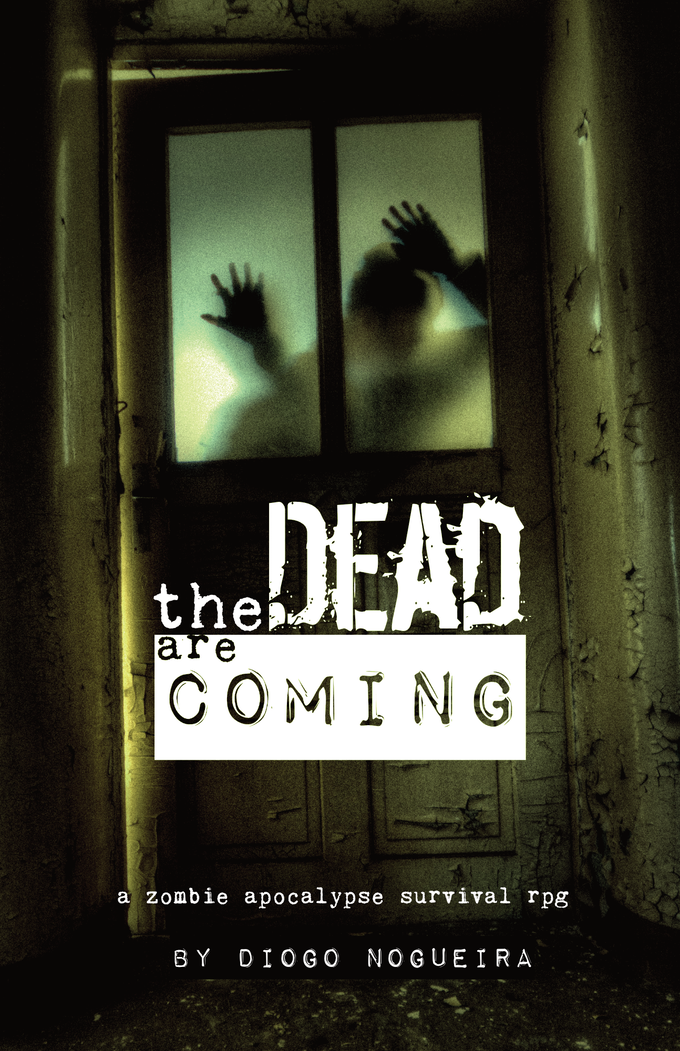
The Indie/Zine RPG Review Part IX: The Dead are Coming


The Dead are Coming (Old Skull Publishing/Gallant Knight Games)


What it is: Although this has been a general review of slim lite system indie zine RPGs, one could be forgiven for thinking this is a review series on "Into the Odd Powered games" or "games by Diogo Nogueira." Diogo has made no less than five of the games on my review list, and there are more I just don't happen to own. The Dead are Coming is a slim take on The Walking Dead and the broader survival horror zombie apocalypse genre, with an emphasis on the post-apocalypse, though I think you could tweak it a bit to start a game at the beginning of the apocalypse.

The System: The Dead are Coming equips you with the Into the Odd-derived mechanics necessary to make an excursion into a world overrun with the undead. Clocking in a bit shorter than Screams amongst the Stars at about 46 pages, its a tight focus on the subject at hand. The game morphs the rules in genre-specific ways: scars are critical injuries, and its a suitably gruesome table. Stress events are when you take critical damage on willpower, but its not really different from Screams. There are food, fuel, bullets and water you must track as depletable resources. A zombie bite that deals direct strength damage means you are infected, and three saves are necessary to live. 

In the spirit of the system there are rules on building up a band of survivors and turning them in to communities. This, along with the potential for some bonuses on critical checks on the scar and stress tables are the only potential for character improvement, so TDaC is a bit closer to Liminal Horror in this respect.

In terms of the game, the mechanics are otherwise very much the same as Into the Odd and Screams amongst the Stars. You get three stats, roll saves against them, have hit protection, and all combat starts with rolling damage and taking potential damage immediately. The book includes lots of spot rules for genre appropriate stuff, including the aforementioned depletable resources as well as vehicles, burst fire in combat, exploration and foraging rules, and more. 

The Setting: The implied setting is some time after the fall of humanity to a zombie plague. The game supports this with an array of useful charts and table for encounters and locations, as well as an array of possible foes: 9 zombie types that anyone familiar with video game zombies will recognize the origins on including spitters, exploders, zombie dogs, and so forth, along with 10 creepy living human survivor types to deal with including death cultists, raiders, cannibals, opportunists and more.

The many charts for the GM to roll stuff on the fly include a "What are they carrying" chart, a series of charts themed by area for landmarks, structures, findings and hazards, with sets for the countryside, small towns, and the big city. Finally we have an adventure idea chart and a D100 table of "things to do in the zombie apocalypse" which provides plenty of "Oh no, this happened, what will you do?!?!" events.

Overall there is enough here to run a nice mini-campaign or three in a zombie-ridden world. I don't know if it would hold up for much longer (in contrast to Screams Amongst the Stars which I think could sustain some meaningful campaigns), but you could also use this book for charts and inspiration while running a zombie apocalypse campaign using a more robust game system easily enough. I could easily see this book as a chart and idea resource for a BRP campaign, for example.  

Graphically the game is filled with evocative and decent imagery and art. A stylistic design on labels for titles and careful placement of text and font types makes the book interesting to look at but not painful to read. It's well organized and the location of information makes sense.

Supplements: like with the other Old Skull books, this one is stand-alone, but is fully compatible with other game systems. The monsters in this book could port to Into the Odd or Screams Amongst the Stars. The characters in The Dead are Coming could play with Liminal Horror PCs with almost no real need for conversion, just establish which setting rules take precedence (fallout vs. stress events, for example, and whether other spot rules such as resources, magic and such are mechanics you will need or not).

Who is this For? Its turning into a redundant question, but getting easier to answer every time. The Dead are Coming is for gamers who want a ultralight, portable rule system for zombie survival games. It's for gamers who do not like larger rule books but do like evocative and horror themed settings. It's great for anyone who has a Walking Dead campaign idea germinating. It's also useful as a resource for other game systems that can be easily subbed in, as most of the setting/inspirational content (mostly on the charts) is easily used without effort in other games.

All that said, it's still a zombie apocalypse simulator, and as a stand-alone book its usefulness is going to be limited to that specific subgenre. You could easily run this sort of campaign with other game systems with minimal or no effort, including Liminal Horror which this game is 100% cross compatible with. If you can only get one, I suggest Liminal Horror....but if you can get both, they will complement each other nicely.

Monday, July 24, 2023

The Indie/Zine RPG Review Part VIII: Screams Amongst the Stars

Screams Amongst the Stars (Old Skull Publishing/Gallant Knight)

$24.87 in POD and PDF at DriveThrurpg.com

$20 in print+PDF at Exalted Funeral (when its in stock)

What it is: I've reviewed a lot of the big ones I was quite impressed with, so now its time to look at some of the more modest but also impressive zine RPGs out there. A trilogy of games from Old Skull Publishing and Gallant Knight games all have the distinction of taking the core game system from Into the Odd and adapting the lite rules to specific genres. Interestingly, the author of Solar Blades & Cosmic Spells as well as its predecessor Sharp Swords & Sinister Spells, Diogo Nogueira, chose to use the Into the Odd system for Screams Amongst the Stars and its two companion games (The Dead are Coming and Running out of Time). This is an interesting choice, as I guess the intent is to specifically aim for the simplicity of the Into the Odd mechanics, but I would have preferred to see the SS&SS/SB&CS game system used for this horror universe of gaming, it would have been the superior system for the universe of cosmic scares invoked in Screams Amongst the Stars. But....the advantage now is that you can blend and borrow as much as you want from Screams Amongst the Stars, Into the Odd, Liminal Horror and the other games using this system as you want with ease.

The System: Like all Into the Odd-based systems, you have three stats ranging from 3-18 (Strength, Dexterity and Willpower), a hit protection score (1D6), a background with equipment rolls, and some additional personality and descriptor charts. New to this edition is an Oxygen score (Oxygen is precious in the universe of SatS), and when you take critical damage you are at risk of scars and crisis events. Both charts are neat, but not nearly as evocative as (for contrast) the crazy stuff you can get when rolling on Liminal Horror's fallout charts. 

Like Into the Odd, the combat system is short and brutal: you roll damage on an attack (no roll to hit needed), and apply to the target's hit protection, minus any armor roll. If you run out of hit protection (HP...) you subtract from Strength if its physical damage or Willpower if its mental damage. You make a check to see if you took critical damage against the affected stat. In other words: combat is guaranteed to have consequences and be brutal if you are not careful. 

Advancement is interesting. You get a chance of improvement each time you survive a crisis event. So the game rather deliciously (and perversely) requires you to take willpower damage and fail a critical check, thus inducing a crisis event, in order to advance in power. Truly that which drives you mad makes you stronger, apparently!

The rest of the 60 page book is filled with equipment, situational rules and hazards, starship rules which are rudimentary but they work, and frankly I could see using this as the basis for a lot of other RPGs with starships where the ship mechanics need to stay out of the way and be nice and simple. The rules are pretty comprehensive, and even touch on some of the larger conflict elements Into the Odd delved into, with rules for example on deploying larger units of soldiers to a planet's surface for time when a squad of marines are what you really need. 

The Setting: 27 of the 60 pages in this book are dedicated to setting and scenario content. There are several distinct alien species of various threat levels, each with a nice write up and a bunch of random charts to inspire the GM. Each of the alien write ups include a chart to roll on for rumors, jobs and events. 

First are the engineers, a progenitor species which has left many artifacts and big cosmic objects lying around to be discovered. Part of the engineers' mystery is if there are even living remnants of this species, as corporations seek to find their artifacts and understand them. The Promethean engineers of the Alien universe seem to hold some inspiration for this species, along with other inspirational sources (Heechee come to mind).

Next up are the Dreamers, who are tied to a mysterious pyramid and seem to induce hallucinations of waking dreams and nightmares through some sort of psychic manifestation. In reading on this species I got Forbidden Planet and 2001: A Space Odyssey vibes.

The Watchers at first glance feel like stand ins for Grey aliens, but in reality these odd cylon-looking things remind me more of The Day the Earth Stood Still for some reason. Enigmatic suited aliens with one red eye on their faceplate, they can intervene but seem content to observe more than anything....and are overwhelmingly superior in technology.

The Devourers are the bug race. A lot of Starship Troopers mixed with a bit of Alien and other resources make these the insect-like dire threat, and their first encounter with humanity was on the moons of Saturn, where they apparently are all over the place. The definitive "bug hunt" alien.

The Doppelgangers are the final main species provided as a threat in the book. Inspired by The Thing and Invasion of the body Snatchers these are the ones that duplicate and replace you, and the suggested plots and jobs revolve around fear, paranoia and uncertainty as to their motives and how far into human civilization they have infiltrated.

After the section on aliens we have an overview (brief) of the human governments and forces in space, as well as the corporations that are always present in this genre of SF. Charts for colonies, weird events, strange planetary events, alien ruins, job ideas and random events flesh out the GM section. You have enough weird charts here that I think any GM who is good with some improv can roll up a random scenario and have something workable within 15 minutes or so. 

Supplements: There are no supplements specifically for SatS that I am aware of, though you can borrow content from other games powered by Into the Odd. One could conceivably use other books in this line to populate specific worlds for the space explorers of SatS to discover and explore: Into the Odd's strange world affected by esoteric forces could be a good landing spot. A remote colony overrun by a zombie virus could be simulated with The Dead are Coming. A Cyberpunk world could be emulated with little effort in Running out of Time. So in a sense, all the games powered by the Into the Odd engine are sufficiently simple as to be cross-compatible and supportive of each other if you so desire.

Who Should Get This: If you're into other horror RPGs out there in this same genre, you will find this to be a welcome addition to your library. Even if you don't run SatS as-is, its many random charts and alien ideas port over easily (almost without effort, really) to both Mothership and Death in Space. You could even use it for ideas in the bigger-volume tome from Free League, the Alien RPG, if you don't mind veering off into decidedly non-canon areas of the universe. That said, it's still a fully functioning RPG on its own merits, and the brutal nature of combat in its base system (where every blow hits and it's all about mitigating damage) can make for a very suitable horror system where every conflict carries consequences. 

I do think if you happened to have this book and Liminal Horror, I would look at borrowing the fallout effects from LH to use in SatS. The Crisis Events in SatS are perfectly fine, but just a bit too mundane and uninteresting after I have read the way LH handles its fallout. 

My last comment on Screams Amongst the Stars is that it, like many games in this category, have the distinct advantage of being something you can stick in a back pocket (or in PDF on a tablet), and so long as you have a set of dice, paper and pencil you can get a game going pretty quick. It does not feel like a truncated or simplified game; this feels robust, like something you could run a good long campaign with. I like that feature a lot.

EDIT - A word about the art: I just realized I didn't comment once on the aesthetic look and design of the book. In short, this has a lot of stylish and consistent art, all very good, with a vaguely CGI-rendered quality. It's been out long enough that I don't think (but am not 100% sure, so take that for what it is) that any of it is AI generated. It feels too good for that. The layout is comprehensive and readable, playing with structure of words on the page a bit but never in a manner anyone will find confusing. 

Friday, July 14, 2023

The Indie/Zine RPG Review Part V: Into the Odd

Into the Odd (Free League Publishing)

$39.99 (give or take for the SK to USD exchange rate) print plus PDF

Before reviewing Into the Odd, it is worth mentioning the history of this particular game system as I have stitched it together. Into the Odd's mechanics appear in the original game, and the one we are looking at is the revised version published through Free League Publishing. Into the Odd is a sort of prequel to another, larger game with the same core rules called Electric Bastionland, which takes place in the future of Into the Odd. In addition to these two titles, we see the mechanics pop up in a trilogy of games by Old Skull Publishing, including Screams Amongst the Stars, The Dead are Coming, and Running out of Time. Into the Odd's core mechanics are also the driving ruleset of Liminal Horror from Exalted Funeral, which is where I first ran in to it. I was initially thinking to myself of Liminal Horror "these are some bold choices for a horror game, I like it," but when I got Into the Odd and discovered that it stems from this more pragmatic decaying arcane steampunk universe, I found it utterly fascinating, for the intent and feel of the rules unique in how it likely drives player engagement, as you shall see below.

What it is: Into the Odd  is a game about an old world, with an ill-defined past that is either forgotten or best not spoken of; things called the arcana, curious devices and relics of either a forgotten age or another realm, are sought after by the adventurers of this world, which centers on one specific corner: the city of Bastion and its environs. Bastion runs on a steampunk pseudo/quasi-Victorian age of unusual technology with a bit of magic fused in, creating a not-quite-19th century and not-quite-D&D universe feel to the setting. It is its own beast. The adventurers of this world the power of these mysterious arcana, and find them in expeditions. When not on expeditions they build up their power base and reputation within the city. All of this is handled in about 57 pages total including the referee section, and the next 100 pages are setting, scenario locations, and an appendix of interesting optional rules and nonhuman player character options. 

An important thing to note about Into the Odd is its layout: this is a game system and scenario set which is deeply entrenched in a modern aesthetic using the economy of design to both get to the point of what you need to know and evoke the sense of the exotic without overwhelming you with unnecessary detail. This game, similar to Mork Borg, Mothership, Death in Space and Old-School Essentials wants you to play it and build on it; it does not want to dictate unnecessary information to you, or hamstring your ability to creatively expand the world as you see fit. 

The System: Into the Odd's system is dirt simple. Players roll three stats (strength, dexterity and willpower), determine Hit Protection (a different concept from hit points), and some equipment. if they are lucky the PCs get an arcana. Determining your starting powers is done by cross-referencing your highest ability score against your hit protection. Interestingly, you will only get unique powers or arcana if your highest ability score is low or average; the game assumes a high stat is reward in itself to start. This will cause no end of angst to players who seek to min/max things.

Arcana are things of various natures with short descriptors, ranging from utilitarian to incredibly potent. Some negotiation is expected, and this is the point of the system, to get players and referees thinking outside of the box. Arcana are effectively Into the Odd's magic system, and anyone can benefit from it.

Combat in the system is going to be a make-or-break for some gamers. It is readily one of the most interesting approaches to combat I have seen, and worth noting that it fundamentally changes the core conceit of many RPGs: within Into the Odd, when you engage in battle there are no rolls to hit, you just do. When you attack something, you go straight to rolling your damage dice, and your enemy must roll any armor or protection dice. If damage is dealt after subtractions, then it applies first to hit protection and then to your strength for physical damage or willpower for mental damage. When you take any damage to a stat you must make an ability check against the modified stat, and if you fail you are critically injured and will die eventually if not tended to. If you take a critical injury against willpower you are mentally broken until you get proper rest. If strength reaches zero you die right away. It is a simple and elegant approach, but it also means that because any engagement is almost certain to lead to harm for the combatants, one may consider carefully whether the combat is worth it. Luckily, recovering most damage is fairly quick....but surviving long enough to have time to recover is hard. 

The rest of the rules include the basic mechanics, which are roll-under for saves, and various basic spot rules. Samples of useful things including a handful of weird monsters, traps and lengthy rules for broader engagement and social buildup of the characters during downtime. Worth noting is that the rules provide plenty of information for new players and referees, so this book, while minimalist, has enough information (including play examples) to help new players figure things out.

One oddity is the level up mechanic, which starts at a novice rank and goes through several levels that require adventuring and later engagement within the city to advance. On the one hand it is neat in that it prompts players to do stuff outside of exploration, giving them a motive to build up a reputation and power base in Bastion or elsewhere. On the other hand, the "meat and potatoes" of the book is the exploration, and while there are rules for this downtime engagement, it is not quite as exciting as the exploration part, meaning some players may be facing a lower rank cap if they don't want to build a stronghold/go to war/engage in mercantilism or what-not. YMMV I suppose. 

The Setting: The bulk of the book is detailing the world in a series of regions written to provide exploratory crawls. Surprisingly little information is given on the city of Bastion, though Electric Bastionland which is set in the future provides a vast amount of information, but by virtue of its future setting point that won't be overly useful here. 

The book outlines a series of scenario locations. The format is concise and to the point, within the barest minimum of exposition. This sort of scenario is closer to an outline of an adventure than an actual adventure, but it is the sort of design that works extremely well for gamemasters who wish to riff on what is provided. If you are the sort of GM who prefers to have this exposition provided for, this is probably not going to work for you.....but if you much prefer to have the important elements up front and the exposition left to your own devising, then this is going to be a very comfortable format.

Lastly an appendix provides mechanisms for running mutants, simple folk, unhumans and alternative gear packages. This is a welcome addition worth adding once players are comfortable with the basic stuff, or right away if you have experienced players. 

Supplements: none so far as I am aware, though many other games as mentioned earlier use exactly the same rule system. 

Who Should Get This? Honestly, Into the Odd is a tight book which provides enough material for a lengthy campaign of exploration, and a surprising amount of "down time" reputational/power development for character position and status in Bastion. It is still very skeletal in its setting, despite having so much evocative imagery and descriptors. Much of the flavor will come out of the unique organic experience of play and interpretation....a thing which I rather admire and like, thus why I have this high on my list of game I would like to play with my group. 

I do not recommend this game for players who wish for deeper mechanical contrivance, elaborate exposition, and clear and unambiguous goals. If, however, your group likes setting their own goals, exploration for its own sake, and mysteries aplenty where the GM can riff freely, then yeah, try this one out. In fact....I'll talk about Electric Bastionland at a later date, but its really interesting contrasting Into the Odd against its successor. Into the Odd is, in my opinion, the better of the two books in so many ways, and maybe down the road its sequel can get a revision that brings it more in line with Into the Odd's economy of design.