Tuesday, November 14, 2017
GURPS is suddenly on rpgnow!
And just like that GURPS joined the rest of the gaming community. Stealth ninja marketing at it's finest!!!

Star Wars: Battlefront II First Impressions (PS4)
It's no secret I liked Star Wars: Battlefront from 2016, even though it lacked a single player campaign, and was initially a bit anemic in terms of map content. That changed quickly enough, but the design approach to the first Battlefront, which gated map and scenario content behind for DLC packs, made for your typical fragmented community.....you couldn't just play "blast" on Cloud City, for example, without getting in queue with a bunch of hardcore mofos to play only that DLC content. Still, I played enough that I got really damned good at the game (compared to my usual level of multiplayer suck), and had tons of fun....so much so I even leveled up twice, once on the Xbox One and again on the PS4! And it is the single most played co-op/split-screen game in my house with my son, my wife and myself, too.
Anyway, that's a long winded way of saying I was totally ready for Battlefront II, and had even pre-purchased it when it went on preorder, a practice that some rightly deride, but when I know I'm going to get it, and play it, I'll make an exception.
So far, the best thing about the game is actually the single player campaign, in which you play through the story (mostly) of a special forces storm trooper named Iden Versio, who operates as a sort of black ops specialist for the Empire and watches her career take a crappy turn when they fail to intercept rebels on Endor's moon from blowing up the Death Star II's shield generators. From there its a spiraling tale of Imperial fragmentation, questioned loyalties, betrayal and revelation.
It also happens to be the best thing put out for Star Wars to date (in video game terms) since the original KOTOR. Yes, that good! Not in an RPG way, but the sense of immersion and the attention to detail with the Star Wars style from the Rebellion Era is shockingly well done. There's a sequence where you get to play Luke, and I was really thinking, "This is how they could fill in the backstory between Return of the Jedi and The Force Awakens....this is the perfect medium."
The rest of the single player offerings, which are a mix of co-op sequences with loose stories attached and an arcade mode which generates either team deathmatch fights or straight duels is plenty of fun, and if you've heard the stories about locked characters note that that's all for the multiplayer offering.....you can play with pretty much anyone on your couch (though as you play through maps set in the Clone Wars era you might, like me, wish there were more thematically appropriate hero choices...)
The game doesn't bug you with accuracy, so if you want Kylo Ren to fight Yoda on Yavin 4, go for it. Want Rey to slug it out with Darth Maul on Kamino? Why not! This was annoying the hell out of me....especially when Darth Vader showed up working with the separatists (I had a fanboy stroke for a second) but its ultimately completely superficial. Give it time, and they will no doubt release more hero characters. Right now you can play:
Heroes: Luke, Han, Leia, Chewbacca, Lando, Rey, Yoda
Villains: Kylo Ren, Vader, The Emperor, Boba Fett, Bossk, Maul
I fully expect to see lots more available in the coming months, as I think there's an idea that EA wants people to buy new characters (or earn them with in game credits if they have the endurance to play long enough), and Phasma and Finn are both confirmed for release with the first DLC. It also seems likely to me that previously released heroes from the first Battlefront will inevitably make their way in to this one, which includes the likes of Nien Numb, Greedo, Bossk, Jyn Erso and Commander Krennick.
As I dive in to the multiplayer in depth I may report back with more detail to give you a sense on whether the loot crate component of the game is really something to worry about. My experience with loot crates has (so far) been as follows: they are incredibly easy to ignore, and if they appear to be irrelevant to the enjoyment of the game, then all the better. For example, despite having some egregious loot crates in Call of Duty WWII, I can't say I care one bit and they appear to offer nothing noteworthy to the play component of the game I enjoy. On the other end of the spectrum there's that Middle Earth: War for Mordor game (or whatever it's called) where my sensibilities were already offended at the liberties the game took with Tolkien characters and lore, so loot crates are just one more dump on the pile of indecency, so I can safely ignore the game entirely.
Given that only about six characters are currently locked away (including Versio, Luke, Vader, Leia, Solo, and the Emperor) but the rest are all immediately available, this just doesn't seem to be as much a problem to me as the news cycle wants it to be. On the other hand! I really hate the principle of loot crates in general, so I feel like apathetic "meh, it's not so bad" is unfortunately just my own psyche accepting that the standards of game development have reached a new, inevitable all-time low this year with the standardization of these things. Next year, when the 2018 holiday release includes games that start sneaking pay-to-win loot crates in to the experience? Yeah, that's going to be too much. I hope.
Anyway....as a deep, unapologetic fan of the new Battlefront series, if you just got this game for the campaign mode you would not go wrong. And if you like the multiplayer (and can resist buying loot crates), then you will show that you are strong in the force, too!
Monday, November 13, 2017
The Psychological Effect of Pathfinder Pocket Editions
These books continue to amaze me. Sure, they're just the exact same rule books I ran my campaigns with from 2009 to about mid 2013. Yeah, they're exactly the same game in every possible way, with all that entails for Pathfinder.
But holy cow they are suddenly the most portable thing I've got,* and complete, too! I mean....you want an easy-to-stow "go anywhere" set of rules that takes up minimal space and affords all the luxuries you might want in a robust rule set? Pathfinder's pocket editions have totally got you covered. Add a set of miniature dice and a 5x9 notebook and you've got yourself a stew going.
I'm definitely not advocating that if you didn't like Pathfinder before then you will suddenly fall for it. But I am saying that the psychological impact of these tiny tomes for someone like myself is shocking....I've been genuinely enjoying reading these Pathfinder books again, with almost a weird, nostalgic fervor. I'm remembering the fun times I had with Pathfinder all of a sudden rather than the intense drag I all too often recalled in the past.
I know it's a combination of "tiny and cute" and "all in my head," but I can't help it! Weird, I know.
I mean....I bet I could fit six frickin' Pathfinder pocket rulebooks into a single Pathfinder Beginner Box! (EDIT: Almost! The box needs to be a little wider, but you can get the Bestiary, Core Rules and GameMastery Guide in there, totally. I mean, if you take out the Basic Box stuff. You know what I mean!)
Anyway, if you're keeping score they have so far released pocket editions of:
Pathfinder Core Rulebook
Advanced Player's Guide
GameMastery Guide
Ultimate Equipment
Bestiary
Bestiary 2
Bestiary 3 and 4 along with Ultimate Magic and Advanced Class Guide are up for pocket editions next. I imagine we'll continue to get more, as it seems these must be selling well. Wizards of the Coast take heed! I could sure use some pocket editions of D&D 5E, too. I'm getting old, and my back hurts carrying eighty pounds of books to game night.

While searching around on my blog I realized that I have a real "thing" for pocket editions of RPGs. Go figure!
Final note: none of the above really relates to reality, which right now is that I am totally loving Xanathar's Guide to Everything and can't wait to get to D&D Wednesday for some 5E fun. More on this magical tome later this week.
*I have lots of highly portable OSR stuff, yes, but nothing that lets me roll a tiefling inquisitor or oread ranger/witch. The fascination I have for these pocket editions is the fact that they pack so much complexity for their size. Not everyone wants that, of course. But man am I on a crunch kick right now, and I don't know why. The only retroclone in the OSR domain I am familiar with that shoots for "more options" rather than less is Blood & Treasure...and you know, I'd buy a pocket edition of that one, too.
But holy cow they are suddenly the most portable thing I've got,* and complete, too! I mean....you want an easy-to-stow "go anywhere" set of rules that takes up minimal space and affords all the luxuries you might want in a robust rule set? Pathfinder's pocket editions have totally got you covered. Add a set of miniature dice and a 5x9 notebook and you've got yourself a stew going.
I'm definitely not advocating that if you didn't like Pathfinder before then you will suddenly fall for it. But I am saying that the psychological impact of these tiny tomes for someone like myself is shocking....I've been genuinely enjoying reading these Pathfinder books again, with almost a weird, nostalgic fervor. I'm remembering the fun times I had with Pathfinder all of a sudden rather than the intense drag I all too often recalled in the past.
I know it's a combination of "tiny and cute" and "all in my head," but I can't help it! Weird, I know.
I mean....I bet I could fit six frickin' Pathfinder pocket rulebooks into a single Pathfinder Beginner Box! (EDIT: Almost! The box needs to be a little wider, but you can get the Bestiary, Core Rules and GameMastery Guide in there, totally. I mean, if you take out the Basic Box stuff. You know what I mean!)
Anyway, if you're keeping score they have so far released pocket editions of:
Pathfinder Core Rulebook
Advanced Player's Guide
GameMastery Guide
Ultimate Equipment
Bestiary
Bestiary 2
Bestiary 3 and 4 along with Ultimate Magic and Advanced Class Guide are up for pocket editions next. I imagine we'll continue to get more, as it seems these must be selling well. Wizards of the Coast take heed! I could sure use some pocket editions of D&D 5E, too. I'm getting old, and my back hurts carrying eighty pounds of books to game night.

While searching around on my blog I realized that I have a real "thing" for pocket editions of RPGs. Go figure!
Final note: none of the above really relates to reality, which right now is that I am totally loving Xanathar's Guide to Everything and can't wait to get to D&D Wednesday for some 5E fun. More on this magical tome later this week.
*I have lots of highly portable OSR stuff, yes, but nothing that lets me roll a tiefling inquisitor or oread ranger/witch. The fascination I have for these pocket editions is the fact that they pack so much complexity for their size. Not everyone wants that, of course. But man am I on a crunch kick right now, and I don't know why. The only retroclone in the OSR domain I am familiar with that shoots for "more options" rather than less is Blood & Treasure...and you know, I'd buy a pocket edition of that one, too.
Sunday, November 12, 2017
Traveller Archive!
It's about time I had one.....anyway, go here to see all the blog's Traveller articles (or all I could find using the search function) in one spot.


And the winner remains: Traveller
Although there's definite interest in trying out Starfinder, my group resumed our ongoing Traveller game tonight instead. We'll rotate this with Call of Cthulhu for a while (I'll get back to the Mesopotamia campaign when I decide what system to proceed with).
Traveller (MGT2E version) remains insidiously easy and available. It helps that I've worked out most of an entire sector for my "Authority Sector" campaign, a remote region at the fringe of the Imperium where most of the local nobles have pulled their interests out and essentially subcontracted the work of sector administration and enforcement to the Sector Authority. The group has some ongoing characters who've already been involved in fairly world-shattering (literally) events, and they continue to ply their trade as mercs and traders while hoping the law doesn't catch up to them....fun stuff.
The group currently consists of a Aslan bioresearcher who has a sociopathic talent, a retired military veteran who grew disenfranchised with the Imperium, a young psionically adept woman who escaped from the clutches of an order known as the Omnium Collective, a professional cyber thief who pulled off the greatest heist ever but lives on the run and an ex mafia-type who slept with the boss's wife and has been on the run ever since. This does not include deceased former PCs!
Traveling with the group (right now) includes a young noble child who the group kidnapped for reasons even I as GM am not sure about, an aslan woman who specializes in smuggling alien embryos for research, and they're about to get embroiled in a local religious war.
The thing I love about Traveller.....at least, my games.....is that Traveller campaigns seem to go like this:
1. Show up in system, find starport, spend hours buying and selling while repairing and refuelling. Watch money go away.
2. Find patron(s) and grab job.
3. Head to planet X and in process of doing job for patron get embroiled in local politics.
4. Have horrific Reservoir-Dogs like conclusion to business, escape with lives (sometimes) and ship barely intact.
5. Go to 1.

Traveller (MGT2E version) remains insidiously easy and available. It helps that I've worked out most of an entire sector for my "Authority Sector" campaign, a remote region at the fringe of the Imperium where most of the local nobles have pulled their interests out and essentially subcontracted the work of sector administration and enforcement to the Sector Authority. The group has some ongoing characters who've already been involved in fairly world-shattering (literally) events, and they continue to ply their trade as mercs and traders while hoping the law doesn't catch up to them....fun stuff.
The group currently consists of a Aslan bioresearcher who has a sociopathic talent, a retired military veteran who grew disenfranchised with the Imperium, a young psionically adept woman who escaped from the clutches of an order known as the Omnium Collective, a professional cyber thief who pulled off the greatest heist ever but lives on the run and an ex mafia-type who slept with the boss's wife and has been on the run ever since. This does not include deceased former PCs!
Traveling with the group (right now) includes a young noble child who the group kidnapped for reasons even I as GM am not sure about, an aslan woman who specializes in smuggling alien embryos for research, and they're about to get embroiled in a local religious war.
The thing I love about Traveller.....at least, my games.....is that Traveller campaigns seem to go like this:
1. Show up in system, find starport, spend hours buying and selling while repairing and refuelling. Watch money go away.
2. Find patron(s) and grab job.
3. Head to planet X and in process of doing job for patron get embroiled in local politics.
4. Have horrific Reservoir-Dogs like conclusion to business, escape with lives (sometimes) and ship barely intact.
5. Go to 1.

Thursday, November 9, 2017
Hyperlanes vs. Starfinder

I've been reading Hyperlanes lately, and also reading Starfinder, and I admit...I'm kind of torn.
Hyperlanes has the following pros:
- Fantastic alien design system for players that gets unique results fast
- Six core classes that appear diverse and interesting
- Hardcore space opera SF thematics; you add magic if you want from D&D 5E, but it assumes nothing
- The gambits are a interesting and effective way of having "spells" without having spells
- A simple but effective chart/template mechanic for designing NPCs and foes quickly with a default balance mechanism
Hyperlanes cons so far:
- As near as I can tell, there's very little escalating damage baked in to the game, but hit points keep accruing. This suggests higher level games will be long slogs of "get shot twenty times" events which has me nervous; 5E usually balances high HP at upper levels with high damage output.
- Absence of any sort of psionic class without reskinning seems like an oversight
- The weapons tables are pathetically small for a SF game, which relies on equipment and tech as a key feature (imo)
- It doesn't appear to have any pending support forthcoming in the future
Contrast with Starfinder....
The Starfinder Pros:
- A robust range of classes, pregenerated alien races, and some interesting mix-ups on the D20 mechanic with themes and archetypes baked in
- A really extensive set of mechanics for equipment, ships and gear
- A very nice monster manual (Alien Archive) that oozes with plot ideas
- Plenty of support for your favorite sci-fi themed space fantasy game that aims for the veneer of "high tech" fantasy
- One could conceivably use Spelljammer universe design principles with Starfinder and get away with it
The Starfinder Cons:
- It's running on the Pathfinder 3.75 D20 system so YMMV
- Why do starships have levels? Why does gear have levels? Why is this all mapped out in a manner which feels suspiciously like the gamey D&D 4E approach?
- Thematically tied to the Pact Worlds setting in a manner which feels hard to easily separate the setting from
- Aimed at high-tech space fantasy only; hard SF need not apply (in it's defense hard SF wouldn't be able to apply at Hyperlanes, either....but it could pretend more easily)
Decisions, decisions.
My group is largely leary of Pathfinder. I have two "hell yeahs" and a mess of "oh nos" to contend with. But if I run it, I think they will give Starfinder a shot. Hyperlanes has so much coolness going for it, though......but I predict a game lasting to level 5-6 before we start noticing that the only dude with escalating damage of note is the muscle. For me, I'm really tired of "high hit point" style games and even D&D 5E gets a bit annoying for it at times. Pathfinder handled it fine until about 10th level when everything started to get too big, too gonzo. 5E remains balanced consistently throughout, and it plays very well as a result....but I am concerned that maybe Hyperlanes' classes weren't thought through so carefully, and their escalating structure is missing as a result.* I'll need to play around with it a bit more, see if I can identify if there's something there I'm just missing.
But Starfinder...wooo! That Alien Archive alone makes me want to run this baby. Hmmmm.
(It doesn't help that I've been thinking seriously about returning to Pathfinder for a campaign again. Sigh)

*Example: most core 5E classes do one of the following: gain extra attacks on their attack action (fighter), gain damage increases for their special (rogue) gain level up bonuses (all casters with at-wills) or similar effects that have a net result of the class insuring that as you level up and foes get tougher, your ability to dish it out gets better. It makes lower CR foes easier to kill, and higher level foes aren't as devastating if you are able to concentrate fire. I'm just not seeing that in the Hyperlanes class structure for most of the options, even though HPs will go up, and creature templated damage goes up.
Tuesday, November 7, 2017
Cool new stuff: 13th Age Bestiary 2, Astonishing Swordsmen & Sorcerers of Hyperborea 2E, Symbaroum: The Witch Hammer and Conan RPG
A number of new games have started filling my "to be read" shelf. If you didn't know about the following, here's a head's up:


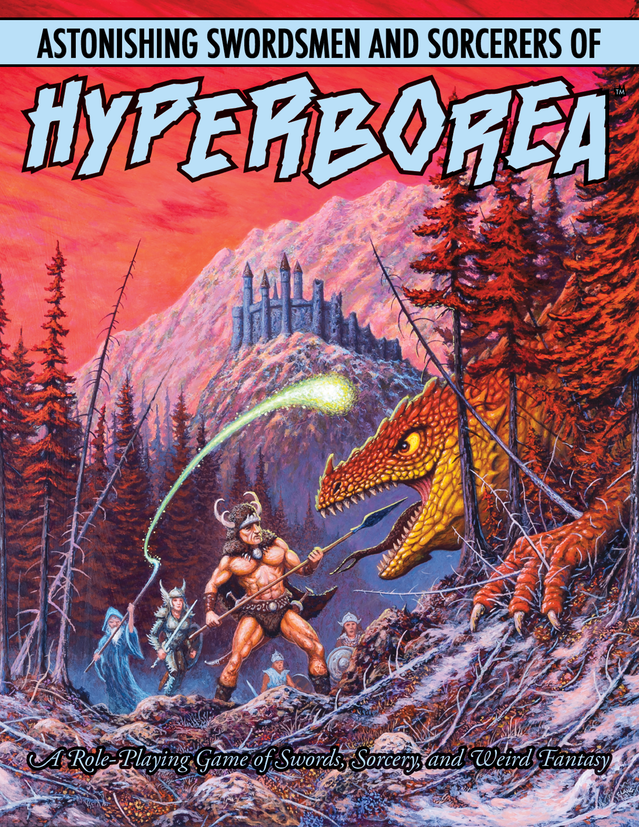
My print copy arrived last week, and after unpacking the monster I have to say it's a really impressive package. The original boxed set was very nice and retro, but this beast will hold it's own at the table, clocking in at an impressive 608 pages with a full color map insert. Everything you liked about the 1st edition --plus a lot more-- can be found within, but this time in a weighty tome that almost dwarfs Zweihander in size. Almost. I'm keeping the two together on the shelf right now, they make Hero System 6th look like a slim economy system when placed next to each other.

Symbaroum is a fascinating Swedish fantasy RPG in the vein of "simple rules, dark classic fantasy" with some impressive art and design. The second major campaign book is now out, and honestly, this is one of the few "packaged world setting" books I will likely run exactly as presented....one day, when I get around to it. Like the other tomes, this one is a mix of campaign setting content and modules, written in a sort of open-world style that I really enjoy.
If you're on the fence about Symbaroum, I'd liken it to a cross between Zweihander, Beyond the Wall, and Grim Dawn, but with better art design and a slick, modern system.
If you're on the fence about Symbaroum, I'd liken it to a cross between Zweihander, Beyond the Wall, and Grim Dawn, but with better art design and a slick, modern system.

13th Age remains my favorite D&D alternative. When I am not running a D&D 5E campaign it is probably because I am running a 13th Age campaign. The new Bestiary 2 only enourages such campaigning because it is chock full of amazing monster adaptations and evocative ideas for your own games. Like the first Bestiary, but even cooler.

I hardly feel like this one needs pimping, but now that I have a physical copy in hand and have had some time to explore it, I feel compelled to offer my support for a very well designed and researched RPG. Conan was my primary gateway in to fantasy fiction and gaming, right behind Tolkien, and evidence of Howard's (and Carter, de Camp, Nyberg, Wagner, etc.) influence in my own gaming and fiction preferences is obvious. I also (fair disclosure) wrote some books for the Mongoose edition....so seeing Modiphius make such a fine book is really fantastic, and I can't wait to give this iteration a spin.


I had a chance in 2005 to write for Mongoose. I did Tales of the Black Kingdoms, and the second and third books in the Messantia Adventures set. Some of my Black Kingdoms content somehow showed up in their Return to the Road of Kings release, too. Writing for Mongoose was an interesting experience.....but the pay was not bad, honestly. Tales was commissioned based on a book idea I pitched (I was quite happy to dive in to it). Messantia Adventures was a request....the author dropped from the project (or moved to another) after writing book one, and so I was asked to write the system material (book 2) and adventure (book 3). It was....tough, I'll put it that way...as I hated what he had done in book 1 (it had little that I felt was distinctly genre-appropriate, and was not written to be engaging), and disliked what was required of book 2. Writing social combat rules that were instructed to be in volume 2 when I felt they were not appropriate for Conan as a genre was hard, but I had a lot of fun working up the adventure in book 3. The final boxed set had a great set of cards, some not bad art, but as I recall some map errors that only lamp-shaded the problems Mongoose had with product quality, errata and typos. Tales had issues too, albeit less so than Messantia....odd typos, some changes to the adventure I didn't really follow, but overall wasn't that bad. Plus it had one of the best covers in the line, I felt.
Sunday, November 5, 2017
Griping about Mythras Combat
Recently I've been running a campaign set in ancient Mesopotamia, powered by Mythras. In some ways this seems like a no-brainer: Mythras by design appears to be eminently suited to running a historical campaign set in the ancient world, and it absolutely is.
But....I really dislike the combat system, I've decided. Every time I run Mythras I am confronted with the specter of my more intimate familiarity with the BRP system, especially Magic World and Call of Cthulhu. I keep saying, "why does this game have so damned many special exceptions, variables and obscure little mechanical contrivances to do what the other BRP games accomplish to exactly the same effect, but with fewer rules and less effort?"
I've told my group we can plow on through....the last time I had a successful campaign with the Mythras system it was shortly after RQII from Mongoose released, and I remember I was about three sessions in and hating the combat system before it "clicked" and seemed to get easier, as well. Maybe that will happen here....or maybe I'll wimp out and tell everyone to convert to BRP.
I suppose I could also mod out Mythras a bit. Borrow some BRP elements and simply adapt Mythras to work more to my liking. Instead of tracking action points, just tell everyone "you have 2 APs" and then instead of Evading and Parrying costing APs use the mechanic where each successive dodge or parry incrementally increases in difficulty by 30%.
I could also keep the APs but have each person take a single combat round to spend all three, then reason out order of actions from there. "I run 6 meters that way, draw sword, attack" can become one declaration rather than drawn out over three phases of a round.
I could state that specials don't happen unless they are pre-declared, and use the mechanical reward of specials as the confirmation that the special happened.
If I were ever to have an opportunity to suggest a rewrite to the system, I would get rid of descriptors used in place of actual numbers. No more "increase/decrease 1 increment, go see other chart X that we don't tell you about here" nonsense. No more "Formidable" or other descriptors, just tell me right here what the frickin' value is. I hate it when a system adds two layers to a task by attaching a descriptor and a number, where the number is what you need, then forces the descriptors in the text instead o just using...you know...numbers. FFG's Star Wars RPG does this (sort of). FATE does this. It's all annoying.
Some of this will make it more like BRP, of course, but I consider that a good starting point. Mythras remains forever a weird duck to me, because it changed the mechanical foundation of BRP style combat just enough to throw it all off, and in the name of elaboration and detail it sacrificed flexibility and intuitiveness--at least, until you play it long enough for everything to become second nature. But I just don't have the energy and time anymore to get to that point....I don't think. Do I?
Things I must mull over. But damn if we (my group) don't all agree that Mythras remains the system we love so much until it comes to the combat.

Edit/Update: I feel a bit differently now after giving it time. Will post more soon, but I realize that the problem is a bit more nuanced than I realized, until I considered it carefully. It boils down to this:
1. As a GM I will make a rule call when the specific rule is not obvious in play to speed things up. As I have limited time to prep for games, I often go in to a game with a "learn on the fly" approach, but for games like Mythras that means I'm sometimes applying modifiers I know about, or looking them up...but may not consider something I haven't memorized.
2. I have a rules lawyer in the group. This causes a lot of problems in the play session I mentioned as every time I tried to adjudicate a quick rule he would contradict me and this causes slow down as we looked up the process. This happened enough to get everyone frustrated.
3. The players aren't very savvy to the specials/crit process and the maneuvers. My default is going to tell everyone that they must accept called shot/max damage as defaults until or if they become more familiar with other options for their attack type. No five minute pause to research!
But....I really dislike the combat system, I've decided. Every time I run Mythras I am confronted with the specter of my more intimate familiarity with the BRP system, especially Magic World and Call of Cthulhu. I keep saying, "why does this game have so damned many special exceptions, variables and obscure little mechanical contrivances to do what the other BRP games accomplish to exactly the same effect, but with fewer rules and less effort?"
I've told my group we can plow on through....the last time I had a successful campaign with the Mythras system it was shortly after RQII from Mongoose released, and I remember I was about three sessions in and hating the combat system before it "clicked" and seemed to get easier, as well. Maybe that will happen here....or maybe I'll wimp out and tell everyone to convert to BRP.
I suppose I could also mod out Mythras a bit. Borrow some BRP elements and simply adapt Mythras to work more to my liking. Instead of tracking action points, just tell everyone "you have 2 APs" and then instead of Evading and Parrying costing APs use the mechanic where each successive dodge or parry incrementally increases in difficulty by 30%.
I could also keep the APs but have each person take a single combat round to spend all three, then reason out order of actions from there. "I run 6 meters that way, draw sword, attack" can become one declaration rather than drawn out over three phases of a round.
I could state that specials don't happen unless they are pre-declared, and use the mechanical reward of specials as the confirmation that the special happened.
If I were ever to have an opportunity to suggest a rewrite to the system, I would get rid of descriptors used in place of actual numbers. No more "increase/decrease 1 increment, go see other chart X that we don't tell you about here" nonsense. No more "Formidable" or other descriptors, just tell me right here what the frickin' value is. I hate it when a system adds two layers to a task by attaching a descriptor and a number, where the number is what you need, then forces the descriptors in the text instead o just using...you know...numbers. FFG's Star Wars RPG does this (sort of). FATE does this. It's all annoying.
Some of this will make it more like BRP, of course, but I consider that a good starting point. Mythras remains forever a weird duck to me, because it changed the mechanical foundation of BRP style combat just enough to throw it all off, and in the name of elaboration and detail it sacrificed flexibility and intuitiveness--at least, until you play it long enough for everything to become second nature. But I just don't have the energy and time anymore to get to that point....I don't think. Do I?
Things I must mull over. But damn if we (my group) don't all agree that Mythras remains the system we love so much until it comes to the combat.

Edit/Update: I feel a bit differently now after giving it time. Will post more soon, but I realize that the problem is a bit more nuanced than I realized, until I considered it carefully. It boils down to this:
1. As a GM I will make a rule call when the specific rule is not obvious in play to speed things up. As I have limited time to prep for games, I often go in to a game with a "learn on the fly" approach, but for games like Mythras that means I'm sometimes applying modifiers I know about, or looking them up...but may not consider something I haven't memorized.
2. I have a rules lawyer in the group. This causes a lot of problems in the play session I mentioned as every time I tried to adjudicate a quick rule he would contradict me and this causes slow down as we looked up the process. This happened enough to get everyone frustrated.
3. The players aren't very savvy to the specials/crit process and the maneuvers. My default is going to tell everyone that they must accept called shot/max damage as defaults until or if they become more familiar with other options for their attack type. No five minute pause to research!
Saturday, November 4, 2017
Call of Duty: WWII First Impressions (PS4 release)
I'm about five hours in to exploring a mix of the campaign, multiplayer and zombies modes in Call of Duty: WWII (which fortuitously came out as my extremely busy last two months of work came to a pause), and it's an interesting enough bag of angry cats that I felt compelled to comment on it....
First off: The Campaign
The campaign mode isn't going to win converts over. It's got the exact same linear format that you see in all other CoD campaigns, which means you're basically on rails with just enough room to not feel like it. The cut scenes/story is really well done, as you might expect; after several years of grizzled future mercenaries mugging the camera while betraying each other with shocking regularity, the homey forties-style "average guy sent to war" comraderie of the characters in the main story is downright quaint and refreshing all at once.
Unfortunately the cut scenes end and suddenly you are forced to play a game which is simultaneously the CoD we all know and either love or loathe, or maybe have gotten tired of.....but they decided to mix it up with two things I feel are contentious: quick time events (QTEs) and health pack regeneration.
QTEs are easy to hate, so I won't elaborate. You're forced to aimlessly hit random button/swing of the analog stick moves to get past a cut scene that has been arbitrarily gamified.
Health packs (medkits) though......I know health pack regeneration is a hallmark of classic gaming, and there's a division among FPS fans on those who feel that auto-regeneration is unrealistic and coddling vs. those who really enjoy not scrounging for arbitrary resources every fifty feet to heal up. Having gotten quite used to the "hide and regenerate" method since Modern Warfare (I forget if World at War introduced it) I have to say....going back to health packs, which for about ten minutes seemed amazingly cool, suddenly became the most immersion-breaking component of the single player experience yet. Here's why:
Stopping to heal with a med pack every couple of minutes lampshades just how non-immersive the experience is. People who claim this is more realistic aren't thinking about what's going on here. If you use the "hide and regenerate" mechanic it's surprisingly easy to assume your PC narrowly averted a near-death experience by taking cover, and that the indicators on screen suggest a bullet grazed you, or the are a metaphor for a near death event. But a medkit says, "I am taking the seventh dose of morphine and bandages in as many minutes, and that directly suggests I am very badly shot up, but I'm the only guy on the battlefield with a magic medkit which heals me, and only me, with perfect precision and no consequences of overdose, ever."
I'll have to try it on a hardcore mode, maybe it limits your medkit useage, which I would find more appropriate. But I've heard at the hard move the accuracy of the enemy becomes painfully, annoyingly precise even when blind firing....so hmmm.
Finally, the game doesn't feel to me like it was fine-tuned for the medkits. It doesn't offer as many reasonable cover points for hiding to heal as you'd expect (at least, it felt to me like it was offering the usual "charge forward" thematics of most CoD campaigns while discouraging that tactic with the medkit requirement). You also are assailed with uncommonly accurate distance shooters in the campaign, who target you like you're their bitch when you're forced to hold the line at a mounted gun.
On top of all of it, odds are there's always a medkit nearby, or a medic ready to hand you one. If you're going to add resource management to the game, then why not make these things more scarce? I'll have to try it on hard mode and see if that changes things.
So....good bits, but actually more frustrating than normal for a CoD campaign.
Next: Multiplayer
Mutliplayer is much tighter, and you can tell more effort at fine-tuning it went in to the design. It's actually a real pleasure to play on the PS4...when you can get it to work. So far it's been 50/50 on whether the online component was working when I log in so far.
Interestingly, the multiplayer uses the "hide and regenerate" mechanic, which I kind of wish it didn't....if it had an optional setting which let you turn on the medkit rule, and then allow it only once or twice per life, that would be a really cool hardcore option (hmmm maybe it does and I haven't found it yet). Think about that.....you could have a hardcore immersive mode in multiplayer. That would be cool (YMMV but I would love it; not surprising, given that I enjoy the hardcore modes most of all in CoD MP).
Overall the success of MP in CoD:WWII will depend entirely on how many current CoD fans are willing and able to go back to the less jumpy thematics of old school combat, and set aside the wacky wall-running of the last three years' of games. For what I want, the WWII multiplayer is fantastic.
Finally: Zombies
The WWII Zombies campaign is least explored so far but I got through the prologue. So far it looks more elaborate, and provides a shockingly higher level of serious detail to the storyline. I am intrigued to explore this option at length and will report more later. For now, let's just say that if you really want to play Ving Rhames killing zombies in WWII, this is the only place you can.
So.....at this point, my suggestion is: if you have been waiting for CoD to get back to where it was in the Modern Warfare and original Black Ops/World at War era, this is it (except for the medkits). But I don't think the campaign is living up to the original Call of Duty 1 and 2, except for the amazing graphics. As for multiplayer, if you think the future was held in Black Ops 3 and Infinite Warfare, then this is not the CoD you are looking for.
Wednesday, November 1, 2017
Ruins of the Four Corners - Aztec and Salmon Ruins
By fortuitious coincidence I had an opportunity to explore some ruins in the four corners area after a work event. No family around to go "But I'mmmm Booooored!" means I get to take my time and enjoy the trip....anyway, had fun in two Chaco Outlier sites, relatively easy to get to in the Bloomfield/Farmington/Aztec area: Aztec Ruin is the more public and accessible (and very well restored) location, but Salmon Ruin had better literature with more interesting "here's what we found in here" facts, which was cool....
Anyway....there is nothing like exploring some ruins (even if it's well restored in a ranger-maintained national park!) to really inspire....so here you go:
Both of these sites popped up around 1084-1090 AD and thrived until the collapse sometime around 1180-1200 AD of the greater Chaco Culture in the region. Both of these ruins were outliers to the main Chaco Complex (which is a fantastic exploration in its own right), which itself was either an outlier of or influenced through trade by northern Mexican traders (pochtecca, as they would be known during the Aztec period) of the Mogollon culture as well as Hohokam groups in southwestern Arizona.
The Chaco Complex was part of a northern trade network operating around the time the post-classic period Toltecs were going in to active collapse in central-southern Mexico. This strikes me as a bit too much of a coincidence....even if the Chacoans in these regions never met an actual Toltec trader, they no doubt traded with other northern complexes such as the Mogollon group at Casas Grandes (which had some overlap around 1130-1180 AD) in northern Mexico (Chihuahua province), as many trade goods, including carefully kept macaws, demonstrate.
If there wasn't some non-coincidental consequence that ultimately impacted the greater Southwest region as a result of conflict or an interruption of trade I would be very surprised. Even something as simple as a collapse in trade with the south, followed by a few years of drought near 1280 AD, could have been enough, as this was not a region known for stable conditions. The dwellings were ultimately abandoned and settlements began to appear elsewhere in the region, such as the cliff dwellings at Mesa Verde. Those cliff dwellings are incidentally better, more defensible positions (as well as providing better access to resources, albeit with more climbing)....just saying! Remember, when the material provided talks about "social differences or conflict," that's polite phrasing for "somebody was probably killing their neighbors around here." Not always....but sometimes, for sure. And if resources are suddenly scarce? That doesn't help.
Keep in kind that, depending on which scholar you read, it is possible (likely, in fact) that the Athabaskan groups we know as the Apache and the Navajo began to arrive in the region, right around the time of abandonment in the area. The ancestral first land of the Navajo called Dinetah, which is directly east of these ruins, is awfully close. There's a lot of evidence that these new arrivals did not get along well with the existing puebloan groups.
This is also a gaming blog, so it seems unfair not to include some actual maps. Next time you have a neolithic high desert culture that needs a community for trade, commerce and ceremony, consider these:
Anyway....there is nothing like exploring some ruins (even if it's well restored in a ranger-maintained national park!) to really inspire....so here you go:
 |
| Exterior shot of the main complex at Salmon Ruin. Not as restored as Aztec, but every room was laden with interesting details. Also the site of a room with an identified ceremonial altar used to mark sunlight around June 19-22 for the Summer Solstice. |
 |
| Old ranch house/barn remains near Salmon Ruin |
 |
| The Tall Kiva entry with restored ladder approximately where the Sipapu roof entrance would be. |
 |
| Entry to Aztec Ruin's hidden interior, where you can first pass through restored original entries as intended, but then turn west and you are faced with numerous taller, reinforced entrances dug by turn-of-the-century pot hunters leading into the deep, dark interior... |
 |
| Looking back through the deep, dark interior of Aztec Ruin |
 |
| Panorama of the ruins from the north side view |
 |
| View from the south side of Aztec Ruins |
 |
| The fully restored/recreated Great Kiva at Aztec Ruin |
 |
| The restored/recreated interior of the Great Kiva at Aztec Ruin. It had an unmistakable "feel" it as a place of ceremony and worship. It was also incredibly quiet and cool inside. |
Both of these sites popped up around 1084-1090 AD and thrived until the collapse sometime around 1180-1200 AD of the greater Chaco Culture in the region. Both of these ruins were outliers to the main Chaco Complex (which is a fantastic exploration in its own right), which itself was either an outlier of or influenced through trade by northern Mexican traders (pochtecca, as they would be known during the Aztec period) of the Mogollon culture as well as Hohokam groups in southwestern Arizona.
The Chaco Complex was part of a northern trade network operating around the time the post-classic period Toltecs were going in to active collapse in central-southern Mexico. This strikes me as a bit too much of a coincidence....even if the Chacoans in these regions never met an actual Toltec trader, they no doubt traded with other northern complexes such as the Mogollon group at Casas Grandes (which had some overlap around 1130-1180 AD) in northern Mexico (Chihuahua province), as many trade goods, including carefully kept macaws, demonstrate.
If there wasn't some non-coincidental consequence that ultimately impacted the greater Southwest region as a result of conflict or an interruption of trade I would be very surprised. Even something as simple as a collapse in trade with the south, followed by a few years of drought near 1280 AD, could have been enough, as this was not a region known for stable conditions. The dwellings were ultimately abandoned and settlements began to appear elsewhere in the region, such as the cliff dwellings at Mesa Verde. Those cliff dwellings are incidentally better, more defensible positions (as well as providing better access to resources, albeit with more climbing)....just saying! Remember, when the material provided talks about "social differences or conflict," that's polite phrasing for "somebody was probably killing their neighbors around here." Not always....but sometimes, for sure. And if resources are suddenly scarce? That doesn't help.
Keep in kind that, depending on which scholar you read, it is possible (likely, in fact) that the Athabaskan groups we know as the Apache and the Navajo began to arrive in the region, right around the time of abandonment in the area. The ancestral first land of the Navajo called Dinetah, which is directly east of these ruins, is awfully close. There's a lot of evidence that these new arrivals did not get along well with the existing puebloan groups.
This is also a gaming blog, so it seems unfair not to include some actual maps. Next time you have a neolithic high desert culture that needs a community for trade, commerce and ceremony, consider these:
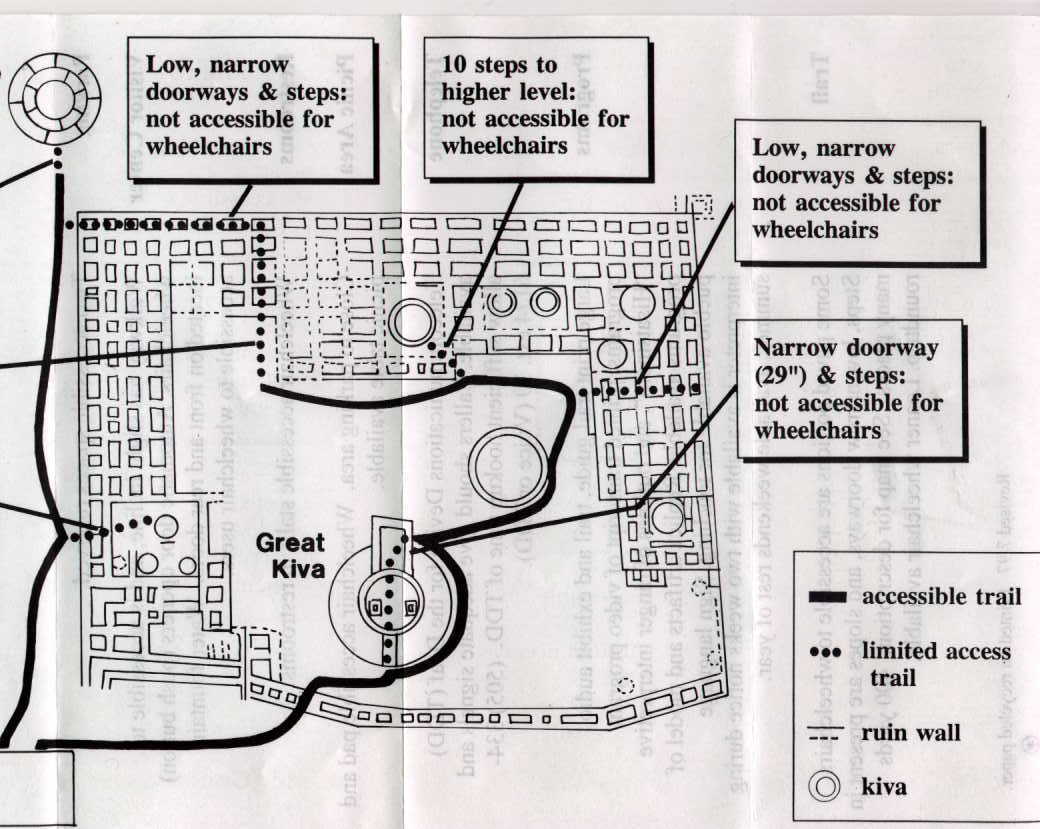 |
| Aztec Ruin Map |
 |
| Salmon Ruin Map |
Subscribe to:
Posts (Atom)