Showing posts with label Savage Worlds. Show all posts

Friday, January 30, 2026

January Gaming Review

 At the end of 2025 I predicted I would play a lot of Starfinder and Pathfinder this year because I am getting stuck in my ways. That is half right; I would say that is true, but part of my ways include being fickle and annoyed with the systems of choice. Right now, after the last month of running both Pathfinder and Starfinder each campaign is hitting a story arc conclusion which means I could comfortably take a break and try something else for a while....or keep going to the next story arc. 

The problem with Paizo's two systems is that they work best with a serious time investment in absorbing the rules and really meshing yourself in an understanding of the mechanical elements of both the structured intention of play and the possible emergent play. This is a problem when you have tiny slivers of time in your daily life to actually devote to preparing for such elaborate game sessions; one can run games off-the-cuff or with a mildly structures campaign arc as I tend to do, but its a rough ask in a game like Pathfinder where a GM should plot out scenarios to include suitable downtime, or to consider carefully the wide array of magical items that could eventually be distributed as useful loot by the level-based mechanics of the system. If you don't take the time to do this, your game can rapidly devolve into loads of encounters mixed with roleplaying that may (at least to me) feel like stalling before the next set-piece encounter. 

Sometimes, in fact most of the time, I really prefer a more relaxed emergent gameplay element. I love game systems where I don't necessarily have to think about every encounter in advance, and so systems where random encounter tables where the element of chance plays an important role are quite appealing. I love random treasure table options because it is never that fun to me if you simply have zero chance by the system as written of getting an amazing magic device just because you're not the right level for it. You can technically break the mechanical design of Pathfinder by granting higher level magic items as loot, but the system starts to creak at the seams when you do this, and it creates power disparities that are evident in play. 

Indeed, with Pathfinder and Starfinder I have at least a couple players who are often absent, but by the rules as written their characters need to keep leveling up even if they are non-participatory for a session or two because the game design is so tight that it really can't handle PCs of varying levels very well. This has always been a bit of an issue in D&D and its cousins with level-based design, but it was generally handled better in prior editions; PF2E and SF2E both only really work well when everyone is on the same page in terms of level and power.

I have also complained about how Pathfinder handles skills in the past. While I have mellowed on this (or more accurately, just gotten used to it), this continues to be a rough spot for the players who often want to do something interesting, only to be told by other rules lawyers at the table that no, in fact, you cannot do that because you lack the requisite skill feats and such for it. This is a severe drag on the players' creativity. My last pathfinder session only had the old veterans who know Pathfinder very well, and they had a good time because everyone was sympatico, but the absence of the players who want to think out of the box was noted by me, at least, as a sign that they may not be showing up because its hard to have fun in a game system that needs that fun to fit neatly into the mechanical box and is not into the creative expression elements. 

That led me down to the rabbit hole of realizing that as a GM while I can run the mechanically rigorous system, I would really rather be running a game system that was neither mechanically rigorous nor so procedural; a system which actively encouraged creative expression and emergent gameplay. Obvious systems exist for this purpose: Cypher System comes to mind, but any game system which encourages this style of play will work. Shadowdark, for example, and even Tales of the Valiant, which offers plenty of randomization and does not lock content such as magic items behind level-based mechanics. 

A good example of what I am talking about: my level 1-4 range group includes players who want characters who have skills that let them tinker with and make or install augments (magical and cyberware stuff). But actually doing this seems to be rather heavily gated by a range of skill, feat, and tool requirements that are incredibly difficult to achieve at these levels, even though a majority of the augments are meant to be for this level. It also requires parsing out multiple different sections of the book to get the full picture on this. It is, in short, complicated.

To contrast, imagine doing this in Mothership, Savage Worlds, Traveller or Cypher System: it is essentially a non issue, and the absence of structured mechanical prerequisites means that the system itself can breathe a little, and let these things happen more organically according to the needs of emergency gameplay and story.

So yeah....I think for February I really need to think about some alternative systems that fit the play style I am more in the mood for. 

Friday, December 5, 2025

The Second GM Inspiration: GURPS Places of Mystery


The Second GM Inspiration: GURPS Places of Mystery

In its many years GURPS, especially 2nd edition and 3rd edition, generated a copious wealth of useful sourcebooks that were almost universally appreciated by those looking for a bit of history or realism in their games, whether they were actually used for GURPS or not. One of the best of these books, one which has remained in my collection for decades now and gets brought out for periodic use and inspiration, is GURPS Places of Mystery.

Places of Mystery contains twelve sections focusing on historical, archaeological and sometimes mythical locales in our world, providing enough detail on their mythological and historical relevance, along with maps, to funnel your modern day or historical adventurers and investigators through hundreds of hours of interesting gaming. Just a sample of topics and locales in this book include:

The Bermuda Triangle

Stonehange

Ley Lines

Temples of Thebes

Lamaseries

Mohenjo Daro

Nubia

King Solomon's Mines

Knossos

Camelot

The Kremlin

Ayer's Rock

Anasazi Towns

And etc etc.....this is just a sampling of one or two locations from each chapter!

For modern games like Call of Cthulhu, Savage Worlds or Cypher System this is an invaluable book. 95% of it is system-neutral as well, and what few rules are here for GURPS are remarkably easy to interpret into other game systems with little to no difficulty.

For fantasy games you can easily take these locations and reinterpret them within the light of your preferred fantasy setting. Adopting many of these locations may let you fill out and even explore some ideas in your fantasy campaign that you might not otherwise have considered before, now with a veneer of quasi-historical authenticity.

Anyway, check it out! PDF here and Amazon Print Edition here

Tuesday, July 29, 2025

It is Settled (for now): Mothership and Tales of the Valiant

 So I have at last wrapped the D&D 5.5 campaign (we have loose plot threads, so who knows, maybe it will be revisited eventually) and Wednesday night formally begins with a Mothership ongoing campaign. I am plotting for around 5-10 sessions, but maybe we'll get more out of it; who knows! Mothership is a very fun game, but it is easier to do one shots and short campaigns with it than it is to do protracted campaigns....similar to Call of Cthulhu, the group can only sustain so much horror before it transitions from spooky fun to "wow how aren't we dead yet."*

I have had an infrequent Friday group as well, which my son was occasionally running Pathfinder for (and I ran Shadowdark for them before that). The group expanded to six players with last week's return to form, and I began running Tales of the Valiant at long last! It was a good session 0.5, with some char gen followed by a bit of gaming. I am introducing the variant concepts to them as we go (such as lineages and heritages, luck, doom, dread and so forth) bit by bit, in a completely new world setting I devised jut for TotV. I had initially planned to use preprinted modules but after reading through everything I had I decided most of them sucked for purposes of my GM style and what I wanted out of the game, and so I devised my own low level intro campaign module instead. I meticulously followed the encounter design rules outlined in the Gamemaster's Guide and have so far found them more satisfying than 5e/5.5E's traditionally more vibe-based guidelines.

Anyway, this mix seems to work for now! I have plans soon to try out Cairn 2E, Fabula Ultima, Outgunned, The Electric State** and possibly a return to Savage World's Pathfinder edition. We shall see.....but the important thing is, lots of options that require no further engagement with D&D 5.5.  


*Or, alternatively, "We have all lost multiple PCs, does anyone have a living PC who remembers why we landed on this haunted space station in the first place?"

**RPG and the original book only, we will not speak of the Netflix movie. 

Tuesday, February 18, 2025

The Ever Changing Gaming Prospects for 2025

So! The conundrum set off for me by my dislike of the design direction of the current edition of D&D has led to a close evaluation of options. It has led me down the following path:

Mythras - So I am actually running Mythras on Wednesdays now, which is not much of a stretch as I have run Mythras on and off over the last several years. My goal this time is to maybe, just maybe, stick with it for longer than a short campaign. We shall see; the problem is that my intrigue at the style/approach Mythras offers is often occluded by the more conventional approach D&D and Pathfinder take; or put another way, sometimes deep simulationism and verisimilitude are not as fun, long-term, as slightly gamified fun can offer.

D&D 5.5 - One of my friends sort of talked me into giving it a try, to look at the good options and maybe hold judgement on the bad bits until I see how it plays at the table (and over time). I decided this is a possibility, if I run a campaign that is new, built ground-up on the implied expectations of the new edition. I did devise a decent campaign outline so far, but I am still not feeling overly motivated to run D&D 5.5; my theory is that secretly, maybe even almost unconsciously, I am just really burned out on it all and this is as good an excuse as any to take a break. 

Dragonbane - I want to run this but I feel like it needs an expansion rulebook to hold long term interest, and I am regularly thwarted by my players' threats to roll all mallards. 

Pathfinder 2E Revised - this actually looks like the best overall prospect to me for continuing a D&D-like style of play without all the finnicky expectations of a new edition that foundationally change the core feel of the game. That said, Pathfinder 2E Remaster has its own special issues, not least of which is trying to figure out what monsters have been arbitrarily renamed or remastered into analogous replacements (e.g. gnolls now being kholos and such). But, aside from that, and my general irritation at may little design decisions in the system, it is still shaping up to maybe be the best choice for me. Except, of course. for.....

Tales of the Valiant - So it's basically D&D 5E, but with some nice revamps, and its main problem is not offering enough player choices (yet). But that aside, it is sort of the default no-brainer for me to continue gaming with. My group does seem deeply interested in D&D 5.5, but I think if I push hard enough I can get them to at least give this a shot. 

In digging through my collection I also found a few choice relics that I would like to play but which often get neglected when time to plan something comes up. Specifically:

Swords & Wizardry Revised - this lovely remaster of the S&W Complete rules, now with two additional rules/monster tomes filled with new content and classes are really my favorite iteration of the OSR (aside from OSE). Alas, my only problem with running it is that I am just not sure I could get most of my group to tolerate going to back to an old school state of mind. Last time I ran it (and OSE) I find about half the group would rather sit out a few sessions than bother to play an OSR game. Yeesh!

Forbidden Lands - I was really enjoying reading up and learning the intricacies of this Year Zero Engine based game and in looking at it again I realize it would be a fascinating experience to play. All I need to do is figure out how to "make it my own" in the sense that its default world assumptions are not always in alignment with what I want to do with it.....note that this is the exact same problem I now face with the new D&D books, they have shifted away from D&D as it has existed in prior editions (though maybe not as extreme as FL in terms of the implied world assumptions), but who knows, maybe I could find time to absorb the default setting and figure it all out as it is intended.

Cypher System's Godforsaken and More - Cypher System is a great game, and easy to run. I love a lot of it mechanical elements and focus on story. It has a good series of sourcebooks for supporting fantasy play. Maybe I should consider looking to it for my D&D-likes. It certainly is flexible enough to support the campaign settings I want to adapt to whatever system I pick.

GURPS Fantasy and Dungeon Fantasy - I have never been overly keen to run Dungeon Fantasy because it is essentially taking the core strength of GURPS (its generic, universal flexbility for realistic gaming) and wedded it with D&Disms. If I want D&D dungeon delving, there's always D&D. Same problem with Classic Fantasy for Mythras. But there is regular GURPS and the Fantasy sourcebook (and Magic). It's main problem is one of scope and work; I'd need to put a lot of effort into building stuff out for a game, and at my age I no longer have the time and interest to deal with GURPS's level of fiddliness (Mythras is on the edge of my tolerance level). But! I used to run GURPS all the time with a fairly low level of prep, though usually for modern day or SF games. Maybe I can find a happy middle ground here. Worth thinking about at some point.

Savage Worlds - With the Fantasy Companion and the Pathfinder for Savage Worlds books this would seem to be a no-brainer, but for various reasons I can't quite pinpoint easily, I was finding myself less than satisfied with the system in a recent Supers campaign I ran. I think the sense of gravitas and engagement with the mechanics were not there. Almost....dare I say it....too simplistic and swingy for my tastes, although maybe also my fault for picking a genre (comic books) my group was not terribly into or familiar with. The net result was disppointing, at least to me. So maybe doing fantasy with SW is actually a better bet as the group is most definitely more familiar with this genre and the system in that sense.

Okay! So enough pondering on this for now. 


Tuesday, December 31, 2024

Death Bat's 2025 Gaming Plans: Dragonbane, Mothership, Savage Worlds and the Usual Suspects

Here it is! The short and sweet outline of what I plan to do for 2025....at least in theory:

Part I: The things I am certain to be running this year:

Dragonbane

Starting next week we are going to finally start a campaign in Dragonbane. I am really looking forward to this, as until now if you wanted to play BRP Fantasy, the only real options were: find a copy of the out of print (albeit POD) Magic World, customize Runequest, or finnagle Mythras. Actually those are all good options, but Dragonbane has a astyle, character and odd mix of OSR and modernity that resonates well with me. I am looking forward to this.

Savage Worlds

We started Savage Worlds this weekend, using Supers/Horror mashup for a sort of Planetary/Hellboy/Horror Comics inspired campaign. I think this is going to be a fun, long prospect for a campaign as I get to lean in to my secret obsession I never usually write or talk about: the comic genre and all its quirks! I also plan to offer up more SW genres down the road, and am really looking forward to the new Science Fiction Companion when it ships in February.

Mothership

I plan to run more Mothership intermittently throughout 2025, and may warm up to a short or long campaign again at some point. I realize with Mothership it is as much about the player investment in the experience as anything, so how much Mothership I get to run will depend on the group I assemble.

Part II: The things I expect to run or try to run this year, but there are caveats:

D&D 5.75

The new D&D is on hold until the Monster Manual comes out. I have to see how the final tome in the revised books looks so I can assess my feelings on the new revision, and how it all comes together. Right now, using existing monsters with new characters makes the characters feel a but overpowered and I can't tell if that's by design, or because we're missing the appropriately revamped monsters to accompany them.

Tales of the Valiant

I really want to run this, but I need to detox a bit from having run way too much 5E in 2024. If the final book in the D&D 5.75 set doesn't really live up to expectations, I may just insist that any future 5E in 2025 be via Tales of the Valiant.

GURPS

I would love to get a chance to play GURPS again, but it's thunder may be stolen by Savage Worlds in 2025, which is honestly a better fit for my regulars. I may get to run GURPS with my son and some new players, though, if I can find them.

Mork Borg and Vast Grimm (and Maybe Death In Space)

This is all part of the Mork Borg universe. I anticipate running more one shots and short 2-3 session games here at some point, especially if this year is not monopoloized by protracted D&D campaigns. That said, which flavor and variant (and I also just got Ronin, another Mork Borg spin off that is amazing) depend on mood, I guess.

Part III: The Fever Dreams

I can sum the unlikely candidates up like this: Runequest (because I can't quite invest in Glorantha); Mythras (because as soon as I start diving in to relearn it I remember why I stop); Vaesen (I really want to, but the cute approach to the art is at odds with my ability to convey a horror atmosphere); then there's Pathfinder 2E, which I actually fully expect I may be playing in as a player, but do not think I will get around to GMing this year, but who knows! I often say that then prove myself wrong for at least one session. Also Traveller, which I wouldn't mind running, but I need a shift in my group dynamics before I will consider it (e.g. honest die rollers only please). That last one applies to a lot of these games, actually. 

I didn't mention Cypher System because I can't quite pin down what I want to do with it, but that could change in 2025. I also can't quite bring myself to offer it up right now (despite loving the system) because the die rolls are all player facing, and when you may have one or more suspects in your group who like to cheat on their die rolls, it can be very demoralizing. Yes, I likely need to have a chat with the specific person(s) about this. If you wonder why I don't just kick them, keep in mind I am gaming with a group of players who have in some cases been together as gamers and friends for 18 or more years, so these are not just randos, or people I don't know (or want to know), or pickup gamers. So at some point an honest talk is a better approach. Also, we're all really old now, and so one would think age would make us better people, both on how to approach this and (yes) why on earth would anyone at this stage cheat? It is frustrating....but it is not like 20+ years ago when when the cheating was generally unheard of among those I gamed with, as we all took the experience more earnestly. So yeah, I do need to decide what to do about this and how to approach it, and maybe I am doing so in too nuanced a fashion, but age has a way of doing that to you I guess.

Anyway, See you all on the flip side in 2025! Some predictions to come next. 


Tuesday, December 10, 2024

The Value of Dynamic, Speedy and Unpredictable Action and Combat

 My group is fizzing out a bit on D&D, and it's probably because the new edition (5/75 or whatever version # you want to give it) is mainly a continuation of standard 5E, which is easily the least exciting version of D&D when it comes to dynamic combat and variables. While it is true that 5E spun out of the 3rd and 4th edition eras where the amount and volume of combat mechanics was either so overwhelming or so procedural that it led to an arms race in rules mastery and tactical acumen among many gamers, the 5th edition response is to create a tepid experience which is fun for a while but eventually it all starts to feel very much like the same thing, over and over again. This might be forgivable if it was quick, but D&D combat is often anything but, even when it is sufficiently simplified that you basically have combat down to a basic roll to hit or save, deal damage, repeat process.

Other game systems manage to do much better and more dynamic combat, but not too many manage to hit the perfect trifecta of being dynamic, speedy and unpredictable. As it happens, perhaps one of the best game systems of all time for dramatic, fun and fast combat comes from the Fast! Furious! Fun! RPG itself: Savage Worlds. Indeed, Savage Worlds is so fast that if you are too used to running typical combat and pacing modules in D&D style format, then it can be a bit shocking to watch Savage Worlds compound the same experience in to less than half the time, leaving the GM scrambling for more content.

This is a roundabout way of me saying that Savage Worlds is back on the menu in my game group, and we will be playing it again, perhaps as early as this weekend, although I have also promised Mothership (which is also engrained with a fast, furious and fun approach to combat!) I'm just so very, very tired of the distinctly samey feel of all things in 5E/5.75E these days, but at least I can identify the burnout as being system-based, and not idea based!

Savage Worlds and Mothership both fit the bill for this sort of more engaging and dynamic but very fast combat approach. I think Mork Borg fits in well, and if you go back to the OSR era then any number of classic OSR games can fit this bill as well. Among more contemporary systems we can get quick and dynamic combat out of Cypher System, too. I'll have to try Dragonbane eventually and see how it feels as well.....I am sure it will be dynamic and unpredictable, but not so sure how speedy it will be. 

Thursday, August 31, 2023

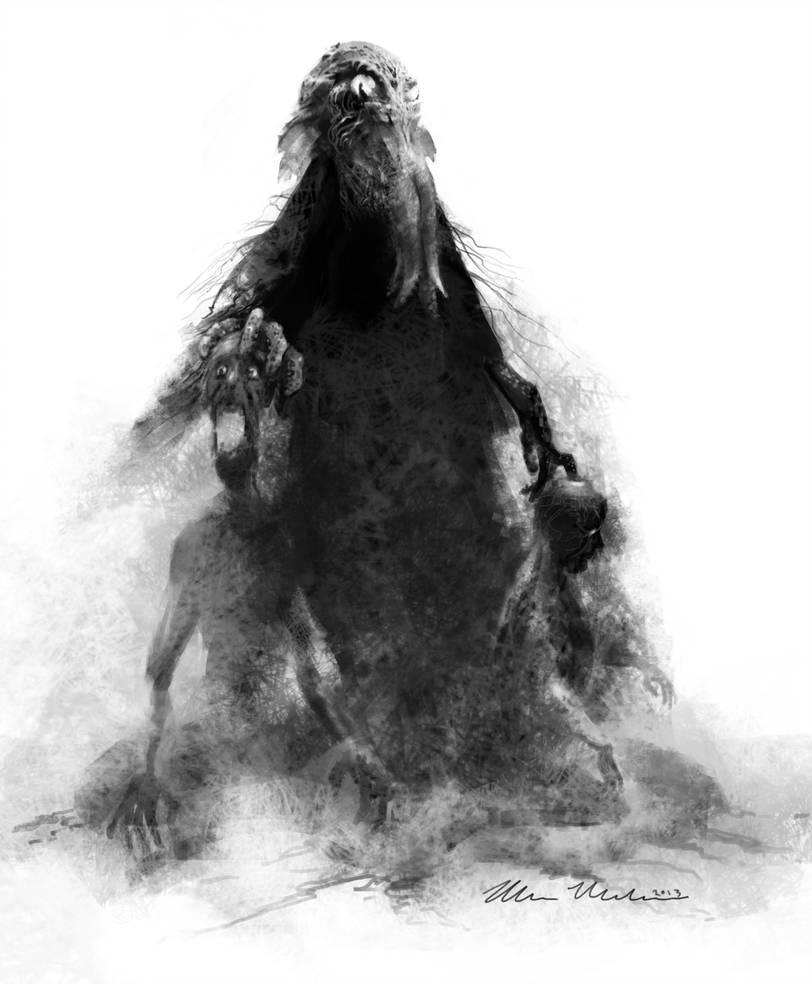
Savage Flayers - Mind Flayers in Savage Worlds and the Warlords of Lingusia Era


The Hyshkorrid

A savage denizen of the Underworlds of Lingusia

Savage Flayers, a Monstrous Wild Card For Savage Worlds Adventure Edition Fantasy Companion

The Hyshkorrid are conquerors of the psionic mindscape, travelers from distant universes, and telepathic masters of manipulation. Though few in number, these cephalopodic humanoids dwell in the depths of the Underworld beneath the shifting Sands of the Hyrkanian Deserts and the Mountains of Madness (the Slithotendan Mountains). The few scholars to interact with them say the hyshkorrid are obsessed with the observation of the mad god Slithotep, though perhaps not in a reverent manner, but they do worship Thasrik, the insectoid god of control and domination.

Hyshkorrid feast on the brains of sentient beings and use their potent psionic powers to lay waste to small armies. They are not physically adept at battle so usually prefer to dominate an opponent first to make their attack certain.

Attributes: Agility D8, Smarts D12, Spirit D10, Strength D6, Vigor D6

Skills: Academics D10, Fighting D8, Intimidation D10, Occult D8, Psionics D12, Stealth D8

Pace: 6, Parry: 6; Toughness: 9 (4 from psionic deflection)

Edges: Arcane Background (Psionics), Power Points X2 (+10 PP), Extra Powers X3 (6 powers)

Power Points: 20

Powers: All powers have a psionic/mental trapping; a typical array of powers include: Blast – Psionic (3 PP base cost), Confusion (1+ PP), Disguise (2 PP), Farsight (2 PP), Invisibility (5 PP), Mind reading (2 PP), Mind Wipe (3 PP), Stun (2 PP), Telekinesis (5 PP)

Gear: robes, masking hood, usually 1D3-1 magic items (potions, scrolls, rings, wondrous items), one roll on special chart below

Special Abilities:

Brain Extraction: STR+D6 damage, 2 AP. Hyshkorrid are incredibly proficient at extracting a brain from a humanoid skull. If a target is reduced to incapacitated by this attack then the hyshkorrid will use its next action as a Finishing Move; the brain is extracted and eaten. An extracted brain immediately restores 1D4 psionic power points.

Psionic Immunity: Hyshkorrid are immune to mind-affecting powers of psionic or magical nature that impact the mind (such as mind wipe, confusion, etc.)

Psionic Armor: Hyshkorrid have perfected the art of telekinetic deflection and gain +4 for toughness due to this trait. If a hyshkorrid is somehow caught unawares this bonus cannot be applied.

Natural Telepath: The hyshkorrid can only communicate via telepathy at will within 120 feet. For 1 PP it can extend the range to 1 mile for a minute.


1D10 Items on the body of a Savage Flayer:

1 – A necklace of grown coral wrapped around a tiny crystal ball showing the image of an eerie cosmic landscape

2 – A hideous holy amulet to Thasrik, the scorpion-like god of domination and control

3 – A carefully folder flayed skin of a humanoid species with a zipper attached to the back

4 – A locket which opens up to reveal a windable watch and the painted image of a blonde woman of Imperial descent; behind the clasp is a carefully folded note: “To my beloved, whom I shall devour last.”

5 – A clutch of what look like marbles but are squishy like eggs, and against a strong light you can see tadpole like beings swimming within

6 – A mimir skull of a kobold imbued with Smarts D8, Common Knowledge D8 and Academics D12 which can speak on any subject but only in draconic or aklo languages.

7 – A belt of threaded shrunken heads, all of gnomes, which begin to animate and laugh hysterically when touched by anyone who fails a Spirit check.

8 – A small, murky globe of swirling coppery color which speaks strange and hideous chants in aklo when held by an unprotected hand, and requires a Spirit check at -2 or the bearer experiences sudden terror and must roll on the Fear table.

9 – a backpack with a folded-up, small animated skeleton of a goblin, which functions as a servant that can carry out three word commands

10 – a tiara of platinum and diamond that looks worth 1,000 GP but if worn immediately requires a Spirit check at -2 or the wearer’s mind is overwhelmed by the commanding presence of the god Thasrik; a new save can be done once per day to break the spell


Monday, March 6, 2023

Operation Blackwatch - A Savage Worlds Supers/Horror Mashup

 I ran this in the older edition of Savage Worlds a few years ago, it was a lot of fun and I am thinking of revisiting this campaign again soon:


Operation Blackwatch Campaign

A Savage Worlds Horror/Supers Mashup (but would work with GURPS, Hero System, Cypher, etc. just fine) inspired by the likes of Hellboy, Creature Commandos, X-Files and all those faddish Zombie/Superhero What If Tales)

Premise:

A top-secret international covert ops organization named Operation Blackwatch is founded in 1946 after it is discovered that atomic bomb testing has resulted in a weakening of the fabric of reality’s walls….the “universe’s skin” has been damaged and something from somewhere else has begun to bleed through in to the physical world.

Initial encounters with the phenomenon proved deadly, and reports were enigmatic….the first appearance of “aliens” in Roswell, the appearance of enigmatic, Aryan figures in “sky chariots” to hapless drivers in the night, all seemed to have some connection to the opening phenomenon which materialized in the New Mexico desert a year after the initial tests were successful….a night which left dozens dead and three ghost towns in its wake. Demons in one location, aliens in another, and angels or gods of old in a third, all appearing within months of one another.

While the government instituted smokescreens such as Project Sign and Bluebook to disguise what was really going on, A covert team of specialists were assigned to study the aftermath of the “Old Organ” incident, especially specimens which had been recovered in the battle. The first team called these things demons, but settled on a more familiar term to the locals: skin walkers. The reason was simple: each creature appeared to have ripped its way out of the skin of the humans they seemed to inhabit, transforming them into brutal monsters.

Over several decades Blackwatch worked behind the scenes with other organizations, including Majestic-12 which was established by the US to coordinate negotiations with non-hostile “outsiders” as the term came to be for these beings which spontaneously appeared. Of the few who were willing to work with groups such as MJ-12 and Blackwatch, the so-called Vegans (three entities who suggested they were divine angels from the planet Vega) and the “little green men” of Roswell who never admitted to being aliens or otherwise, but would attempt to dominate human minds with psionic control at any turn if they weren’t kept unconscious with an oxygen rich formula, left the investigative teams suspect as to the intentions and contradictory stories of these beings. In 1951 in Korea a being called a Gunung manifested at the October 1950 incursion allegedly aided by the Chinese. The Gunung was so called because local Korean soldiers on both sides saw it as a manifestation of a brutal war god of old mythology, and it turned the tide against South Korean forces aided by the US.

The Gunung was the first concrete evidence of powerful manifestations outside the US. In a secret charter the Blackwatch Covert Operations Teams were reappointed as a agency under international UN jurisdiction to investigate any supernatural manifestations that happened worldwide. Within five years a dozen major manifestations had been reported. The most notable of these was recorded in The Soviet Union of all places, when a disturbance in Tsarskoye Selo (now Pushkin) revealed what appeared to be Grigori Rasputin, reanimated and undead, brought back by the supernatural energies. Aiding him was a manifestation straight out of mythic Russian nightmares: the fowl-legged hut of the legendary witch Baba Yaga, who had materialized in the flesh. The stories go that it took Soviet forces, including tanks and hundreds of men to drive the witch and her hut back into the woods with Rasputin, where they lost all trace of them….for a time. The two continued to haunt the Soviet Union for decades to come, as they appeared to take great umbrage at the Communist regime in charge of their country.

The Soviets allegedly formed their own group to study the supernatural phenomenon manifesting in the hinterlands of their country as well. Called the Night Watch (the Nochnoy Dozor), it would have multiple run-ins and conflicts with the UN’s own top secret Blackwatch over the coming decades. The Nochnoy Dozor continues to function in a modified role right to the present, and holds as many as one hundred supernaturally enhanced agents.

The practice of recruiting the “enhanced” began in the late fifties when the first humans who appeared to manifest unusual abilities as a result of an encounter with or exposure to supernatural elements first appeared. Some projects (such as MK Ultra) tried to exploit these enhanced for their own purposes to mixed results, but Blackwatch was uniquely qualified to recruit, train, and deploy these agents in to the field, using their own experience and abilities to counter and contain dangerous supernatural phenomenon.

Over the decades the incursions of the supernatural have grown. There were several hundred reported incidents from 1946-1960, but by 1990 there were another one thousand documented incidents world-wide, and by 2000 the number of cases had doubled. News stories were out of control, and it was only luck that prevented the public from being directly exposed to these manifestations in a manner that could lead to panic social unrest. By 2019 it is believed that there are over 5,000 humans and entities masquerading as human documented on record, and as many as 15,000 cases worldwide that have been records; Blackwatch can no longer keep up. A social engineering program in the early 00’s aimed at normalizing the concept of superhumans to the public and through film and other media this has had mixed success. Blackwatch remains an unknown operation, but a public group named Operation Skywatch ( a tribute to the days when most phenomena were perceived as UFO events) now seeks to identify and contain or train certain selected enhanced manifestations as part of a public program, and the operation openly implies that the powers of these individuals come from aliens.

In 2019, Blackwatch continues to fight from the shadows seeking containment of dangerous threats, while Skywatch seeks to create a public face to the increasingly hard to disguise presence of supernatural beings and humans who have been enhanced by this presence. Behind the scenes though the fight is getting more desperate, and Blackwatch realizes it may have overlooked a powerful hidden movement behind the scenes; the malignant and dangerous beings, the ones labeled demons and monsters, appear to have been forging their own alliances and working on their own agendas.

Threats and Secrets:

Blackwatch knows that there are hidden sources of order among some of the foes they have encountered. Study of these creatures, when captured, has revealed that they have formed “cabals” and “coteries” working to share knowledge and resources. Some of these groups are larger and more well organized; lots of evidence from Russia suggests that Rasputin and his patron saint of evil, Baba Yaga, are working behind the scenes to influence the heart of Russian politics and power, for example.

One recurring thread however is that the beings are growing more complicated, more insidious and manipulative. Most of the beings seem to manifest as identifiable creatures ripped from folklore, film, nightmare and myth. However, they all share the following hierarchy of traits:

1.      First Stage or “Primal” manifestations are beings which appeared the year following the atomic testing, and which appeared with consistency, usually a year or so later after additional atomic tests. It wasn’t until 1963 that Blackwatch, working through the UN, convinced the major world powers to agree to a test ban when they confirmed conclusively that the atomic testing was the actual source and cause of the manifestations.

The Primal First Stage Manifestations are the most terrifying and other-worldly. They seem to take on the most distinct and unrecognizable forms, as if they had not yet assimilated the appearance of horrors known to their first victims, though some rapidly changed and shifted, either into parodies or precise copies of those same victims. To this day Blackwatch has found less than ten of the estimated three hundred beings that appeared in 1946. These creatures, when found, are considered the most dangerous. It is believed that Baba Yaga is one of them, though it is suspected her power is what brought Rasputin back to life.

2.      Second Stage Possessors or “Inhabited” manifestations are more common, and start with a supernatural event manifesting in the region of a likely host subject. The individuals exposed to the “radiation” of supernatural energy from the bleed in the wall or reality rapidly degenerate and either mutate or become transformed by entities who seek a host organism in which to reside. These beings usually twist and mutate the host human in horrible ways, and sometimes are not successful in making the host viable. They seem able to abandon a host form to attempt to gain control of another body at times, though if this happens they seem unable to return to the old host form. Survivors of this sort of possession almost always manifest enhanced gifts….if they survive.

3.      Third Stage manifestations are known more commonly as Incursions as they seem to be creatures who claim to have come from some source of mythology, religion, fiction or nightmare in our world and seem to appear whole cloth. They are regarded as dangerous as their behavior seems to be dictated more by what people expect them to do as the beings they appear as rather than hold fast to any more common-sense agenda. Some early manifestations such as the Korean Gunung and the Vegans fit this description. These are often considered the most dangerous manifestations, but they can be hard to distinguish from Primal Manifestations or Possessors who have had time to shape their form and take on an identify unless you catch them at the moment they appear. The Vegans, for example, attempted to demonstrate their origin from a distant star by sending several agents to that location….their bodies were later discovered in orbit by observant sources.

One common agreement with study of the Incursions is this: they seem to need to take on forms chosen by the humans they intend to manipulate, terrorize or kill and feed off of. They are unable to survive without this “fear contact.” Certain classified experiments with captured Incursions have demonstrated that they seem to come apart and go insane, eventually killing themselves or dying when kept in isolation.

4.      Fourth Stage manifestations are identified by a Tibetan term and are called Tulpas. These entities are unique as it appears they are formed from others….including talented humans who have learned how, and are effectively simulacra of people. Tulpas can be complex or simple depending on the effort and energy invested in their creation, and some tulpas forged by powerful manifestations have enhanced powers and shapeshifting skills. The tulpa has become a significant danger in the spycraft of the modern era, as it is possible for a talented agent to kill and replace a target with a perfect duplicate, sometimes fooling the enemy for years. Tulpas almost never seem to manifest without being coaxed; but there are few exceptions to every rule and Blackwatch keeps a file on known tulpas for whom no creator as ever identified.

Blackwatch’s most dangerous foe in this game is the entity known simply as The Cabal, though it often has local titles going by whatever vernacular the creatures see fit to use. In the United States the Cabal is believed to be fairly strong and have infiltrated a portion of the government, with an unknown number of prominent organizers behind it, possibly all either hidden manifestations, enhanced humans sympathetic to the monsters, or tulpas in their service. The faceless leader of the Cabal is a being called the Tempest, and it is considered a great failing that no one in Blackwatch has gotten close to identifying who or what Tempest is.

In 1987 the Cabal forged a force of its own and thanks to some good luck and critical mistakes by certain agents the Cabal learned of a Blackwatch Operations Center and infiltrated then destroyed it in a raid, killing over one hundred agents and personnel in the process. Since this day Blackwatch moved to a more distributed operations network of cells spread throughout the world to avoid any one compromised Control Center from impacting the others. From 1988 to 2010 there were only four identified attacks on these cells. From 2011 to the present that tripled to 13 known attacks, and it is believed that the Cabal is getting better at infiltrating.

On occasion agents of the Cabal have been captured and interrogated. The most successful interrogation was with a Primal Manifestation which called itself the Grimjack, a gray, ghost-like being that had been working as a serial killer in the backwoods of Montana for decades. The Grimjack initially appeared incapable of speech beyond small mimicry, but when given paper and pen began to write furiously, producing a mixture of apocalyptic prophecy and occasional moments of lucidity. It was through this writing that the researchers learned that the Cabal’s leader could be a Primal Manifestation, one with strong influence over its kind. It was clear too from the writing that the apocalyptic descriptions of the Grimjack were not of our world’s future…yet….but of another world entirely, possibly one he had come from through the Bleed between universes.

Then, one day, the Grimjack spoke. “This is not the first time we’ve been here,” he told the stunned interrogators. “But this will be the last.” It was moments later that the Grimjack broke free and killed most of the researchers in the complex before disappearing. Rumors today suggest he is somewhere in South Texas, but local cells have yet to pin him down.

The Defectors

Almost all of the so-called Defectors are either Incursions which, though the adoption or their forms and “minds” have appeared as beings empathetic to humanity’s survival, or as victims of Possessors who have managed to survive the experience with enhancements. Defectors are unique in that they are by definition creatures of “the other side” or have been touched by them, but appear to have the best interests of humanity at heart. Angelic beings, demonic beings and other more disturbing entities who somehow found themselves with an undeniable soft spot for humanity have cushioned out the ranks of the Blackwatch. Long before they are considered for field duty as operators these beings undergo rigorous examination and testing to confirm they are not plants of the Cabal. So far, about one hundred such beings have made agent status.

Of interesting note about these defectors: each tends to firmly believe it is a correct and true manifestation of whatever supernatural element it presents itself as. However, in each case these beings seem to have strange “blank spots” in their memory that seem oddly to not bother them, but which constitute the rift in any memories that might lead to confusion about their natures. An angelic incursion, for example, might not remember its appearance on earth and instead think it descended from Heaven, but claim in its mortal form to have little more than feelings or impressions of what Heaven was like. Such beings, if interrogated too closely about their true natures, sometimes seem to go mad and may spontaneously change at that time to more hostile forms. Blackwatch’s interrogators have perfected a method by which they can attempt to force such reactions out of Defectors; if the defector resists and does not succumb to madness, or acknowledges it recognizes its existence as a manifestation of human creation then it has passed the test.


Monday, January 9, 2023

Five Game Systems I Plan to Visit in Lieu of The Big Two (D&D and Pathfinder 2E)

 Okay, there's nothing wrong with either Pathfinder 2E or Dungeons & Dragons as rule systems....well, there may be issues,* obviously, but this is the year that I really want to do something different, other than play these two systems. Last year I enjoyed Call of Cthulhu (always a good staple), and Mothership reared its head. OSE was fun for a couple mini campaigns, and there are no doubt other games I ran in 2022 that I can't remember at the moment.

For 2023, I may wish to enjoy some fantasy gaming that's not the two top dogs. Here's the list I've compiled (akin to my SF list I posted a week or so back):

Forbidden Lands - first up, the Free League Year Zero Engine powered fantasy boxed set was once really hard to track down. I now have the core and all the supplements, as well as a couple sets of the lovely dice (you don't need special dice to run this, but I like having them anyway). I feel very comfortable with the system mechanically; it's got a nice reductionist approach to skills and talents with an elegant and distinct method of dice resolution. It's focus makes characters both pragmatic and effective but also fragile and always at risk. You are practically expected to engage with the world; building fortresses and settlements and finding mentors makes improvement through experience much easier, so there's an active mechanic for players to want to forge their own path in the world. The default setting is interesting enough for me to consider using it as-is, something that is honestly very hard for me to do with all of my own game worlds I like advancing in storyline.....but the good news is its written in a manner that lets me use it as I wish, with my own setting if I so desire. And it has a lot of fan support on Free League's page on Drivethrurpg.com. 

 Savage Worlds Using the Pathfinder Expansions or Fantasy Companion - The as yet soon-to-be-printed Fantasy Companion is a revision that takes a queue from the Pathfinder for Savage Worlds books. Its also compatible with those books, which means that you can run a lot of fantasy now with Savage Worlds, and itr finally can be said to have a lot of easy to use support for fantasy gaming. Savage Worlds' SWADE edition is a great mechanical update and restatement of an already fine game system, and I know my group is interesting in trying this all out....so I should probably prioritize this one.

Dragonbane (Drakar och Demoner) - This lovely kickstarter is a reimagining/revision to a classic era Swedish RPG that spawned out of a translated edition of the 1982 Magic World from Chaosium. Free League is in charge, and you can tell fom the design, but given I love their stuff so much its a small wonder I am keen on this. The print edition is not coming out until late in the year, but the working draft/playtest copy is quite functional and I definitely want to run this for a short test game soon. Plus, playable mallards that aren't from Glorantha!!!! I secretly hope this spawns more content and turns in to the spiritual Magic World successor we all deserve.

Those are the big three. I have contemplated to varying degrees the possibility of Mythras, but for various reasons I am stymied by the possibility, chiefly with the weird character sheet on Roll20. I then look to BRP's Magic World, but while I know we could have some fun with MW, it is am imperfect tome with a lot of errata (which did get in to the PDF, I think, but still). 

There is  a strong fourth contender, although I know the initial learning curve (mostly in PC generation) is steep: Dungeon Fantasy RPG (powered by GURPS)! I might indeed propose this last option, I have a deep and abiding love for GURPS and have gone far too long without running it. It is possible I might instead propose some GURPS historical gaming finally....I was working a lot on some GURPS Egypt campaign ideas last year, and those are still lurking in my files, waiting to be unleashd. 


*Okay yeah I am playing in a Pathfinder 2E game right now that reminded me in a hard way of why I don't want to run it anymore again.

Wednesday, July 27, 2022

Gaming in July - A Weird and Unexpected Resurgence of D&D 5E and Lots of Time as a Player

 I haven't posted in quite a while, failing my (very mild) commitment to blog more often! I suspect the days of blogs are certainly dimmed, if not over, as vlogs become all the rage, but I just can't bring myself to even entertain the idea, I feel hideously unphotogenic, let alone "video material." 

For July, it looks like my post-vacation fugue turned from "what game will grab my interest?" into "Dungeons & Dragon 5E kind of does all I want for this particular genre of gaming." Part of this is no doubt due to the fact that I am only running one actual live game right now....and when  only have to focus as a GM on a single campaign, I find myself more creatively energized, less spent, and genuinely interested. As a result the campaign has been chugging along with lots of weirdness as I try to see what my players decide to do with their wayward characters.

I haven't abandoned other game prospects, though. I have a campaign for Call of Cthulhu in the works that takes the PCs back to a weird northwest set in 1812, to follow up on a strange campaign twist that happened in another modern day CoC campaign I ran back in 2018. We've been waiting for follow up on this one for years now, so good to get to it again.

I have also been slowly (very slowly) prepping campaign ideas for Mutant Year Zero and Savage Worlds Pathfinder. The latter languishes a bit due to my persistent desire to keep doing D&D 5E but maybe we'll jump in to it soon, I dunno. My Saturday game was postponed while my cohort in GMing for that night stepped up to plate and has been running the Extinction Curse (I think that's it) Adventure path for Pathfinder 2nd Edition. It's been fun to play, but I have been amused by the fact that I now think Pathfinder 2E is actually easier to GM than it is to play....and also more rewarding. As a player I am having fun, but the game's needless layers of complexity in character design are palpable when compared to D&D 5E, Savage Worlds, or even GURPS if I am being honest.

As a player I am also in a live game of Dungeon Crawl Classics a buddy of mine is running (the randomness of it all is a lot of fun, very core and basic but makes for fast-paced and entertaining gaming), Friday night Gaslight Cthulhu which will soon be rotated with a family-focused Dungeon Crawl Classics game my wife is trying to put together (I am interested to see how this goes, her interpretation of therewith!) and sooner or later we will get another Mothership game going, I imagine. Maybe.....I have some SF ideas I am experimenting with....which leads in to:

I'm still working on campaign ideas and stuff for GURPS, too. I don't know when or where I will spring these ideas, or on what hapless group, but I have a strong vision for the historical Egyptian campaign now, along with a fair amount of detail on a prospective exploration-based GURPS Space campaign. 

Monday, June 20, 2022

Getting to Observe Gaming from the Other Side of the Table

 Playing a lot more recently has afforded me a chance to think about what it is that I have been enjoying (and not enjoying) out of RPGs recently, with the added advantage of feeling less pressure to prep material for games ongoing. As of right now, I am many sessions in to a Gaslight era Call of Cthulhu 7E campaign, three sessions in to a Pathfinder 2E campaign, and I have just wrapped a D&D 5E campaign (which will eventually return), with tentative plans to start a Pathfinder for Savage Worlds campaign to try it out when I return from summer vacation. Meanwhile Mothership is there, and we play it when all parties can find themselves in the right moment to set the time aside....but that's really tough, it turns out, to do more than once a month.

So here's what I've noticed so far:

First and most important, as a player I can be picky, or at least I used to be, but these days I am just enjoying not having to drive the game forward so am happy to play the role, regardless of the game subject. So while I might have some notions of what I'd like to play (and I will be straight up on this, my player interests are still trapped in the early nineties in terms of what sort of game experience would make me happy) I am at this point just happy to be playing so the scenarios in action are good enough. Likewise, I applaud my cohorts who are currently GMing, as I feel their pain, acutely.

Now, I love Call of Cthulhu as both player and Keeper, so I have no issues there. We did experiment with Pulp Cthulhu for a time (not my fave), but its since been largely redacted as I think the Keeper realized it didn't really mesh so well as one might like. Pulp Cthulhu exists, and there are no doubt strong advocates for it, but I felt like playing with the Pulp rules was putting the game on "cheat" mode a bit and am happy to see it dialed back to more normal Cthulhu rules these days.

Lesson learned: I do like it when the game is tougher and expects you to know that being careful is important.

Now, in three sessions of Pathfinder 2E I have simultaneously come to appreciate that PF2E was most definitely written by game designers who wanted to both make the GM's life easier and put uppity players in their place. They also were obsessed with balance, to some weird degrees. And the action point system...it feels like its a malevolent social experiment designed to tempt players to poke fate and learn the hard way that second and third iterative attacks, at least in PF2E, are borderline traps, quick pathways to failure. 

It's all kind of interesting to see this not from the angle of the GM, for whom I will argue the mechanical aspects of PF2E are actually simpler than the player facing mechanics, but to really feel it hammered home that the game weighs odds against the players every step of the way. We're even using a published Pathfinder adventure path, and the GM is very by the book, so I know he's running the scenarios exactly as presented. It's brutal, and part of my likes it, but another part of me realizes that Pathfinder 2E, from both sides of the screen, has some profound flaws in design. 

I have already decided that while I will continue to play PF2E, no problem, I am done with it as a GM (well, in theory)....I just think there are so many other, better game systems out there that fit my own style and tastes better. I thought PF2E would cut it, but over time my love of it has soured badly, I guess.

With no immediate games that I need to plan for in the future (except for Savage Pathfinder which is in the can and waiting for when I am ready to run it), I have had ample time to think about what I really want to do with the many game books I have purely for my own amusement. So far, there has been one clear, out-of-the-park winner: GURPS. I've been designing stuff for a hypothetical GURPS Space campaign, filling out NPCs and pregens for my planned GURPS Egypt campaign, finally taking a serious look at what I could do with Dungeon Fantasy RPG, and reading through the many, many PDFs of GURPS I have acquired over the years. 

I'm also still intrigued to do more with D&D 3.5 down the road, but when and where I have no idea. Both D&D 3.5 and GURPS appear to be calling back to a sweet spot in gaming for me, a period from roughly 1992-2006* during which I ran mostly one of these two systems, only occasionally breaking out into other territories. My middle agedness is showing, I guess. 

Ultimately, to run GURPS again I need to get buy-in from my players. Some of them I can count on, others I think might see the perceived complexity of GURPS as a nightmare from which they can never escape. GURPS comes from an older era of design that assumed a level of focus and attention which I think is hard for a lot of gamers (anyone, really) to sustain today. If I run it, I am going to need to do all the heavy lifting at first, including providing lots of pregens, or restrict them to GURPS Lite for a while. We'll see.

Still, we may be able to play some games on our lengthy vacation that is about to start, and I am debating dragging GURPS along for personal fun, and Savage Worlds along because it will be easy to teach to the family members (mostly kids along with my son). Savage Worlds has a wonderful simplicity to it, and its inherent physicality with the card decks, bennie chips, dice as stats and so forth make it a fun game to teach kids. But who knows....usually there's never any actual time on these summer vacations to game (its just me deluding myself) so I should really just pack a handful of things I think I might actually find time to read. We shall see.


*For a lot of that time it was still AD&D 2E, but it was the AD&D 2E with tons of bloated splatbooks and the "2.5" rulebooks, all of which desperately made us crave a cleaned up, newer ruleset, which of course WotC eventually graced us with. And for 2000-2003ish it was the 3.0 version of those rules, which I loved dearly even if I can't go back to them after the 3.5 fixed so much.

SECOND NOTE: If you look at my post prior to this, outlining five campaign ideas, notice how while those are all fine ideas for any old campaign, they would be really cool in a GURPS campaign. Just saying.....I'm not kidding when I say I have that GURPS thing on the brain.

Thursday, February 4, 2021

Odd Synergies - Pathfinder Savage Worlds and Other Fusions

 A comment on the earlier post I made about the Pathfinderized Savage Worlds mashup currently on Kickstarter got me to thinking: this actually happens more often than we realize in the RPG hobby, in which one game blends in some fashion with another game to produce an interesting new hybrid or take on the setting or rules as a result. Ignoring licensed IPs which tend to jump around a lot out of necessity, we can see some other examples of this over the years with just a brief view in the wayback machine,  including some noteworthy gems:

GURPS Traveller - wedding the "reality based" verisimilitude and deep skill system of GURPS with a variation on the Traveller Imperium in which the canonical events of Megatraveller and Traveller: The New Era never happened. While Traveller's mechanics are a mainstay today, with Mongoose's Traveller 2E being a close match in spirit of design and intent to the Classic Traveller of 1st edition, at the time GURPS Traveller came out it was the closest anyone could get to a "patch" on a system that had experienced a significant mechanical upheaval in the TNE edition along with a setting upheaval of equivalent contention in the game universe.

Fuzion - One has to dig back a ways to remember this, but there was a time when Hero System and R. Talsorian Games got in to some sort of strange and unholy union, and the result was the Fuzion game system. This is a particularly interesting one, because it materialized as an edition of Champions and then it's own generic system in a slim book that works quite well as a complex but hyper-condensed generic rulebook. The system was an integration of RTG's Interlock system which spawned out of Cyberpunk 2020 and Mekton with Hero System 4th, and the result was...a good think in and of itself, though maybe not ideal for, say, Cyberpunk on its own or Champions/Hero 4th on its own.

Savage Worlds Rifts - That they even scored this crossover was significant, as Palladium has traditionally been very restrictive in its game licensing (which until this deal was all but nonexistent). I'm not a particularly big fan...mostly because I don't like Rifts as a setting all that much (I have played it, just not run it), but this is a case where I think many could argue that it gained a great deal in moving to a more coherent and modern rules system, though it also lost a bit in the unique style of black and white art characteristic of Palladium book designs. Still, Pinnacle does its own art style exceedingly well and I think all fans of both games won out here.

D6 System - What started as the Star Wars RPG of the 80's and early 90's eventually was decoupled from its original IP and developed over time into the mechanical basis for many other games, and eventually even was turned in to a OGL ruleset, allowing it to continue on in to perpetuity in various incarnations. The key detail here, though, is that a set of rules specifically designed with Star Wars in mind turned out to be excellent general mechanics for a wide array of genres and settings for which it was never originally intended.

GURPS Dungeon Fantasy - Yes, GURPS does this sort of thing, a lot. GURPS Dungeon Fantasy is an excellent example of how genre emulation of "D&D as a genre" is a solid thing that exists, now. People don't play Tolkienesque fantasy anymore....they play D&Desque fantasy these days. Gone are all Heartbreakers, long live the Heartbreakers, I guess.

But Back to the Pathfinder/Savage Worlds Mashup!

Now, on Pathfinder with Savage Worlds, its worth noting that nothing about the design and focus of the new Kickstarter necessarily required the Pathfinder license (other than the Golarian setting content and Rise of the Runelords modules). What the licensing appears to do is give us a tailor-made rulebook using Savage Worlds rules that defines how to do things like Pathfinder-like classes in Savage Worlds, a bestiary of distinctly Pathfinder monsters, and a spell system that will function like Savage Worlds but look like a Pathfinder (and therefore D&D) spell system. 

If you are coming at this from the Pathfinder side of the equation it may seem rather odd; fans of Pathfinder (both 1E and 2E) are honestly tethered to the game system for its actual mechanical elements, and not just it's D&D etymology. If you play Pathfinder for its mechanical style, why would Savage Worlds be a good fit? What is the point?

A Savage Worlds gamer can tell you why easily. When you look at Savage Worlds you have an efficient multi-genre system, but like most multigenre systems it does everything reasonably well on a broad scale but nothing in depth unless you have additional content to expand upon. Some genres have a lot of content for them right now: Savage Worlds has science fiction covered rather thoroughly, and arguably its a de facto system for pulp gaming in whatever form you want. But fantasy has been a bit all over the place, rather oddly. More significantly....dungeon fantasy has been a bit lacking in the Savage Worlds vein.

When you look at the trappings of Dungeon Fantasy it is extremely common to see sourcebooks pop up on Drivethrurpg and online for free trying to create various mods and settings for Savage Worlds that let you run it like it's some sort of spiritual successor to different editions of D&D. When you're used to playing just D&D or Pathfinder this may not seem so obvious, but those rule systems and the implied settings lead to very specific styles of world design, campaign design and game play. If you lack the specific tools to recreate those environments, but have a set of rules you think would handle it well (as Savage Worlds can), then the desire to pull it off is intense, and the tons of fan attempts and 3PP publications trying for this goal demonstrate a real market of some sort for the fans of SWADE and its prior editions.

Given that so many other publishers and fans have tried this, though, a generic but distinctly "D&D" edition of Savage Worlds wouldn't really attract a lot of attention from the crowd if you don't have a gimmick. And as I see it, it's a pretty amazing gimmick to say, "Hey, you know Pathfinder, the only other game aside from D&D to pull off what D&D did, and provide the level of content that we expect from actual D&D? Well now it's also a Savage Worlds thing." That's what this Kickstarter is doing...it's promising a full package, a version of Savage Worlds that doesn't feel like one man's take on his version of OSR or D&D or fantasy, that doesn't have the foibles and art limitations of a low budget 3PP, and that in fact has all the structural and design qualities of a Paizo product as well as its art resources and specific design goals....to simulate a Pathfinder like experience for a crowd that actually does want that whole "thing," but maybe doesn't specifically want the D20 system elements that make it difficult to appreciate.

There is a notion running around in some forums, however, that presents a line of thought like this: maybe Paizo is licensing this out to see if maybe they can pick up some steam on product without a lot of risk. This could be happening because they like the idea, or it could be a test resulting from lower sales performance on Pathfinder 2nd Edition. This is a lot of conjecture and I haven't seen anything that could support the claims, but it's an interesting thought. 

Paizo's crew have been more than willing to experiment in the past with licensing, sometimes with disastrous results (Goblinwork's MMORPG) and sometimes with much better results (Pathfinder: Kingmaker CRPG). Licensing this out to a Savage Worlds product seems like a bit of a tame bet. Those same forums raise questions about why Paizo doesn't just start publishing their Adventure Paths in 5E format....and while that could be a valid survival strategy, I think Paizo is aware that their long term survival odds are better if they grow their own IP rather than cater to WotC's. But a deal with Shane Hensley? This seems both safe and filled with some interesting growth potential. 

Monday, December 7, 2020

Fun at Every Level - A Pipe Dream or Design Reality?

A recent comment on an older Starfinder post got me to thinking: the comment was that essentially the problem with higher level D&D 5E is the inverse of lower level Starfinder, that a high level D&D game  and a low level Starfinder game are painful in comparable ways. There is more than a little truth to it. With D&D 5E there's a good chance you've experienced some measure of fatigue with what happens when the game system, built around exploding hit points, gets to a certain point in play at higher level.* The problem with 5E is not particularly new to that edition; it actually plays much better at high level than 3rd edition versions before it, in fact. The problem is "new' to 5E in the sense that it fixed some underlying issues with prior editions (math complexity, juggling stackables, and too many iterative attacks and modifiers) with a new problem (simpler rules, but the hit point bloat just sucks). 

Starfinder has an entirely different issue: at low level it lets you play what essentially amount to pathetic miscreants. You can barely do anything, and you can afford gear that is one step up from a Laser Tag game. You don't get truly interesting class abilities until about level 4, and you don't start affording scifi weaponry that feels like something not handed to the short bus until around level 6-7. By the time you're level 10 you start to feel like a real adventurer. Starfinder is a victim of its own balancing act, carried too far. I'm running it right now, and my goal is to award heaps of XP tro make the first 4 levels just fly by.

I think Paizo realized this was a problem, too. Pathfinder 2E manages to succinctly balance out the merit of low level gaming against higher levels in ways neither of the other two systems are all that good at. Low level PF2E characters feel squishy, but they have bite. High level PF2E characters are interesting and complex, but fights somehow only last a little bit longer than low level battles do. It's a good design balance, and I love how smooth it is. 

Now, to contrast there are other games out there which handle this very differently, suggesting that the high level/low level problems of some games are more characteristic of D20 systems than they are of, say, Cypher System or Savage Worlds. Those games have their own issues, of course....but sometimes they also have their own built in fixes, too. For example, Cypher System deliberately makes a lot of tasks at lower level trivial and automatic as characters advance in power, but high level play in Cypher is functionally identical to low level play, just with a greater need for sacrifice from the resource mechanic which drives all actions. Meanwhile, Savage Worlds runs on very flat baseline stats, and all the edges and perks a character gains over time are designed mainly to make it easier to hit the target numbers than anything else; the number stay the same. 

Although I think, for purposes of D20, that Pathfinder 2E hits the mark very closely for me, I bet there are still better ways to design a D20-based system which manage to retain the rules simplicity of 5E with the tactical granularity of Starfinder or Pathfinder. These designs might even retain consistent feelings of fun and engagement at all levels of play. If you know of any systems out there that seem to do a better job of accomplishing this than the current era of D20 systems I'd be interested in hearing about them.


*This issue with high level 5E is more evident to first time gamers than those who survived 3rd edition D&D, as we all remember the gruesome high level gaming days that 5E "fixed" for our purposes at least!


Hah had a typo in the title. Pire. Shoulda been Pyre! Would be even more odd than Pipe.

Tuesday, October 6, 2020

Historical Gaming - Best Traits in a Game System

In this 46th year of role-playing games as a formal hobby we've got all sorts of fine tuned, precision level gaming engines out there for all sorts of things. Recently though I've been really getting back in to a deep dive on historical readings and the thought of running historical games has become all consuming. I've got campaign ideas ranging from revisiting my Mesopotamian campaign set around 2330 BC to a deep dive into England around 650 AD on up to my particularly strong obsession: the rise and fall of the rule of Akhenaten in Egypt from 1351 to 1334 BC. This is an especially interesting time period since a vast trove of diplomatic missives called the Amarna Letters exist, and these include a great deal of interesting insight into what was going on in this particular period of time. Never mind the revolutionary...some might say heretical....upheaval in religious tradition that Akhenaten implemented; there are all kinds of interesting stuff going on in this period in history.

Anyway, when I want to play something that involves exploring dark holes in the ground while fighting monsters both D&D 5E and Pathfinder 2nd Edition work really well for that. When I want even more cinematic excitement in that same vein 13th Age is a good choice. When I want science fiction Traveller is a basic default. So what is the best default for historical gaming?

A key element of a good ruleset for a specific genre must be that it supports what you want out of it. If the rulesystem provides only nominal coverage toward the genre then you may find yourself missing elements you crave. For my purposes, I define the historical genre like this:

Verisimilitude is Critical

Historical settings and themes work best out of necessity when the game system's underlying mechanics support the ideas of the real world. There are many systems which support cinematic or literary storytelling, but a suitable historical experience must at least feel like it is grounded in reality. Some systems let you take historical themes but are not really providing an historical experience in this manner (Cypher System and Savage Worlds are both examples of this). The obvious game systems for this sort of experience are: Mythras, BRP, Call of Cthulhu and GURPS. Each provide a mechanical framework for an experience steeped in "realistic" interpretations of things such as injuries, pragmatic human limits and physics.

Emphasis on the Mundane over the Fantastical

The "realism" must be supported well and in larger proportion to fantastical elements. If the system or setting of necessity feels like you're missing out if you exclude magic from the setting then it may not be an ideal system for historical gaming. The ability to define characters in terms of the mundane and make them feel relevant is critical; it does mean, for example, that the ability of a character to be interesting because the system provides rules for more in-depth skills is preferable to one where skills are less relevant. Combat abilities may focus in greater depth on what actually happens in real combat, and eschews fantastical or cinematic maneuvers; being good at blocking and parrying (and those being part of the process) will help with the historical realism; whirlwind attacks and fantasy parkour not so much.

Magic is of necessity either optional or irrelevant in these systems. The ability to provide for a form of magic that feels more like the way magic was perceived to work in the real world is helpful; the ability of the system to feel robust with no magic at all is even better. Whether you include magic or not, though, it's got to be with a system that does not overshadow the historical underpinnings such that it negates the intended value of the experience as you want it. 

Of systems previously mentioned it  is safe to say the Mythras, BRP/CoC and GURPS all cater to this. However, of these GURPS provides the most robust means by which you can provide for elaborate characters and avoid magic entirely if desired. Alternatively when armed with GURPS Thaumaturgy you can pick and choose from a range of magical traditions designed to feel like the sorts of magic which our ancestors believed in (as well as others of more literary tradition). Mythras provides four types of magic, which often dovetail well with our modern interpretation of how magic might have been perceived to work, but also tends toward a more mythic and literary reimagining of such. Likewise, BRP is simply the original system from which Mythras evolved, and Call of Cthulhu is very much steeped in providing a historical experience tinged with the mythos, a literary construct. 

Resources!

Researching a game on your own dime and time can and is fun for those who want to do it, and historical gamers tend to fit that bill just fine. That said, the more ready-made content a system can offer you to help the process the better. It is almost redundant to point out that GURPS is the be-all and end-all for this sort of thing, thanks to a spate of almost two hundred historically themed books in the 80's and 90's. They moved away from such resources in print with GURPS 4th Edition, but still occasionally offer some useful content (Crusades, Silk Road) while keeping all the classic 3rd edition books in print....and the conversion work required is essentially non-existent, thankfully. Heck, many people use GURPS resources for other game systems as well.

Mythras also provides some historical resources, and you can find other systems out there that make varying efforts to do so, including some that engage in elaborate, fantastical depictions of historical periods such as Aquellare, a tome which must be truly experienced to be appreciated (or reviled, you pick).

Historical Gaming =/= Wargaming

Lastly, it is worth mentioning that a good RPG for this is not the same as a wargame by any stretch, nor should it be construed as such. For many, the most interesting elements of historical gaming are in the details of ordinary everyday living, experiencing a slice of time in an interesting historical period, and figuring out the many strange mysteries left for us in our own historical and archaeological records. Combat and military actions are just one piece of the pie, and a system which handles all desired elements may well suit those with such tastes the most.

For me, GURPS stands out as the system I can count on to provide the kind of historical gaming experience I want, especially if I want to keep it as far away from too much of the fantastical or literary/cinematic as possible. BRP is a close second along with Mythras, and Call of Cthulhu of course is excellent so long as you want to look at history through a sickly green Cthulhu lens (nothing at all wrong with that of course). Meanwhile certain very specific games out there provide some compelling historical experiences on their own...Aquellare is my most recent discovery, but there are others. What games might I have missed that fit this bill?


Saturday, December 28, 2019

Year in Review: Tabletop RPGs of 2019

I've written a bit less than I have in prior years in 2019, so if you follow the blog you can probably guess where my energy and interest remains focused, more or less. So don't be too surprised by the  RPG products which I have found to be sufficiently compelling in 2019 that they have soaked up a nontrivial level of time and/or interest, a massive feat these days....rather than rehash how much I love Pathfinder 2nd edition, Cypher System and "other," I'll just point out some trends in the hobby I noticed this year:

The Year of Old Favorites Getting Facelifts

This was the big mark for 2019 as far as I was concerned. Savage Worlds got a facelift to a new, reorganized edition which didn't change much but helped consolidate the game into a cleaner edition. So far we only have a few books out for it, but Savage Worlds Adventure Edition looks like it will work a a good "one book standalone" for most people's needs.

Meanwhile, the Cypher System Revised which started as part of the "Your Best Game Ever" Kickstarter from Monte Cook popped out on time with --you guessed it-- a heavily revamped book with few to no rule changes but a ton of organizational changes and additional content.

Finally (well, for my focus in the hobby) we had the formal release of Pathfinder 2nd Edition, a clever revamp that feels more like a new system spun out of the D20 family more than a regular old 2nd edition of its predecessor. Pathfinder 2E quickly seems to have become my groups' favorite system, and as a result it has been almost entirely the only system we've been playing on Saturdays and Wednesdays since August.

There are old favorites out there which have yet to see their time in the sun (GURPS and Hero System both deserve a "modern day" treatment, if only to see what that looks like) but it's good to see that many systems can get a revamp without critical changes to their core mechanics (okay, well 2/3rds of such systems, anyway!)

The OSR Shifted a Bit from the OD&D Core

This year saw the release of The Fantasy Trip in print for the first time since it's death in the early eighties, as well as a slew of new content. It witnessed a return of Mercenaries, Spies and Private Eyes in a slick new reprint with additional material to bring the game into the 21st century without changing any of the original game. It has brought a range of interesting Swedish fantasy games in the OSR vein with a keen ability to handle hardcore old school dungeonering and hexcrawling without being distinctly D&D in the form of the Fantasy! RPG and the impressive Forbidden Lands boxed set (which I finally got a copy of).

It's not that classic-D&D focused content is gone, but more that there seems to be a branching of interest in what the OSR can offer, and that's a good thing.

The Bloggosphere Contraction

It's fairly evident when you look around: many blogs of old are now gone, or on life support. The old era of dedicated gaming blogs has dimmed a bit, probably due to the pervasive rise of vlogging through Youtube. 2019 was the year I first really noticed it, to be honest, but even I find more and more RPG vlogs creeping into my Youtube feed, which is where I'm finding most Pathfinder and Starfinder content these days, for example. Still, there remains a hardcore crowd that I believe is mostly made up of other bloggers keeping it all alive. Tragically, we old guard probably without much exception would find it hard to transition to a vlog environment....I have zero interest in putting my face or voice out there; the blog for me has always been a deliberate exercise in writing, not visual presentation.

Monday, April 22, 2019

The Tricky Gray Apocalypse


This is a bit from the past....basis for a 1 shot Savage Worlds game I ran, with the potential for more....if I re-use this it would work well with Cypher System. 


The Tricky Gray Apocalypse Campaign

To the Players:
You are all people in the near present who have found yourselves one month out from an apocalyptic event*. You were each either chosen, invited or kidnapped by the Reverend Wilhelm Sikorsky to his mountain retreat, the "Temple of the Healing Earth" located in the White Mountains east of Sedona. Traditionally Sikorsky is known as a medicine man and healer, something of a mystic, and a major believer in UFOlogy and the presence of aliens in our affairs, even if we don't know it. One day, abruptly and unexpectedly, Sikorsky invites all of his attending guests to the "cave" where he conducts his spiritual healing ceremonies with the Earth and then....you find yourself unexpectedly locked away, the cavern entrance in the mountains protected by a sealed vault door that can only be opened from the outside....

This is where your tale begins!

Suggested archetypes include: the wealthy millionaire looking for a relaxing vacation, the eccentric conspiracy UFO theorist, the healing crystal follower, the skeptic who was out to debunk Sikorsky's "Cult of the Healing Earth," the complete innocent person who was kidnapped from a local diner in the nearby town of Alpine by two of the cultists and locked in a, anachronistic, secure prison chamber in the network of tunnels behind the "healing cave," or perhaps even a halpess cultist who was just trying to help the newcomers feel comfortable and is completely oblivious to why the Reverend closed the foot-thick steel door that you had always been told was designed to keep the cave a "living" environment by preventing its internal moisture and atmosphere from evaporating. 

Equipment is limited (obviously) by what you would have reason to bring to this "cult spa and resort" but stuff you might have in your bags could be inventoried in the event you escape the cave....

Everyone can start with 10 XP (so, 2 picks). No arcane anything...no magic, weird science, anything. Zero magic world. Any profession that fits "today, or not too far from now" works. 

The Apocalyptic Event:

Each of you is certain doom is nigh. The apocalyptic event you believe in is as follows (pick one, because none of you think it's the same):

1. Asteroid 2015 GL5589 has been rumored to be on close approach, passing between the orbit of the moon and the Earth. You believe (either rightly as an astronomer or wrongly as a fanatic) that there's a deadly risk it is really going to strike the earth and the government is hiding this from the populace. (FALSE)

2. You recently heard about the bizarre outbreak in South America of the mutating Small Pox Virus that is completely resistant to all vaccines and is deadly so far in 94% of those infected. The news claims the virus is quarantined and under control in Brazil, but rumors are that three cases cropped up on the border in the US...(TRUE)

3. In the wake of belligerent diplomats and politicians, a major conflagration took place in the South China Sea between the US and China. Bombastic rhetoric on both sides could be the lead in to nuclear war....or more noise...but either way you're not taking any chances. White Mountains are way off the grid....(TRUE)

4. The sudden surge in UFO sightings in the last several weeks, culminating a month ago in approximately 200 exotic ufo sightings over Mexico City, Phoenix and Denver have level heads stating it's a product of military build up due to the South China Sea conflict, but you know better....this is the culmination of a pattern that began over twenty years ago, a pattern of invasion....! (???)

5. You can't say it's the "end of the world" but a month ago you attended a conference on the American Association of Biology on the adverse risks of CRISPR technology. One scientist warned that it was already suspected that North Korea had used CRISPR technology to create a cordyceps sinensus that was extremely robust and hearty, primarily (it was suspected) to harvest a more robust form of aphrodisiac for Kim Jung Un. The results were questioned however when it was found that the fungus could infect and grow on large scale hosts outside of ants....and rumors were that North Korea had moved it to weapon testing. Disturbed by the concept, you made your way to the retreat a month later to clear your head, after an ex-GF suggested it was a great place to veg out, if you ignored the crystal stuff. (TRUE)

The Set Up
The post-apocalypse was caused by a startling convergence of events. In sequence the following events transpired in the last month which led to an unexpected apocalyptic scenario…an existential crisis for humanity at large:
Day 1
Yellowstone Erupted. The entire American continent is cast in shadow and darkness, and most of the mid-western states are essentially gone. In the White Mountains several inches of ash dust the region, but the real devastation is a winter-storm effect that blanketed the entire country. Over the course of a month the disruption to electronics and the basic infrastructure of the country is devastating.
Day 2-15
In the middle of this event, China abruptly makes a move, strongly and decisively moving in on the west coast under the pretense that it is providing aid and assistance initially, but rapidly taking pains to secure territory on foreign soil. Two weeks in to what started as humanitarian aid, the west coast collapses into anarchy. Nuclear weapons are abruptly engaged, though few know who made the actual call….rumors of a rogue five star general Arnold Mcallahoun usurped control from the President and made a decisive first strike against China abound, but the reality was that China quickly retaliated. The devastation to most major population centers and military installations in the US was swift and devastating….and the remainder of the country collapsed.
Day 4
Rumors of an immense creature, blackened and ruinous, veined with burning light, moving through the devastated Midwest, are largely disregarded as the ravings of PTSD survivors of the event.
Day 10-20
In Asia, North Korea uses its weaponized Cordyceps fungus as a bioweapon against China and South Korea, sparking additional local conflict and war. The cordyceps virus proves even more devastating than anticpated due to its manufactured airborn quality and the virus spreads across the Pacific and throughout Asia rapidly. By day 20, Canada, the US and Mexico are facing an unprecedented catastrophe as desperate people are turned into fungal zombies. Worse yet, the fungus behaves strangely in the “Super Small Pox Virus” which has been hitting South America during this time….people who succumb to the super pox and then are infected by the cordyceps seem to live on unnaturally past the life span of their body and mind….
Day 12 In a crushing state of alert, stories of refugees from Idaho, both covered in ash and bombed by a Chinese attack, are compounded by stories of thousands killed while seeking escape when the immense creature that was previously sighted days ago appears and seems to “drain” the life of all around it for a mile.
Day 21-29
Desperate militia groups, civilians, rogue military and more are seeking out pockets of safety and resources throughout the country to batten down the hatches in the wake of a grotesquely overwhelming nuclear war coupled with the super volcano eruption. The teeming masses of fungal victims from the coast and the south are initially seen as one more aberration but as their numbers increase, the survivors realize that the only hope is to find a way to hide out, and wait for the devastation to past. Meanwhile, along the southern borders the first of the infected “pox” victims succumbing to the cordyceps fungus begin to attack survivors in that region.
Day 30
Acting President of the US Mcallahoun declares that the state of Emergency has moved from martial law to a need for all citizens to arm themselves and maintain defense of local interests until “such time as the United States can restore its essential governance and infrastructure.” He signs off and the national broadcast goes dead….
Day 31 (Today)
The Sons of the Constitution arrive at the Crystal Healing Ranch to take over, having heard rumors that there’s plenty of resources hidden in the healing cave….they find the ranch abandoned, seemingly devoid of life….a pickup truck is attached to the cave door to pull it off. The noise alerts the lurkers in the woods….for it turns out that the compound survivors were all part of a unique ritual, one which Reverend Sikorsky had intended to be the “point of ascension” for his flock to join the Messengers of the Stars.
The Messengers did indeed hear them, and descended, to take possession of each of the cultists. Only those in the healing cave, ironically, were allowed a chance to live….
The new Hunters, lean and oily with black and gray skin, transformed from their human hosts, quickly make short work of the Sons of the Constitution….and the human abominations protected in the Healing Cave are next….!