Sunday, September 16, 2012

3.5 Revisited


I've picked up the reprints of the D&D 3.5 core rule books. They seem to be reprints of the deluxe editions (the black & silver foil cover editions) that came out many years ago...but I never actually owned those so I can't really say for sure if this is the case or not. Its possible these contain errata that postdates those editions, but I'm unable to say for sure.

It's interesting to look at these books again after having been playing Pathfinder so much for the last couple of years. There's a few interesting bits I had noticed which had not previously been so obvious (especially since I haven't look at a copy of 3.5 anything now in about four years). Among these observations:

1. The Pathfinder art seems to be generally better. I guess I'm not a huge fan of Todd Lockwood's style, more correctly. I like a lot of the art in 3.5, but the Pathfinder take seems more modern. I think Pathfinder is a byproduct of the more graphically-intensive current era of game design, whereas 3rd edition was spiralling out of the late 90's and early 00's, a time when it was still possible for a top-tier publisher to use black and white art on occasion.

2. The 3.5 font is bigger than Pathfinder's font. As a middle-aged gamer with vision issues I genuinely appreciate this.

3. The layout on the Monster Manual looks kinda crazy and heavily condensed compared to the Pathfinder Bestiaries. I am surprised to read it and realize that (among other things) the word count per entry in the 3.5 MM doesn't appear to be all that different than the 4E MM, which is ironic considering how much flak was leveled at the lack of monster fluff in 4E's presentation. For whatever reason I don't remember 3rd edition getting the same accusations. Pathfinder by contrast definitely tries to add at least a few extra sentences of fluffy goodness into each monster's description.

4. One thing the 3.5 MM seems to do better than the PF Bestiary is to provide more extensive stat blocks and variant details. Pathfinder has a bad habit of adding a bit at the end of a monster with variants and saying, "do this if you want to have variant X." The 3.5 MM simply gives those extra stat blocks to you ready for use.

5. After playing with Pathfinder's rules changes for roughly four campaigns now (each ending around level 10-15) I think I can safely say that something is weirdly off about Pathfinder math in terms of power scaling. PCs are clearly more effective on average than is implied by the level scaling advice in Pathfinder. Looking back at 3.5 now reminds me of some of the reasons why. 3rd edition PCs had fewer skill ranks, no "bonus features" for favored class (favored class being a way of penalizing characters that dabbled in a weird range of multi-class options) and of course hit points scaled a bit on the lower side (though this is fairly minor). Feats, too. You get a lot more of them in Pathfinder....and many of those feats have been enhanced or made more effective (i.e. cleave, power attack and so forth).

6. The DMG for 3.5 still stands out to me as providing more generally useful content and advice. The Gamemastery Guide is alright, and has some nice bits, but it's never really filled in as handily as the 3.5 DMG did, which carried on reasonably well from the expectations established long ago by the 1st edition DMG as an all-purpose toolkit full of cool stuff to build from.

7. I had forgotten that the whole concept of swift actions was a late-game introduction to 3.5, and does not exist as a concept in the core rulebook.

8. I think the Pathfinder book is very well presented and has a lot of interesting presentation and dialogue, but I have to say, the 3.5 rules are very clear in their presentation and succinct in explaining the game mechanics (with a few very infamous exceptions, such as with grapple).

9. If I ever get to run 3.5 again, I'll run skills by-the-book. Lengthy runs of Pathfinder have convinced me that the skill and rank expressions in PF make for some fairly over-talented and over-the-top characters. However, should I run 3.5 again I would be more rigorous in insuring PCs are recognizing skill synergies, something I think I was fairly lax about back in the day. As it stands,  I have learned over the years that I prefer more detailed and robust skill systems over streamlined and simplified. 3.5's still nowhere near GURPS-level in terms of depth, but it stands out as the most elaborate skill system in D&D's development. Proficiencies from 1/2E had broader skill selections, but with simpler math....both approaches have merit. However, 4E's easy-button skill system and Pathfinder's "everyone is either a freakin' master or they suck horribly" approach have ultimately both worn thin on me over time. I will, however, expel any player in my group who blathers on about optimizing skills and how players should be discouraged from choosing role-play skills over utilitarian skills. Those guys don't need to be in my game.

10. The 3.5 rules have a lot of bits I (and apparently many others) had forgotten about. How often have DMs let players level up and cross-class into something without requiring some background to justify the change, or a training cost in time and money? Seriously, I had forgotten about this bit on page 197 of the DMG, but if I want to slow down the pace of a campaign a bit, requiring training between levels is a clever way to do it. Add in the advice on page 198 about time to learn spells, the requirement of sorcerers to petition powerful entities for spells, and you've got a combination of "slower pacing" mixed with story elements that make progression more tangible in play.

11. If you're one of those people who freaks out about druids and their pets being overwhelming to fighters (a subject for another time) then let the fighter get special cohorts of his own.

Okay....that's it for one day's reading and review. I really would like to run another 3.5 campaign straight up to see how it feels compared to all the Pathfinder I've been running, but that may be a hard sell as my local groups are all heavily invested in Pathfinder. Paizo definitely pulled off one amazing stunt with Pathfinder: a lot of people I know who disliked 3.5 or were scared away from it will play Pathfinder, despite the fact that the two games are effectively twins, with only minor differences. I've always been impressed that he D20 system is like some sort of invasive parasite which can sustain itself so well simply by migrating to a different host...

Saturday, September 15, 2012

Forgotten for a Reason...

Solitary Winner so far of the "Steam Pile of B-Games Backlog" Event spurred on by the fact that I have forgotten how to utilize my free time when I have it, thanks to my wife and child being on vacation!

So in a follow-up to my Wednesday blog (the "forgotten games" I re-downloaded to give a second shot) I am remembering why a lot of these are forgotten. Heh.

Kane & Lynch (both of 'em)--difficult to want even try to play when a monumentally better game in the form of Max Payne 3 exists. I got past the point I was stuck on in "Dead Men," the first one, and it just got worse from there. #2 could be better for all I know (I doubt it) but #1 makes me not want to care. The game feels like it had a crew who really cared about the story and voice acting, at odds with a design team for gameplay who couldn't be bothered to fix the game's many weird issues and poor design features. These games taught me an important lesson: don't play crap if you don't have to. Life's too short.

Warhammer 40K Space Marine--this game looks and feels like something I should like and I even found the jetpack, yet I was overwhelmed with ennui as I played and the only satisfaction I got was in once again uninstalling it. Weird.

The Haunted: Hell's Reach--I like this game, but its a hollow arcade experience solo, and in order to properly enjoy this I need other friends who own this game, which I do not. Yet again I marvelled at how clean an experience it is, and how it would be so much better if the game even offered a semblance of story or direction to keep the solo player motivated. Uninstalled once more.

Homefront--As I slogged through this marvelling at the terrible pacing, poor storytelling and ridiculous level of on-rails shooting thinly disguised as "open" by letting you walk left or right while waiting for the NPCs to do stuff for you (like, say, open doors and stuff) I realized I'm getting really tired of this sort of game. In fact, I realized I was feeling the same way about Warhammer 40K Space Marine earlier....trying to rocket jump and realize I was doomed as usual to rocket jump in the highly confined space the game would allow was a reminder that none of these games were designed by Bethesda. Uninstalled! If steam had a trash bin I'd be chucking it, if only to insure I don't try reloading in the future.

There is one winner so far, though:

Red Faction: Armageddon--if you pretend like it has Absolutely Nothing to do with the previous Red Faction titles its kinda fun, as you watch the clueless and accident-prone Darius Mason stumble blindly through an alien invasion from Mars's core. Pretending its not part of the Red Faction universe goes a long way toward ignoring the many, many confusing questions and plot holes such an association raises. If you assume that it takes place in the Space Ghost universe but with better graphics then it even seems to be kinda coherent and well reasoned. Yay! I shall keep playing this one too, until the ennui sets in, I imagine.

Okay, so I'm not totally done with rechecking discarded games in my Steam Pile, but I do think I've re-evaluated the effort I'm putting into them. Think I'd rather focus on Guild Wars 2, Mass Effect 3 and Max Payne 3 instead.

Darius Mason: he's a winner at being a loser


I just realized I like RF:A because it provides a distinct character, and even if I don't identify with him, he comes off as kinda fallible, like he's not really that amazing, he's just cursed with being in the wrong place at the wrong time....a lot. By contrast I wanted to like Kane & Lynch because the characters were interesting, but the game kept getting in the way. And as for Homefront, the protagonist was effectively inscrutable and appeared to have no voice or opinions whatsoever, no matter what sort of heinous atrocity was transpiring in front of him. I guess Homefront wants that character to be a cypher you can project yourself into, but the game's on-rails heavy-handed control of story direction prevents you from ever feeling like you're on anything more than some sort of acid-tripping slasher-flick adult ride version of Disneyland. And as for Warhammer 40K...I kept wondering why these dudes wouldn't wear their helmets. I mean, it's not like they're freaking Gears, amiright?!?!?

Friday, September 14, 2012

Golmadras: Wachalen, City of Strife


Wachalen: City of Strife

"When I and my companions arrived in Wachalen it was with the best of intentions. I could not have imagined the carnage that would ensue, nor the madness of civil war that had descended upon the mountainous valley, a conflict which spiraled out from the bleak castle guarding the pass like a maelstrom engulfing all in its path. 

"We arrived as four explorers charting out a foreign land of decadent corruption and draconian fascism, to explore the easternmost reach of the dreaded territory of the so-called "Final Lands." What we found was a guerilla war between the native sylvan elves and a bitter garrison of soldiers who were culled from the crudest and most despicable criminals in a land run by criminals. 

"It was, as my old taskmaster in the Temple used to say, "Time for a messy clean-up."
--Excerpt from the Travelogue of Corlance dann Veraskon

Castle Wachalen (Wyldraven)

Part I: The History of Wachalen
Wachalen is an ancient fortress that was built during an age long gone, its first foundation laid by high elves (the Suethenurien folk) more than 3,500 years ago, the quasi-mythical time of the War of the Gods. The old tales speak of the great fortress as a masterpiece of ancient elven engineering and architecture, erected to stand fast in the Atalonian Mountain Pass of the southern Greenmantle Mountains against an invasion by the abyssal armies of that lost era.

As the stories go, Wachalen was then called Atalon’dar, meaning “Throne of the Mountains” in old elvish. It was meant to protect the heartland from the warring armies of the north in a time when gods walked the earth in physical form, using armies of angels and demons to fight for supremacy over the mortal realm. The fortress, according to these legends, served to repel a vast army of demonic invaders and cult warriors to the chaos gods, but it suffered greatly. Some tales say ten thousand elvish warriors died standing in defense of the pass, and that one needs to dig but a few inches into the soil to find the bones of these warriors and their fallen enemy. Other tales say that less than a few hundred warriors managed to stave off the demonic hordes for weeks before receiving aid. All tales agree that the fortress was blasted nearly to oblivion in that era, and that this explains the charred, blackened walls and stone of the region. Local farmers in the high valley pass will also attest to the fact that it is nigh impossible to plow the ground without exposing bones of some sort. Many bones clearly belonged to men and elves, but a great many more appear to have been those of terrifying beasts, judging by the chaotic and disturbing appearance of the remains.
Over many centuries the fortress served either as a garrison of defense in times of war or as a peaceful community where overland trade was conducted. The trade routes east out of the mountains lead to Saddikar (once Blackholm) in the north, as well as Akalios and Ostenar (of Sendral) to the east. The largely unruled and independent folk of the southern Hyrkanian desertlands beyond the mountain often rely on Wachalen (as well as Ostenar) for trade and commerce. They sometimes even seek the council of the ruling lord at the castle, to resolve legal disputes or criminal accusations.

Eleven centuries ago there was a period of great turmoil. The old Hyrkanian Empire was in decline and a dark age had fallen upon the Middle Kingdoms. Octzel was in disarray and was fracturing into multiple smaller kingdoms during the Hundred Year War, and a mystery as yet unresolved led to the Great Deluge, which began with a tidal flood along the coast that destroyed countless towns and cities, after  which the sea level rose by a measure of dozens of feet in some regions, flooding coastland and forcing people to move inland to secure ground. During this time the high elves of old Sylvias sent many stranded folk to dwell in and around Wachalen, as part of a relocation effort to deal with the shrinking coastland.

To the south, the devastation was much greater as the broken land-mass of Karaktu, which consisted of a cluster of large islands, was engulfed in the flood waters, destroying the empires of old. This led to the exodus of the old Argosean people, who in turn sought refuge elsewhere, and tens of thousands of these refugees arrived on the shores of Sylvias. The high elves, though reticent to accept so many humans into their land, felt there was little choice in the matter but to be as accommodating as they could. (See the introduction to Golmadras for more on this).

The flooding of the Deluge lasted for about a century, after which a newer and more dreadful event transpired. About a thousand years ago came the horrific plague years when the undead god Unarak unleashed a plague of undeath upon the land. Wachalen was once again reinforced by warriors who stood fast against the darkness, though this time the troops were Golmadran men or sympathizers, for after several decades the Golmadrans went from immigrants to rulers of the land in a bloody civil war that lasted for three decades. The elves were vanquished and many had fled to other lands to escape. The dark elves of Modra had risen to power. In this time Wachalen was placed under control of the dark elf named Malador Verastain, a cruel warlord and powerful servant of the demon lord Kostchie. Verastain led the human and dark elf forces (as well as many elvish slaves) to victory against the hordes of undead which swept into the pass, keeping it clear and defending Golmadras from the encroaching hoards. Despite the slaughter that went on in the mountain pass, it was noted by many that the undead hordes never struck along the coast or anywhere else in the mountains, which while largely impassable for men would prove to be mere inconveniences for the relentless undead. The emperor, or course, claimed it was divine protection of his realm. Malador Verastain argued otherwise, saying it was the diligence of his men.

In the end Malador Verastain was assassinated by his own mother, Lady Caervalle of house Verastain. His success brought much honor to her clan, but he was apparently accused of consorting with wood elves, and it was said that he had a relationship with Erinesse Valdari, the daughter of the wood elf king Draegas in the high mountains of Eflin. This was too much of an affront, and when rumors of a bastard child surfaced Lady Caervalle contracted the Fire Knives to kill him. Today, his vast and deep tomb can be found in the necropolis east of the city, where it is said that the warlord was buried with illegitimate child and his immediate followers, wives and concubines. Despite being a hero of Golmadras, the emperor stood idly by while the dark elves exacted their own punishment. Some local legends suggest that Malador returned from the grave, and that his vampiric presence can be felt in the streets of the castle and town on moonless nights.

Malador Verastain

Over the last millennium as Golmadras grew, so too did Wachalen. It became a prosperous center of overland trade, more so than in the previous years under the elves, for Golmadras despite its imperialist nature was ever receptive to merchants and coin. The elves of old Sylvias had always been a guarded lot against outsiders (and the Golmadrans proved why). Now, Wachalen was open to all who had coin and goods. This prosperity turned the mountain pass from a remote fortress and township into a sprawling urban city in the high mountains.

This prosperity was not to last, however. Within the last century and a half the city has suffered economically as much of the overland trade dried up due to growing conflict between Golmadras and its neighbors. In the current era (3,501 aw) Wachalen is a city that appears to have slipped into squalor and decadence, a place where the very rich and the very poor commingle and merchants find themselves less and less interested in staying for trade and business. Much of the overland trade has shifted to the young independent city-state of Erazad to the east, and the current ruling governor of Wachalen, the porcine Count Verask Mataelen is furious at the competition Erazad provides. He has petitioned the emperor himself to demand that the Golmadran fleet take action against the budding polity, but for reasons yet unknown to the public no immediate action has been taken. Behind  the scenes there is a suspicion that Erazad has fallen under the protection of both Sendral and the Iron Kingdoms, such that to attack it would be to start a war with two powerful neighbors. The Count does not care, however, and has been looking at creative ways to fund his own private army with a measure of deniability to cause harm to Erazad. Right now this comes in the form of bandit and orc raids along the trade routes leading to Erazad.

Count Verask Mataelen

While the Count worries about his petty trade wars with Erazad, a bigger threat looms. Since the dawn of Gomadras in a blood war against the old native elves, the sylvenurien wood elves of the northern Eflin Mountains have managed to survive against their neighbors for centuries now thanks to their all but impenetrable kingdom within the high mountains. Early on in the rise of Golmadras Wachalen was a center of military operations against the wood elves, but little progress was ever made as the wood elves proved to be the only folk who could safely navigate the treacherous fey-shrouded dominion in which they dwelled. Entire regiments of Golmadran soldiers were said to have disappeared into thin air. Soldiers would go on patrol and return a day later, aged eighty years, or go to sleep and awaken as mewling infants in their bunks. It was a war that could not be fought, and eventually the Golmadrans decided to leave well enough alone.

In recent decades something changed, however. The wood elves have begun to emerge from their high mountain kingdom, at first for an occasional raid, but frequently they have gotten bolder and more aggressive. Wachalen is at the heart of this rising conflict as the wood elves engage in frequent, often weekly guerilla strikes against their forces. Some strategists of the Count suspect that there is a connection between the elves and the city state of Erazad, though no one has proven this yet, but of the few elves captured or killed in these raids it has been noted that some of their gear appears not to be elven-made.

Today, travelers in the region can expect to be at risk of an attack by wood elves, beset by bandits privately backed by the Count, threatened by the large local militia, oppressed by the private militaries of local lesser nobles or roughed up by desperate and penniless citizens. Wachalen is a kettle pot about to boil over into insurrection and civil conflict.

The Eastern Passage


Next: Part II, an overview of Wachalen, its occupants and environs

Wednesday, September 12, 2012

Two Weeks of Forgotten Games

The Original Chainsaw Sword

Starting tonight and going on for a couple weeks I'm going to be all by myself for a bit, as my wife and son are travelling with his grandma (my mother-in-law) to visit relatives stretching from Texas to Oklahoma. It's in the middle of a particularly vicious work cycle for me, so my attendance isn't possible.

What this means, of course, is Free Time, which also means lots of gaming. In preparation for this I looked through my bountiful Steam collection and picked out a few ignored gems, games I picked up either because a) they were on stupid cheap sale (i.e. $5 or less), b) was interested but on actual initial play-through couldn't get into at that time, or c) game was one of those titles which no one seemed to like but which I was willing to give the benefit of the doubt because of option a.

So over the next few days I plan to see how many of these titles are worthy of my attention* (hint: some of them are very worthy, I've just been saving them for a rainy day; others.....not so much):

Warhammer 40K: Space Marine
I have played a bit of this. It's a pretty solid game, but I've never been that into the Warhammer mythos. This is one of those games with a robust multiplayer component, and I'll be curious to see if there's any community left playing it.

Meet generic hero Max...Alex...no, wait! Darius Mason

Red Faction: Armageddon
Same thing here. This game suffered (in my opinion) for a bad opening level (because after you get past that it gets into more space-marine vs. aliens shootery fun) and for being inappropriately wedded to the Red Faction franchise, which irrevocably harmed that franchise despite the fact that this game is pretty solid (if unremarkable) on its own merits as a GoW-like.

Kane & Lynch; Dead Men
There's an early bank robbery level I'd always get stuck at. Going to try and get past that point for the umpteenth try.

Kane & Lynch 2
I tried the opening level briefly. This game like its predecessor is kind controversial but its distinct in that while many reviewers hated it a few really were impressed with how utterly dark and miserable it is. I'm willing to retry it in the wake of my Spec Ops: The Line experience as well as the new-found love I have for all things Max Payne 3.

Rage
I reloaded this one; would still like to finish it. It's a game that suffers because id tried to make it more sandbox-y/theme park-like, when all they really needed was a good hardcore classic shooter (the parts that do that in this game are fantastic). The driving is fun in this game, but I remain continually amazed that they didn't build it with proper multiplayer.

Deus Ex: Human Revolution
I tried this one for a couple hours when it first came out and couldn't get into it...the game felt "off" to me. Will give it another shot.

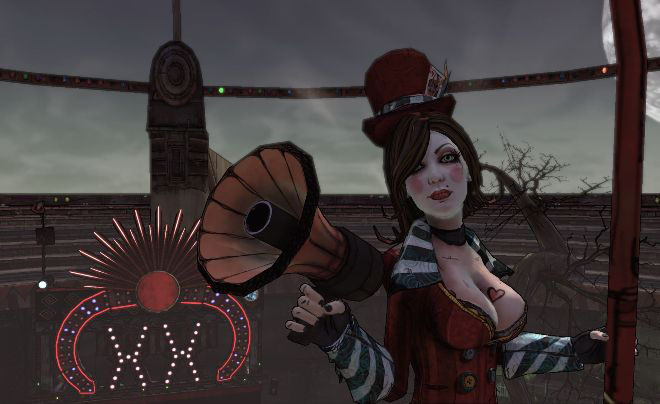
I really would like to meet Moxi and finish this game

Borderlands
I actually played a lot of this and got all the DLC back when it was newer. It's sequel is due soon and i never completed the game, going to see if I can attempt to now. The problem is I really didn't like the core conceit of this game, it's Diabloesque leveling mechanic and gear swaps. Also, it starts off with the promise of exotic and interesting stories and rapidly descends into easily one of the shallowest narrative experiences I've ever seen in a game that could have offered so much more. But I'll give it another try.

F.3.A.R. 
WIll try this one again. I got a couple hours in (which if reports are true is like halfway through the game) before the odd feel of the shooter mechanics began to irritate me, plus the fact that it just wasn't as good as the two prior games. The multiplayer seemed strong though, wonder if its still got any life in it. I could do a whole topic on "forgotten multiplayer experiences."

Homefront
Homefront wanted to be "Call of Duty: The Future" so desperately. It feels very solid except where it doesn't; being such a close imitator forces one to draw comparisons while playing. I got tired of it before because it was so on-rails (much as CoD) but just not as interesting. We'll see if I can finish it. Also curious to see how alive the multiplayer is, there were quite a few dedicated fans on the last time I checked.

Inversion
I only recently got this but I'm including it because I haven't tried it yet except for a brief multiplayer game that felt like I was playing Gears of War with a reskin, and was also not too fun because a single player, either by means of skill or cheats, was dominating the play experience. That said, it being another GoW-like means I ought to enjoy it since I love GoW-likes.

I could do an entire article on the specialized genre of GoW-likes and why most of them fail miserably, especially when they draw too many close comparisons to their parent game. Good example: Spec Ops: The Line is a GoW-like that works well and doesn't draw comparisons. By contrast there is Quantum Theory, which was a horrible game, and played like a badly hacked version of the Gears of War code with pathetic low-rez reskins. So I'll be curious to see where Inversion falls in this range.

My name is Alex Mas...no wait, different game. If this guy ends up being names Marcus, Alex or Mason I will ragequit I swear!


*One might ask why I don't take two-weeks' worth of free time and dedicate it to some decidedly decent games, or even games which I frequent regularly anyway. The answer is easy: much as with films there is an entire fanbase who love B movies and all the glorious badness they offer. The same can be said of games, although with the caveat that I don't generally enjoy games which aren't at least playable. Nonetheless, there's something really amusing about playing....say....Red Faction: Armageddon and noticing the painfully bad dialogue moments or incredibly gaping plot holes. As an example, toward the end of the prequel mission, (spoiler alert not that anyone cares) you end up losing the last great terraformer after Darius learns that the wounded soldier he talks to earlier wasn't really the wounded soldier at all, his boss informs him, while reminding him that they are the only two good guys around. It was pretty amusing because near as I could tell someone writing this must have thought it was quite clever to throw this bit in, despite the fact that it really made the hero look like a knuckle head (an impression that sticks from there on out) and also lead to the fascinating question of how the lead bad guy, by context, must have gone through some interesting efforts to fake being a wounded soldier just so he could punk Darius. I mean, when we see him next, he's in his evil bad guy garb blowing up the terraformer....which means he had to take off his soldier uniform, which he probably wouldn't have been wearing anyway, right, since the base was swarming with goons who would shoot someone in such a uniform, right?

Come to think of it, I'm not even sure why the hell they were all in there fighting each other anyway. Or who the guys with the extremely inflexible spiked armor were, or why they all knew Darius by name and on sight (and even when he wasn't yet directly visible). Talk about living down a family legacy....!

So yeah. The introduction of an alien invasion from Mars's Core (did I mention RF:A is another GoW-like?) is probably a good turn for this game.


Tuesday, September 11, 2012

Warlords of Lingusia Index


WARLORDS OF LINGUSIA INDEX
I'll provide a permanent link to this post, and collect links to each Warlords Era article as I put them up.

First up, the new Golmadras Articles (and one older scenario set in the region):

Advanced Warlords of Lingusia: Golmadras

A gazetteer and map of Golmadras

The Fearsome Four

Four NPC Adventurers in Golmadras

The Lair of Gug and the Lost Shrine of Degalthor

A C&C statted dungeon adventure set in western Golmadras

Of Additional Interest for the Warlords Era Campaign (from what has come before):

Senempar, City of Shadows

The northern Hyrkanian City-State of Men and Monsters

Orcs of Lingusia

Playing orcs (Pathfinder stats) in the Warlords Era

The Dream Temple of Skaeddrath'Akall

A weird multiplanar temple in the Warlords Era

Origin of the Endreti Trolls of LIngusia

The strangest secrets of Lingusia's trolls

Zaidan's Blight

A plot seed I never finished in the region of Halale Woods, Octzel

An Explanation of the Many Ages of Lingusia

Buried here in this post

Lingusian Social Ranks

Although intended for the "Ages/Empire" Era this article works for the Warlords era as well.

AGES OF LINGUSIA INDEX

This material constitutes a complete campaign set in a specific time period of Lingusia (1,950-1,960 aw) about 1,500 years before the current content in the Warlords era. All of this material is fairly system neutral, but any stats are aimed squarely at 4th edition (with some exceptions). The links in order for this "timeline" campaign are as follows:

Introduction to Ages of Lingusia: The Empire Era

Maps of Octzel and part of the Middle Kingdoms in the Empire Era

(I thought I had posted more maps than that. Hmmmmm.)

Gazetteer of the Empire Era

The City of Kymir

The Heartland of Octzel

Guilds, Cults and Societies

Languages of Lingusia

Kindred of the Empire Era

Dwarves in the Empire Era

Elves of the Empire Era

Fey Kindred

Lawful Kindred

Neutral Kindred

Chaos Kindred

Ghuls

Orcs in the Empire Era

Werebloods and Planar Races

Amazons of the Empire Era

Serpent Men and Naga

Scalykind

Mishrag and Other Minotaurs

Trolls of Lingusia

Sherigras

Monstrous Kindred of Lingusia

Gods and Myths in the Empire Era

Overview of the Empire Era Deities and Pantheons

Gods of the Middle Kingdoms I

Gods of the Middle Kingdoms II

The Elvish and Dwarvish Gods

The Dragon Gods

The Eastern Gods

The Amechian Gods

Chaos Gods of Lingusia

The Death Gods (a very popular article)

Dead and Forgotten Gods

Lingusian Social Ranks

The Planar Realms of Lingusia

Villains of the Empire Era

Heroes of the Empire Era

Campaign Ideas

Scenarios and Plot Seeds

The Caves of Chaos Level 4

The Caves of Chaos Level 3

The Caves of Chaos Level 2

The Caves of Chaos Level 1

Swords & Wizardry / OSR Rules for Ages of Lingusia

S&W Adaptation Article II: Lawful Kindred

S&W Adaptation III: Chaos Kindred

S&W Adaptation IV: Neutral Kindred

S&W Adaptation V: New Combat Rules

The Fearsome Four: Four NPCs for Golmadras in AD&D


The following adventurers will be portrayed in the snippets and short tales of adventure and danger as the lands of Golmadras are explored. Each is a noteworthy traveler and explorer of Golmadras, and can serve as NPC encounters or a potentially friendly (or hostile) adventuring party in the dark, wooded dominion of the Final Lands. 

Caveats: I used the stat-generation method V in Arcana Unearthed and assumed everyone started with maximum hit points at level 1, then rolled for it thereafter; each time hit dice are rolled the option is available to reroll but the second result must be kept-an old house rule of mine that goes back ages.

So we have:


Corlance dann Veraskon, a human knight of the southern Octzellan kingdom of Valance. He was formerly of the Order of the Southern Crescent out of Pheralin, but left on a journey to earn his noble title (dann) as a knight errant, aiding the poor, defenseless and needy. Corlance chose the most difficult and demanding task imaginable, in the name of his goddess Enki: the forsaken lands of Golmadras. Aware that his survival in that land depends on a measure of will and trickery, he has arrived anticipating the need to be discreet about his identity. Not long after arriving he was nearly killed by a rabble of drunken templars in the service of the Shadow Temple but was saved by the timely intervention of Syberis Darkmoon and her short ally Quentin Chance. He later made friends with lacuna Helbyrn, who he attempted (and succeeded) in beating at a drinking contest, earning a mild amount of admiration from her at his tenacity. The four have been traveling since, and Corlance plans to see the ruins of Thystivianen next (naga and lamia be damned).

Corlance dan Veraskon, human male Age 22, lawful good Paladin Level 1, native to Pheralin, Valance; STR 14, INT 14, WIS 18, DEX 11, CON 18, CHA 17; HP 12, AC 4; +4 Magical Attack Adj; +30% reaction Adj.
 Paladin Features: Detect Evil 60’ at will, +2 on all Saves, immune to disease, lay on hands 1/day for 2 hp/level, cure disease 1/week, protection from evil for 10 feet (constant);
Languages: Middle Tongue (common), Golmadran, Elvish, Orcish
WP: bastard sword, long sword, battle axe; NWP: Riding 21, Direction Sense 19
Gear: Bastard Sword (2D4 S-M; 2D8 Lrg; THAC0 20); chainmail and shield
XP Earned: 120


Syberis Darkmoon is an ashtarth (drow) dark elf  and the youngest daughter of house Plagistron, though she does not advertise this. House Plagistron is a ruling figure in the northern city of Senempar, but she fled from that dominion years ago after an altercation that led to a call for her execution. She has since made her home in Golmadras, where a dark elf on the surface is a common sight. She provides guidance to foreigners  visiting the land to help them avoid coming into conflict with the oft-times draconian local laws. She is also a remarkably good fence and pickpocket.

Syberis Darkmoon, dark elf female Age 74, chaotic neutral assassin/magic-user Level 3/2 , native to Senempar; STR 16, INT 17, WIS 14, DEX 17, CON 11, CHA 10; HP 13, AC 3; +1 damage adj;+2 reaction/ missile attack; -3 defense; Spells/Day: 2 level 1 spells
Drow Features: +2 save vs sleep and charms; infravision 120 ft; surprised on 1 in 8; 1/day: dancing lights, faerie fire, darkness 5 ft radius; daylight weakness
Assassin Features: Base Assassination Chance (level): 60% (1), 55% (2-3), 45% (4-5),35% (6-7), 20% (8-9), 5% (10-11); disguise; pick pockets 40%, Open Locks 30%, F/R Traps 20%, Move Silently25%, Hide in Shadows 25%, Hear Noise 15%, Climb Walls 85%, Read Languages 0% ; Backstab X2
Spell Book: Affect Normal Fires, Burning Hands, Charm Person, Comp. Languages, Feather Fall,  Friends,  Identify, Jump, Message, Read Magic, Shield, Sleep, Spider Climb, Ventriloquism  
Languages: Dark Elf (ashtarthic), Middle Tongue (common), Golmadran, Elvish, Orcish, draconic
WP: short sword, dagger, light crossbow; NWP: Weaponsmith 14
Gear: Short Sword (1D6+1 S-M; 1D8+1 Lrg; THAC0 20); light crossbow (1D4 s-m/L; THAC0 18) with 20 bolts; studded leather +1
XP Earned: 4,500/4,950 (+10% XP for magic user only)


Quentin Chance is a sylenic Halfling of the South Shores and a bold adventurer by the standards of his people. Quentin had a profound experience on his fortieth birthday when a gypsy woman of the Avernan Nomads read his fortune and proclaimed that he would die in the comfort of his own home, unexpectedly. He decided to thwart death by marching off into adventure, to become a roaming nomad of sorts (counter-logical thinking being common among the Chance family) and has prided himself on his adventures ever since. He took a liking to Corlance when he first met the knight, and has followed him ever since as a loyal companion. Prior to meeting the paladin he had become enamored with Syberis Darkmoon who found him a useful ally when it came to scrounging a living the rough and dirty way she was used to.

Quentin Chance, Mixed Blood Halfling male Age 44, chaotic good fighter/thief Level 2/3 , native to the Golmadran Coast; STR 15, INT 7, WIS 16, DEX 12, CON 18, CHA 17; HP 21, AC 7; +2 Magical Defense Adj; +30% reaction adjustment
Halfling Features: +5 save vs rods, staves wands and spells; +5 save vs poisons; 30’ infravision; surprise 1 in 4 (or 1 in 2 if door opened)
Fighter Features: specialization (scimitar; +1 attack, +2 damage; 3/2 attack rate)
Thief Features: pick pockets 45%, Open Locks 38%, F/R Traps 35%, Move Silently32%, Hide in Shadows 35%, Hear Noise 20%, Climb Walls 92%, Read Languages -10% ; Backstab X2
Languages: Golmadran, thieves cant
WP: scimitar (sp), dagger, short bow; NWP: animal trainer 16, fishing 15, boating 17
Gear: Scimitar +1 (1D8+3 S-M; 1D8+3 Lrg; THAC0 19); parrying dagger (1D4 s-m; 1D3 Lrg; THAC0 20); studded leather armor
XP Earned: 3,500/3,500


Lakuna Helbyrn is a human woman in her late twenties and a former Royal Guardsman of the Imperial Court in Golmadras who once went by the name Aerys Daion. She was cast out after an altercation that led to the death of her commanding officer, but for reasons unknown the Emperor himself intervened in what was ordinarily a death sentence, instead stripping her of name, rank and status and putting her on the streets. Lakuna adopted the name of the legendary warrior woman who was written about at length by the historians during the fabled War of Strife in old Imperial Hyrkania, for her prowess at laying low a balor summoned by the old armies of chaos, and she claims that her ancestry can be traced back to that very warrior so long ago. In any case, she encountered Quentin and became good friends with the scamp, reluctantly agreeing to assist his new friend Corlance in an exploratory journey of Golmadras under her assumed identity.

Lakuna Helbyrn (formerly Aerys Daion), human female Age 31, lawful neutral fighter Level 2/3 , native to the Golmadras; STR 16, INT 9, WIS 10, DEX 15, CON 16, CHA 18; HP 45, AC 2; +1 damage adj; -1 reaction/defense adj; +35% reaction adjustment
Fighter Features: specialization (two-handed sword; +1 attack, +2 damage; 3/2 attack rate)
Languages: Golmadran, thieves’ cant
WP: two-handed sword (sp), dagger, long sword, long bow NWP: Blind-Fighting, Riding 13, Swimming 16
Gear: Two-Handed Sword +1, +4 vs. reptiles (1D10+4 S-M; 3D6+4 Lrg; +4 vs. reptiles; THAC0 16 or 12 vs. reptiles); long bow (1d6 S-M/Lrg, Rate of Fire 2/rnd; THAC0 18) and a quiver with 30 arrows, invisible splint mail +1 (may grant an additional +15% bonus to reaction rolls)
XP Earned: 9,900 (+10% XP bonus)

Monday, September 10, 2012

Love This Giant Download and free copy of "Who"

More precisely, love David Byrne's and St. VIncent's new album, which I linked the video to "Who" a couple days back. You can go to the website here for a free download of "Who" if you liked it, and the album is officially available tomorrow (or today if you buy now).

The video sold me, although I've always been a Byrne/Talking Heads fan. Throw a little light-hearted "David Lynch tries for comedy" into the video and watch my money magically depart my wallet into yours. Walla!


Ah, music. Reaffirming that my circle of fun isn't 100% dominated by D&D and Mass Effect.

Monday Recap

My ME3 multiplayer handle is docfuturity

No column, article or game content today...hopefully by this weekend I will have some time to sit down and write a new series of articles that tie into the existing projects, including the Golmadras articles for AD&D and the Sarvaelen series for Legend/RQ/BRP. I might even try to do some new material for Chirak, or post up some existing content I've had lurking about.

This weekend I had a couple modest milestones in the world of video gaming: two single-player campaigns I had been slowly working on over many months (a few minutes here and there) at last concluded: Quake 4 (one of the last of the "old school" shooters or one of the first of the new school, depending on how you look at it) and Modern Warfare 3.

This was my second play through on Quake 4 (the first was back on the 360 when it first came out). I think I enjoyed it more now, but it was interesting seeing how the game has aged, and also how id's old school shooter design still resonates. It was funny playing a game again with health and armor counters, healing through health kits and armor pieces, and a metric ton of ammunition randomly scattered about. I don't know whether finding a health kit in the heart of an alien empire or a regenerating health meter is less realistic anymore....with shooters, you sorta go with whatever your audience will ignore for the sake of a good time, I guess.

I know it's a bit late to talk Modern Warfare 3, but I have to say that I can't tell if the MW3 single player campaign was just unusually lackluster or if the Call of Duty formula (it's very, very formulaic) is starting to wear thin. I still enjoy the multiplayer (well, to be fair I enjoy the component of multiplayer that lets you play solo) and the black ops and survival missions are a lot of fun....but the resolution of Price's tale of endless vengeance against Makarov felt just a bit drawn out here. I look forward to a future Call of Duty from Infinity Ward that is not about Russians invading the US and Europe, or how the only guys in the world capable of surviving for three whole games are British Special Forces units gone rogue.

I mean, it seems to me that China or even the Middle East would be a better fit for a Modern Warfare title right about now...

I'll make a prediction, though: a future Call of Duty title will be highly futuristic, maybe even Mass Effect style futuristic, and will take place in Spaaaaace....! And I would be very happy if they did something like that, actually.

Either way, I had to finish MW3; after blowing through Spec Ops: The Line I sort of felt obligated to scrub the grime away with a clean, white-washed game. I admit, though, Price and his motives (even his allegorical name) looked a lot more suspicious in light of playing Spec Ops....

"I got your Heart of Darkness right here. Where my boot is. Up your arse."

I picked up Mass Effect 3 for the PC over the weekend and am glad I did. I don't know why but the multiplayer experience is a more solid and generally better experience on the PC, and I am surprised to say that I am enjoying it more using a mouse/keyboard for controls than the Xbox controller (for whatever reason the Mass Effect series on PC doesn't allow for controller use). This is not the norm; usually third-person perspective titles are generally easier to manage with a controller, and tend to be optimized for the experience (I tried Spec Ops: The Line both ways, for example, and found it much easier to manage with the controller than the keyboard and mouse).

Anyway, having a lot of fun with that....more so even than with the conventional MMORPGs. I want do delve more deeply into Guild Wars 2, but I spent the weekend in a state of mind where playing MMOs started to feel draining. I played a fair amount, in short spurts....but a fair percentage of play time was really "standing motionless" as I'd get the boy to lay down for a nap, then go to play, find myself tired as well and go nap. Or he's wake up. Or it was time to cook. You name it. But I did get a few hours in on both.

Overall Guild Wars 2 is a more interesting and engaging experience but I was put off by the early release crowds. It's difficult to explain, but the short version is its possible to be in a public quest like, "Help the farmer walk over here" and have 120 people all escorting him at once while demolishing menacing spiders you can't even see on screen....so I decided to wait a while and play when the crowds thinned a bit.

I was about to run out of time on Rift and decided to play it a bit, see if I wanted to continue. I extended my time a month, and then sunk a fair amount of time into my Bahmi rogue. What I've noticed about Rift is it's a very rich game, lots to do, in a Wow-esque way, and the rift events and invasions add a special dynamic element to it. But after I hit my early level 20's (past the point at which the game is free to play for everyone) regular players get sparse. Moreover, the grindy element of questing gets noticeable when they keep sending you to roughly the same area over and over, which may be why a lot of people say they like all Rift has to offer, except for the soloing. The game can play like this for hours: find quest hub town, gather 3-5 quests in area, do those quests, come back and turn in, then get 3-5 more quests at the same hub for the same region. Over and over.

So I think I'll continue with Rift....but only because my slow pace on the game makes it less intolerable. It's a game I can play for 1-2 hours and feel satisfied about, but if I tried grinding it for a really long session I would find it tough to stay interested (or awake, judging from my efforts to do exactly that this weekend). In the meantime, I may play a lot more Guild Wars 2 soon, but I like that I can enjoy that game (with its buy-once-play-free model) forever and ever. WIll enjoy more GW2 just as soon as the new player mobs thin a bit and I can see what's happening on screen!


Friday, September 7, 2012

AD&D vs. 4E


I started a new 4th edition campaign for Wednesday nights (first session should be done and over by the time this sees print) after a year's absence. After three Pathfinder campaigns all reaching high level play, with two of the three now effectively concluded, I am ready for 4E again. I have been reminded of what I liked about 4E and what it did to repair or fix issues with 3rd. I'm also ready to play 1st edition again, and even 3.5, but more on that later! For now let's just say I've had an epiphany that I happen to really like each edition on their own individual merits, and find it very hard now to play favorites.

As I am also busy reading AD&D again, its impossible not to compare where 1st and 4th edition are philosophically and ideologically different, as well as where they are occasionally united. I'm one of very few people out there who feel that 4E was a good spiritual successor to classic D&D, and as I read through the AD&D tomes I can see both why I feel that way and also see compelling reasons for why so many find them to be diametrically opposed. Anyway, I'll have to give it some thought, starting here and with more to come.

A few minor observations so far about points where the two editions diverge wildly:

1. AD&D was very much opposed to experimentation with non-human races (while still leaving such decisions to the DM). 4E embraces this and empowers and encourages the player to experiment (while also discouraging the DM from limiting race options).

2. AD&D focused tightly on keeping the mechanics on the DM's side of the screen as much as possible, to the extent that no single rulebook gives you the whole story (PHB vs. DMG). 4E is the opposite, placing a great deal of mechanical control in the player's hands. The DMG provides building tools and advice, but doesn't contain any play mechanics (to be fair it's been this way since 2nd edition).

3. AD&D has a lot of randomization and probability at play. 4E is generally focused on precision and a design that encourages specificity; encounters are built, items are chosen according to what works best for the players and not randomly (for the most part), and so forth.

4. AD&D's randomization can lead to swingy characters; you can theoretically roll up an amazing PC, get lucky and gain psionics, and get even luckier with high hit points. 4E contrasts with precision in numbers: you rarely have uncertainty in the values of what you're about to attain. In exchange, however, the system practically guarantees a decent character...effectiveness is baked into the rules.

Now, to be fair 4th edition can support (and even offers rules for) some randomization, as during its development cycle it became clear that many people wanted an element of chance in the game. You can still roll for stats, you can use randomized treasure parcels, and you can build wandering monster tables in 4E just fine (and the rules provide for it). However, 4E's nature by design encourages structure within those random limits: your character's random stats can be re-rolled if they fail to meet certain minimums, treasure parcel rolls still lead to item selections within level and party appropriate suggestions, and wandering monster charts are more complicated in 4E if only because the rules assume you will try and build challenge-level appropriate random encounters. You don't have to by any stretch, but the game's focus on scaling means a more holistic old-school approach can lead to some messy TPKs (or even worse, prolonged battles of attrition).

You can also view player vs. DM agency in 4E as being about "the DM is in control" but with the caveat that, "the rules provide for all, and are meant to be understood by all." In contrast to AD&D this is remarkably different. I think 4E (and 5E when it arrives) are by virtue of D&D's ubiquity in today's gaming culture forced to adopt this posture, because players and DMs alike are all too savvy, too familiar with the mechanics and structure of RPGs today. AD&D was unique in its power to separate player understanding from DM control, because back then the hobby was young and many, many people played the game straight up and without a good understanding of what was going on behind the DM screen.

I like to always drag out Call of Cthulhu as my example of a game that has fundamentally changed over time not due to edition changes (as it has changed little over six editions) but because everyone is either familiar with it or has read Hello Kitty meets Cthulhu. Or, to put it another way, in 1983 when I discovered Call of Cthulhu I could run games that shocked and surprised my middle school cohorts. Even in 1990-1995 in college it was possible to do this. Today, it's actually kind of difficult to find people willing to play CoC who haven't either drunk from the Lovecraft firehose or who think they know what Cthulhu is because they shopped at Shanna Logic once or played CthulhuTech.

So put another way, D&D's current editions can't separate "what the DM knows and controls" from "what the player does and knows" anymore...or at least not easily, and not in a "forbidden knowledge" way like AD&D did it.

The 4E conundrum in item 1 mentioned earlier is an interesting one, and I want to talk about more at length in the next column, but I'll put it this way:

AD&D has expectations for what it's world looks like (which is very Tolkienish, even if Gary doesn't like to admit it in the text). A great deal of work goes into enforcing why this should be so, and the discussion of alternative player races pulls out my favorite straw man argument (player who wants to play a dragon or demon) to suggest that no player wants to be a monster for purposes other than power. It says a lot more about Gary's games and players, I think, as well as the notion of power gaming back in the late seventies than it does about role playing games and D&D as it was shaping out to be. But beyond that Gary does aknowledge that some players may just be experimental, and wraps up with a "it's your table, you decide" approach.

Cut forward to 2008ish and 4E arrives, acknowledging the endcap of what's been going on since Unearthed Arcana in the 1st edition era, the Complete Humanoids Handbook during 2nd edition, Savage Species in 3rd edition and is more or less baked in to the PHBs in 4th edition: players like playing weird things. 4E's philosophy of "a universe where all races are permitted" is a flaw, however, which vexes DMs aiming for specific flavor. But that's another issue entirely.

What's interesting about 4E is that it allows for a range of races, which on the surface seems contradictory to AD&D's premise of "don't let them do it," but that's only half the story. AD&D's actual suggestion is more correctly, "Don't let them do it to be power gamers, but if you've got players who are genuinely curious about running creature X feel free to let them do so and see how it feels for your game." Which is actually exactly what 4E does, ironically. And in fact 4E designs race building in a fashion that both encourages experimentation and prohibits power gaming by design. So...maybe #1 is out the door, after all...

Then again...

My latest 4E campaign has the following lineup: a gnome artificer, shadar-kai spellsinger, shardmind blackguard, dragonborn hybrid paladin/sorcerer, dwarf runepriest, and satyr skald. Not one human among them. I was joking with the group that the only plot lead-in I needed was "the circus has come to town."

It's not hard, I suppose, to imagine why some people might look at their 1E AD&D experience, contrast it with the average 4E experience, and find it difficult to draw comparisons!