Showing posts with label review. Show all posts
Thursday, July 14, 2016
Ghostbusters (2016) Two Reviews!
Review #1 (from my son), kinda goes like this:
1. Remind dad of the Movie Rules (no noise, no jumping around, no being a pest, etc.)
2. Proceed to dance in seat at Ghostbusters theme
3. Realize we are watching Ghostbuster Girls!!!!!!
4. Oh, let dad know we are now playing Ghostbuster Girls
5. He is the smart one with the hair and the positron collider
6. I am the one with the other hair and the twin pistols
7. Is that Staypuff Marshmallow Man? No he's just a balloon! There he is! No that's the Ghost ghost!!!
8. Stay through credits dancing
9. Go home, making sure Ghostbusters theme is playing in car. Once home put on play positron collider pack, and hunt ghosts all night long.
10. ...and the final, telling sign he liked it: go to Google Play store and load Every Single Free App with Ghostbusters In The Title.
Two ghost guns up!!!!
Now for Review #2. My review sort of goes like this:
This was an incredibly entertaining movie, and a real pleasure to watch in a theater not at all crowded...apparently everyone attending this evening was either not in touch with the internet, maybe not even in touch with contemporary nerd hate culture, or defiantly going to see the movie like me because my son frickin' loves Ghostbusters.
I was never a "huge" fan of the original movie...I gradually grew to like it more later on, especially once I lightened up a bit and decided it was okay to have a comedy film borrowing quasi-Lovecraftian theatrics in a humorous manner. I didn't see the second movie until years after it's release, and it was just "okay." So watching this movie....for me, it's actually technically as much or perhaps even more fun than watching the originals, because I was here enjoying it purely on its own merits, and also because I was enjoying it from the visceral perspective of a father who has a son who is really, really in to Ghostbusters.
As anyone knows, when it comes to movies your kids are in to they generally fall into two categories:
Movies the kid really wants to see, and if you're lucky its a Pixar film with some wry hidden adult humor to keep the parent from going mad
Movies the parent really wants to see, and you justify it by telling yourself that your kid is more developed and smart and adjusted than most, so it's totally okay to take him to see that PG-13 movie.
Every now and then, though...you get lucky and find a movie where both kid and parent are delightfully entertained by the medium. Ghostbusters is one of those movies (so is the original....once I got my 1990-era hipster stick out of my butt, anyway!)
Five fun facts about this movie:
1. All the key players from the original have cameos hidden in the new movie, and some incredibly entertaining ones at that (Murray is the best! Aykroyd and then Weaver are close seconds)
2. This movie is only possible because geek culture now has women in it as a norm. Seriously....when the original Ghostbusters came out, despite there actually being geek women in the world, it was not considered at all proper for pop culture Hollywood to depict women as being in the least bit in to this sort of thing....and indeed it was just generally a "no no" in practically all facets of culture. Except in SciFi fandom, restricted to conventions. But on TV, or a big screen movie? Big no no.
3. This is an homage, reboot and kinda-sorta sequel wrapped up in one. I am not 100% sure why they went this direction....a "direct sequel, 30 years later" would have worked just as well, but they chose to go this route.
4. Chris Hemsworth was really damned funny, too. All of the key actors were funny, but Chris's role as the pretty but dumb receptionist was really amusing.
5. Kate McKinnon needs a movie that really lets her take off. I can see her in a Red Dwarf reboot, just so ya know...
Anyway! If you're not one of those people who pre-judged the movie long ago, I suggest you see it. Very funny, a great homage and pseudo-sequel with a lot of humor and the effects were actually pretty cool. Is it better than the original? I think objectively from my perspective they are roughly equivalent, with the caveat that the original has some venerable stars who be definition made that movie one notch greater than the remake....but the new Ghostbusters is head and shoulders better than the last sequel, and honestly damned funny and just plain fun.
And whodda thunk, another movie that comes in under 2 hours and somehow told a great, focused story! Wow!!!!
Ghostbusters get's a solid A for me and an A+++ from my son, judging by how hard it is to get him to go to sleep now.
Addendum: my diatribe on the inversion of men and women in the Ghostbusters franchise
Face it: had I not had a son who is so into Ghostbusters (and a wife who wants to see it too) then I probably would have waited until this movie was in the dollar theater, or maybe a discount priced Blu-Ray. Not because (as with Warcraft) I really wanted to see it but was afraid it would suck, but because I kinda like the Ghostbusters franchise but only in the general sense that I like lots of movies...so no driving impetus for me to see it other than free time and availability for the right price. But by coincidence it turned out to be more fun (for me) than I expected...and maybe even more so due to the fact that the general fan backlash prior to the film releasing told be there was probably something here more interesting just on principle. What I feel I got was less a "wow, amazing Ghostbusters movie" experience and more of a "Wow, we live in a time when four geek women can be the leads in a film like this that engages with the whole audience." That was pretty cool imo.
Or think of it like this: I am very proud that my son is (at least for now) able to have fun playing "Ghostbuster Girls" where he's just as cool being a female character in play acting as he is being Venkman or something. I felt the same way when he tells me he's Finn and I'll be Poe Dameron. It's a sign of the times as I see it that these normatives are not perceived as strange. When he's in grade school I expect the crushing weight of society's norms to barrel down and annihilate his sense of innocence on this, but for now it's just really damned cool. This does, in a sense, make it sound like the "all women cast" of the movie was more important in that way, but really it's the opposite....this movie effectively made it perfectly normal to have women in this role without casting a light on it. They were there just because it was totally okay for women to have lead roles in a fantasy action flick, just because it worked well, and not as a lampshade event. I really liked that. Stuff like this translates well to the next generation, for whom the idea that dad grew up in an era when the only female lead (Weaver) was allowed to exist as a foil for Murray to get the girl thanks to his geekishly hip and ironic charms, to thirty years later when the film can exist in a world where four women who are not there to be sex objects or the foil for men can just do their stuff busting ghosts. That right there? ...it really was cool. I can't wait for Star Wars: Rogue One for this reason, either.
Tuesday, August 25, 2015
Fantasy AGE capsule review
If you've been waiting for your pre-orders like I have, then know that they will be arriving soon. My FLGS got my copy of Dragon AGE in and it's a really amazing looking book...like, a coffee table art book sort of deal, the kind you leave around so people can ooh and ahh at it.
Fantasy Age is slimmer and more utilitarian, but it also looks very playable, and is also gorgeously laid out. Alas, my copy is a 1st printing and has the "interlligence" printing error on the character sheet.....but that's okay, they've got one here that's spelled right. If you don't mind the typo there's a form-fillable version here as well.
Fantasy AGE is hitting at the right time. The market is ripe for mechanically easier game systems that still have some meat on them....people like systems that offer interesting choices but don't require excessive rigor. Fantasy AGE also caters to a slightly different sort of fantasy from D&D, while still being very familiar.
Characters start with nine ability scores with a -/+ modifier from -2 to +4. You have six core races to pick from as well (human, elf, dwarf, gnome, hafling and orc). FAGE adds social class and background rules designed to support a wide array of settings as well; you figure out your social class and then an appropriate background (i.e. merchant, pirate, soldier, performer) out of 24 available choices.
After that, you've got your class. There are three classes in FAGE: mage, rogue and warrior. Each one provides rules through level 20, along with optional specializations (such as mage hunter, assassin or berserker), of which there are twelve. You can also get a focus for a really good ability score. Talents (FAGE's skills) round out the character options. Mages can also gain access to spell arcana, of which there are twelve (each arcana encompasses a handful of spells related to the arcana type).
The gamemaster section includes about 20 pages on how to run the game, 7 pages on magic items, and a bestiary section with fourteen adversaries provided. It's missing a conventional monster/animal list....no wolves, for example, but does provide some good starting points for GMs. While a Fantasy AGE campaign isn't as likely to be focused on the slaughter of monsters as D&D tends to be, you'll probably find yourself wanting to pick up the AGE monster supplements on RPGnow.com* or cribbing beasts from Dragon AGE until a more robust bestiary is released. Also worth noting is the Midgard Bestiary has an AGE edition*. Those resources ought to hold us over until a proper Bestiary is released.
Wrapping up the book is a short section on world building and a setting/adventure location to get you started. All told, for 144 pages it's a nice, compact set of rules with plenty of meat. If you can sustain yourself on the meager adversary offerings you'll be okay --for a while.
I haven't seen the Titansgrave module yet but expect to have it soon (ordered it via the FLGS). I do happen to have all of the AGE System PDFs Green Ronin offers, and for the price they are worth it if you are in to the system.
Five things Fantasy AGE does really well:
1. The stunt system. It's a dynamic combat mechanic that is only rivalled by Runequest 6's combat system.
2. Lot's of flexible character design features. You can make a lot of interesting characters in this system, but it remains focused and easy to roll up new PCs. While it has only three classes, the dozen specializations, numerous backgrounds and talents/focus rules make for a wide range of character options.
3. Emphasis on the fantasy tale vs. just monster killing/dungeon crawling. To be fair, D&D 5E (for example) provides lots of tools to do all sorts of cool stuff, but then limits the bulk of it's XP system to slaying things. FAGE provides a more well-rounded experience as part of its core design.
4. Ease of play. It's all about six sided dice, and the game has some very clean math in my experience.
5. Gorgeous, readable book! This is harder to achieve than it sounds, but Green Ronin really knows how to produce a nice looking, easily accessible tome.
Some downsides:
1. The "interlligence" typo is indicative of a few such editorial gaffs. On the plus side maybe the already-planned second printing will fix these issues.
2. It really needs more adversaries as well as more conventional beasties statted out in the core, or in a bestiary hopefully out yesterday. But with the PDF and Dragon AGE resources out there you can make do for now.
3. This is still definitely a "basic book" in the sense that it gives you enough to run with the game (a lot more than the D&D Basic Rules, to contrast) but after a year of using these rules I bet I'd start wishing for some follow-up material. I am confident Green Ronin has plans, though.
EDIT: I've bounced around a lot on what system(s) to use for my Sarvaelen (Watchers of the Sullen Vigil) setting....now thinking Fantasy Age might be the best fit....hmmmmm!
*All of the old AGE System documents are directly compatible with Dragon AGE but need minor conversion to Fantasy AGE, which uses some slightly different ability score names, and the combat skills (formerly dexterity in DA) is now split between accuracy and fighting scores. Abilities and attacks seem to mesh fine, however. Hopefully Green Ronin will think about releasing Fantasy AGE -compatible editions of these prior works that require no effort at conversion.
Thursday, July 9, 2015
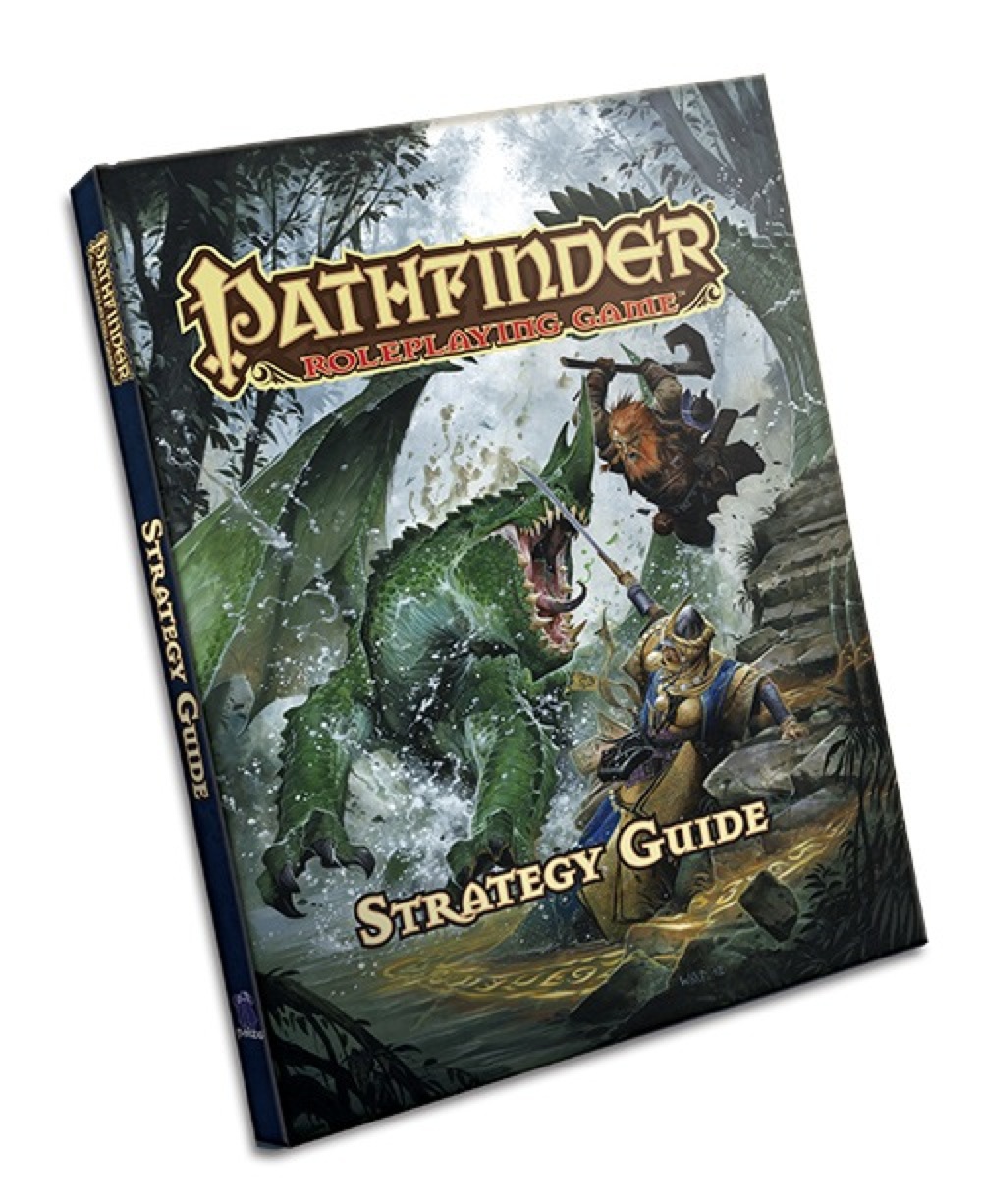
Looking at the Pathfinder Strategy Guide
This is going to sound odd, but I'm still reading Pathfinder books, and even collecting them. Yes, I got rid of a significant chunk of my Pathfinder collection....and yes, I have implied or outright stated I don't plan to run it again (but I said the same thing about virtually every edition at one point, so whadda I know). I've suggested that the elegance of D&D 5th edition has arrived and replaced Pathfinder, which was merely a placeholder in fantasy gaming for the Big Dog's return. But....well....I am thinking I will be running it again, and it does have a place. It's nestled at the top of the food chain in terms of "D&D likes," reveling in it's mechanical complexity, with only Fantasy Craft and D&D 3.5 nesting alongside it. There is no greater edition of D&D out there right now for mechanical rigor and tactical focus, and since I've had over a year away from the game now I have found time to restore my old appreciation for it.
I doubt I'll get to run it much, mind you, because D&D 5E is so damned easy to run as a DM it's hard to want to look elwhere....but books like the Pathfinder Strategy Guide actually make me want to at least play it, even if only as a player. I had fully expected this book to be a terrible slog through esoteric tactical advice, weird new rules, detailed explanations of system mastery and mechanical rigor to extremes only delusional internet fanboys could conceivably imagine....clearly a sign I've been hanging out at certain forums online too much. In reality it's a wonderful beginner's book, an effort to create a sort of "Idiot's Guide to Pathfinder" without actually calling it that.
The Strategy Guide gives you literally everything you need to understand a given class and all its choices through level 20, talks about different features of Pathfinder games and RPGs in general with tips on how to role play in different contexts and environments....advice good for any D&D or Pathfinder game, to be honest. It is presented in a clean, friendly format with lots of layout styles cribbed from the Pathfinder Beginner box....indeed, this book could be regarded as an excellent second step from that book (though it does not subsitute for the Pathfinder Core Rules).
It's just really, really neat. I want to have this available to hand to my players who need help. There are at least two at my table right now who could use the general advice.....and if I run Pathfinder it really looks like a necessity for my table, already. I did not expect that.
We get really used to playing with old vets, seasoned "system mastery" specialists, min/maxers and the whole specialized lot of 3rd edition era/Pathfinder players, it's easy to forget how many of them are not like the elite. In fact, realizing that as much as I have enjoyed Pathfinder as GM in the past (and sometimes not) I have always been a middling player due to my general disdain for builds and optization....here however is a book which teaches how to play the game, make smart choices, and not feel like you have to jerry-rig the game to get something to wow the table. Who knew?
I'd like to see them make a real GM's book like this now. I think it would be very interesting to see what a Pathfinder GM's Strategies book looks like. The old Gamemastery Guide had some useful content, but nowhere near what this tome does for players.
Monday, March 2, 2015
Reviewing The Order: 1886 - Why it's one of the best games almost no one will like (updated)
I've been playing The Order: 1886 for a while now (I am roughly 5-6 hours in, around Chapter X, so I have about eight more chapters to go, I think; EDIT: finished at roughly 9 1/2 hours. Probably 1/2 an hour of that alone was reading the various newspapers in the game). Before I go any further let me clear up some general misconceptions of the game:
1. Despite the marketing for this game it is not "Gears of War with werewolves." In fact werewolves are only a partial element of the broader story. The GoW comparison...at least for the combat segments, is spot on however (but see below).
2. It is definitely steampunk. Such exquisitely crafted steampunk that it has single-handedly changed my interest in the genre from one of mild loathing to genuine interest in pursuing more info on.
3. It's storyline is actually really well done.* If someone tells you otherwise, take note that their opinions on things like story cannot be trusted. If they say "the story is great but it's all cutscenes and the game has very limited player agency," know that you can trust that person's sense of judgement.
Anyway, if you've read any media on the game you can tell that most people seem to hate the game for various reasons, top three being it's got too many cutscenes, it's too short (assume 8-10 hours for a normal average player**), or it's got too much story and not enough gameplay (one person I read equated it to a Telltale game and I wouldn't say they're too far off in that respect).
However, a few people absolutely love it, especially for the staggering attention to detail the game puts into its world and story and how it weds the two together. I'm closer to this category, but I really do think The Order: 1886 deserves some of its criticism as a game, and here's why:
The Order: 1886 doesn't really know how to actually be a game most of the time, because its developers were too busy crafting an amazing story that they wanted to go a very specific direction. Paper and pencil RPGers know what this is called: it's railroading. In computer games railroads, or rather "on-rails" means you are always going in one direction toward one goal; there's no deviation from the path. In fact a majority of AAA games these days (and many budget titles) are actually on-rails, but they've learned to disguise this fact very well. The Order is no different in this regard. A better term for this is "player agency," which is how much choice the player has in what's going on. Player agency is a big deal in this era of open-world sandbox titles like Assassin's Creed, Saint's Row, Infamous, GTA V and Watchdogs. Going from any of those to a game where your choices can be as limiting as "hit square to not be knifed....okay you didn't hit square fast enough, try again until you do" is damned frustrating.
The Order only has three elements to its structure:
1. Story scenes, which occasionally start to blend with player-controlled events through QTEs (quick time events). I hate QTEs and this is one of the reasons I am annoyed with the game even though I'd rank its story A+++ and it's gunplay a solid A-. There's nothing wrong with the cutscenes in and of themselves...it's like watching an amazing movie with great actors in the best steampunk film ever. It only fails when held up in terms of volume to the other two game play styles below. Because there is a LOT of story in this game.
2. Exploration scenes, where you move methodically through the environment, occasionally finding interesting objects which you can pick up and study in slavish details with very realistic movements. This part is very immersive if you go along with it, and I am frankly amazed at the time and effort spent in rendering some of the items you can find. It shows that they were trying to go for an immersive story which was backed by its environment....and it does work, except for the part about how while moving through these environments you only ever end up going in the same direction, and a lot of players...especially players who bought this game thinking it's a steampunk Gears of War.....will be pissed at the fact that they are forced to walk through this stuff. The tempo of these sequences only works if you're a player who wants to meticulously explore these environments as you go from point A to point B. It doesn't work so well if you don't want to do that....but the game forces you to walk through it all anyway.
Gears of War had this element in its gameplay, too. It was when Marcus Phoenix was walking along talking in his radio. GoW used these moments to preface each action sequence with a 30 second monologue between characters to explain why you were going to be shooting stuff in half a minute, and had to move from A to B. The Order essentially does it for the same reason, but over several minutes sometimes. If you're busy going "wow, I want to read this newspaper and listen to that phongraphic recording" then it works for you. If you could care less.....then you're gonna be pissed.
3. The third and final gameplay element is the run and gun segments, which are tried-and-true cover-based third person shooting, a style of play that has been honed to an art. I can't say much more than that it is very smooth, although so far as of Chapter X there are moments where I wish they'd stop hurling crazed mercenaries for the East India Company at me for a minute like they were suicidal locusts from GoW. Also, I keep feeling like some of the targeting is a bit off when aiming at a guy behind cover with a bit of his body exposed. There are shots that don't work even when they look like they should. Other than that....this part is fine.
So I don't really know who The Order: 1886 was targeting. Fans of story-rich RPGs, Telltale Games and Visual Novels will love element 1 (the story bits). Fans of immersive environments and exploration for it own sake will enjoy item #2 although in truth I don't think they give us enough of this to make it feel like more than a glorified depiction of how well they can render objects and photographs in the game engine (it's very good). And for #3, the part that they marketed to, it's fun but not enough on its own merits...the first two pieces of exploration and story need to appeal.
So they made a game for me, basically....but I don't think I'm that huge of an audience, and judging by the reaction (minding that I'd only pay attention to people who admit to having actually played it....it's shocking how many people out there are trashing the game based on hearsay or from watching a Twitch recording) I'd have to say that if The Order: 1886 has a future, it's going to end up unfortunately looking a lot more like what the general audience wants.
I inevitably look forward to The Order: 1887 now with 200% more multiplayer and an open world London that you parkour through looking for exotic collectibles in exchange for achievements. If I'm lucky they will include a special loyalist edition that lets you cut out the crap and get to the story. That, or they could just make a movie. I'd be down with that.
EDIT: Final Comment on finishing the game: there's a sequence towards the end, when sneaking through lavish English gardens murdering stray East India Company men, that I found myself wondering two things: first, why is my character so bloodthirsty that his only takedown involves a knife in the spleen? Second, why is it I am forced to use a QTE for take-downs and failure means being shot? If I had been given more player agency in this game, I would not have been choosing to murder the guards (even an NPC questions why you do it), because these guys are honestly just hired mooks. That got me thinking that maybe there was something in the narrative I had missed....and in a way there was, as later reveals suggest that the evil at the heart of EIC runs deep. Still, it seemed....excessive....in the context given.
(There's also a moment....SPOILER!!! Big. Huge. Spoiler....where you meet the vile vampire behind all the stuff going on. You only engage with him in a cutscene and a QTE.....but that's okay, because honestly I realized that there was no way they could have done justice to a fight with the vampire in the GoW-based cover shooter system they were using here.)
All those stealth QTEs with a pass/fail consequence were even more annoying than the way Assassin's Creed does it, if you can imagine that! And ultimately its the devil in the details like this which will make or break a game. The Order: 1886 has the best graphics of any game I currently own, and one of the best stories. But they didn't spend enough time making the gameplay just as amazing.
*You know that common complaint that people have when playing Battlefield 4's or Call of Duty's single player campaigns? The one where they admit they have no fucking clue what's going on or why they are going through a given level? That doesn't happen here. You are so involved with the story in The Order that it takes an almost concerted effort at not paying attention or a medical condition affecting attention to be confused about what's going on in this game.
**I'm not sure if the length of time is really an issue. It takes me about 8 hours to finish the original Gears of War, for example....but yes, GoW doesn't have 2-3 hours of cutscenes so there is that. On the other hand I've played and finished GoW four times and I am still not 100% sure what the plot was, whereas I will not soon forget the amazing story in The Order. So....YMMV.
1. Despite the marketing for this game it is not "Gears of War with werewolves." In fact werewolves are only a partial element of the broader story. The GoW comparison...at least for the combat segments, is spot on however (but see below).
2. It is definitely steampunk. Such exquisitely crafted steampunk that it has single-handedly changed my interest in the genre from one of mild loathing to genuine interest in pursuing more info on.
3. It's storyline is actually really well done.* If someone tells you otherwise, take note that their opinions on things like story cannot be trusted. If they say "the story is great but it's all cutscenes and the game has very limited player agency," know that you can trust that person's sense of judgement.
Anyway, if you've read any media on the game you can tell that most people seem to hate the game for various reasons, top three being it's got too many cutscenes, it's too short (assume 8-10 hours for a normal average player**), or it's got too much story and not enough gameplay (one person I read equated it to a Telltale game and I wouldn't say they're too far off in that respect).
However, a few people absolutely love it, especially for the staggering attention to detail the game puts into its world and story and how it weds the two together. I'm closer to this category, but I really do think The Order: 1886 deserves some of its criticism as a game, and here's why:
The Order: 1886 doesn't really know how to actually be a game most of the time, because its developers were too busy crafting an amazing story that they wanted to go a very specific direction. Paper and pencil RPGers know what this is called: it's railroading. In computer games railroads, or rather "on-rails" means you are always going in one direction toward one goal; there's no deviation from the path. In fact a majority of AAA games these days (and many budget titles) are actually on-rails, but they've learned to disguise this fact very well. The Order is no different in this regard. A better term for this is "player agency," which is how much choice the player has in what's going on. Player agency is a big deal in this era of open-world sandbox titles like Assassin's Creed, Saint's Row, Infamous, GTA V and Watchdogs. Going from any of those to a game where your choices can be as limiting as "hit square to not be knifed....okay you didn't hit square fast enough, try again until you do" is damned frustrating.
The Order only has three elements to its structure:
1. Story scenes, which occasionally start to blend with player-controlled events through QTEs (quick time events). I hate QTEs and this is one of the reasons I am annoyed with the game even though I'd rank its story A+++ and it's gunplay a solid A-. There's nothing wrong with the cutscenes in and of themselves...it's like watching an amazing movie with great actors in the best steampunk film ever. It only fails when held up in terms of volume to the other two game play styles below. Because there is a LOT of story in this game.
2. Exploration scenes, where you move methodically through the environment, occasionally finding interesting objects which you can pick up and study in slavish details with very realistic movements. This part is very immersive if you go along with it, and I am frankly amazed at the time and effort spent in rendering some of the items you can find. It shows that they were trying to go for an immersive story which was backed by its environment....and it does work, except for the part about how while moving through these environments you only ever end up going in the same direction, and a lot of players...especially players who bought this game thinking it's a steampunk Gears of War.....will be pissed at the fact that they are forced to walk through this stuff. The tempo of these sequences only works if you're a player who wants to meticulously explore these environments as you go from point A to point B. It doesn't work so well if you don't want to do that....but the game forces you to walk through it all anyway.
Gears of War had this element in its gameplay, too. It was when Marcus Phoenix was walking along talking in his radio. GoW used these moments to preface each action sequence with a 30 second monologue between characters to explain why you were going to be shooting stuff in half a minute, and had to move from A to B. The Order essentially does it for the same reason, but over several minutes sometimes. If you're busy going "wow, I want to read this newspaper and listen to that phongraphic recording" then it works for you. If you could care less.....then you're gonna be pissed.
So I don't really know who The Order: 1886 was targeting. Fans of story-rich RPGs, Telltale Games and Visual Novels will love element 1 (the story bits). Fans of immersive environments and exploration for it own sake will enjoy item #2 although in truth I don't think they give us enough of this to make it feel like more than a glorified depiction of how well they can render objects and photographs in the game engine (it's very good). And for #3, the part that they marketed to, it's fun but not enough on its own merits...the first two pieces of exploration and story need to appeal.
So they made a game for me, basically....but I don't think I'm that huge of an audience, and judging by the reaction (minding that I'd only pay attention to people who admit to having actually played it....it's shocking how many people out there are trashing the game based on hearsay or from watching a Twitch recording) I'd have to say that if The Order: 1886 has a future, it's going to end up unfortunately looking a lot more like what the general audience wants.
I inevitably look forward to The Order: 1887 now with 200% more multiplayer and an open world London that you parkour through looking for exotic collectibles in exchange for achievements. If I'm lucky they will include a special loyalist edition that lets you cut out the crap and get to the story. That, or they could just make a movie. I'd be down with that.
EDIT: Final Comment on finishing the game: there's a sequence towards the end, when sneaking through lavish English gardens murdering stray East India Company men, that I found myself wondering two things: first, why is my character so bloodthirsty that his only takedown involves a knife in the spleen? Second, why is it I am forced to use a QTE for take-downs and failure means being shot? If I had been given more player agency in this game, I would not have been choosing to murder the guards (even an NPC questions why you do it), because these guys are honestly just hired mooks. That got me thinking that maybe there was something in the narrative I had missed....and in a way there was, as later reveals suggest that the evil at the heart of EIC runs deep. Still, it seemed....excessive....in the context given.
(There's also a moment....SPOILER!!! Big. Huge. Spoiler....where you meet the vile vampire behind all the stuff going on. You only engage with him in a cutscene and a QTE.....but that's okay, because honestly I realized that there was no way they could have done justice to a fight with the vampire in the GoW-based cover shooter system they were using here.)
All those stealth QTEs with a pass/fail consequence were even more annoying than the way Assassin's Creed does it, if you can imagine that! And ultimately its the devil in the details like this which will make or break a game. The Order: 1886 has the best graphics of any game I currently own, and one of the best stories. But they didn't spend enough time making the gameplay just as amazing.
*You know that common complaint that people have when playing Battlefield 4's or Call of Duty's single player campaigns? The one where they admit they have no fucking clue what's going on or why they are going through a given level? That doesn't happen here. You are so involved with the story in The Order that it takes an almost concerted effort at not paying attention or a medical condition affecting attention to be confused about what's going on in this game.
**I'm not sure if the length of time is really an issue. It takes me about 8 hours to finish the original Gears of War, for example....but yes, GoW doesn't have 2-3 hours of cutscenes so there is that. On the other hand I've played and finished GoW four times and I am still not 100% sure what the plot was, whereas I will not soon forget the amazing story in The Order. So....YMMV.
Wednesday, October 15, 2014
Rite Designs reaches the 13th Age with 101 Not So Simple Monster Templates
![]() |
| I don't know about the serpent-wraith-lady, but that rakshasa is full of awesome. The come hither pixie lass with her favorite skull is a bit concerning though! |
This crept up rather innocuously on rpgnow.com (and its other drivethrurpg site). Rite Publishing has done a lot of stuff for Pathfinder over the last few years, most of it good or notable as 3PP resources go. This foray into the 13th Age is no exception, and actually the first really cool 3PP resources I've stumbled across that's worth a review and mention.
101 Not So Simple Monster Templates provides exactly what it indicates: one hundred and one templates you can overlay on existing 13th Age creatures. The templates follow the standard set in the 13th Age core rules, which is basically additional features or modifications that enhance or change the existing creature (so, standard D20 system stuff). Unlike some of the existing monster templates in the game, these offer a really wide range of the strange and familiar all at once.
Want a kyton-bound minotaur? Here you go. Are you determined to stat out that homeless, legless beggar? Add the legless template. Eager to take out your party with an exploding manticore? Add the Pyrrhic template. There's some good stuff here.
All of these templates are concise and too the point, except for the ones that are really complicated or offer a lot of specific detail such as the winterwight, walking fortress, grim reaper or bloodshackle templates.
Some of the templates add in some "D&Disms" to 13th Age currently absent or under-represented. If you've been missing crypt things in your game, you can make all sorts of them with the appropriate template. The aforementioned kyton-bound, constructed, divine, phase, and others will fill in needed gaps.
All of the templates offer definitely flavor and make for interesting and distinct creatures....for the right mix of encounter stew, naturally. A few could be the basis of entire plot lines (I'm thinking a kyton-bound template would open up all sorts of interesting denizen concepts for a visit to the City of Chains, for example).
Anyway, if you're a 13th Age junkie like me this is a PDF well worth checking out. I've printed out my copy for easy access at the table in my next planned 13th Age campaign (coming soon!)
Rite Designs has a sample on their blog if you'd like to see a bit for free.
Monday, September 15, 2014
Review of The Void: Role Playing in a Lovecraftian Hard SF Future
A while back I mentioned acquiring The Void, a system from Wildfire available on PDF and print at rpgnow. The Void is a new game system that adopts the Cthonian Stars setting from Wildfire into its own entity (the original was Traveller-based), and is based on a "not to distant future" hard SF setting in which something out in the void is approaching the solar system, and with it comes the horrors of the Cthulhu Mythos to once again descend upon man.
Characters in The Void take on the role of Wardens, solar "rangers" and peace-keepers who have the resources and the need to travel through the habitable worlds solving crimes and espionage, and also dealing with futuristic mythos-tainted X-Files situations in the process. The Player's Guide expands character creation to include all sorts of other background options, as well.
So far I have all of The Void in print, not least of which is because the standard-color print editions are pretty cheap, and this is a fun game with an easy system to learn. My goal is to run a campaign very soon, possibly starting in a couple weeks if I can convince one of my groups to go back to a bi-weekly rotation away from D&D 5E.
Anyway, here's what's out for The Void so far:
The Void Core - the main rules, which give you all the basics. Free version is available, and it's also written as a "open source" set of rules so you can produce content for the game as long as you attribute your sources correctly. I'd like to see someone take advantage of this feature, maybe even myself....
Secrets of the Void - a mess of useful ideas for GMs on the presence of the Old Ones and their influence in the solar system.
Player's Guide - hardly needed if you're just planning on running a couple games from the core about the wardens, but invaluable if you'd like to make the system and setting something you'll revist frequently. Lots and lots of new options for characters.
Horrors of the Void 0: Expanded Horrors - there are only a few monsters in the core book so this is pretty essential, containing a mix of classic and new Lovecraftian horrors and details on their role in the future of The Void. About 30 monsters in all.
Horrors of the Void 1: Body Horror - if Dead Space is going to be a major thematic influence on your campaign then these body horrors will be very useful. Lots of detail on four specific monsters and how they change their hosts...
Pandora's Paths I: Adventures - three scenarios to get you rolling. There is also a four-part scenario series in PDF only on rpgnow called the Stygian Cycle, which I am hoping is eventually grouped into its own print collection.
Some notes about these books and system:
First, they are all 5X7 digest format, and the format looks good in PDF, so if you want a PDF version these will read well on any normal sized 7 inch and up tablet. The books are all full-color and the full color editions read well in print since the text area is kept clean of any background clutter, and in a decent font size, so kudos to Wildfire for making these books nice and acessible to older eyes.
The art is great in all of the books. The full color art is evocative and the artists know their Lovecraft well enough to convey it quite nicely. I suppose this should come as no surprise since this is the same crew which devised the slavishly illustrated Cthulhupunk line. Note that Cthulhutech and The Void are not otherwise related to the best of my knowledge; the anime-mythos crossbreed of weirdness that is Cthulhutech is its own separate universe.
Mechanically the game system uses a very simple "test" mechanic where you roll a pool of six sided dice based on relevant skill and attribute. Your goal is to roll 5's and 6's, and get as many more than the target number which is usually from 1-4. Thus, you may have Demeanour 3 and Intimidation 2, and would roll 5 dice to try and intimidate a guard. The GM might declare a target of 2 to beat....get two or more 5's and 6's and you succeed.
The core rules include plenty of information on equipment, including some starships and lots of details such as planetary travel times and costs. The entire system, sans mythos, could readily serve an ordinary hard SF campaign with no problem at all....you could easily run this as an Outland-style campaign without once exposing your players to a mi-go or seethari. Heck, with a modest bit of work on adding in some FTL concepts you could use the system and most content as written to produce a near-future FTL interstellar exploration campaign, too.
The game does lots of work providing some simple rules and direction on providing for "hard SF" concepts, enough so for me to be happy with it...happier than I was when I first started reading it, in fact. Every now and then I may disagree with one or two points.....colonizing Venus, for example, is highly unlikely to happen in the form of subterranean habitats....the sheer engineering prospect alone of digging sustainable underground habitats on the Venusian surface strikes me as beyond the scope of even the future civilization presented in The Void, for example. Another one that I scratched my head at was the macguffin introduced to keep Mars safely "red" and free of terraforming...a mysterious substance that is basically useless and makes mining prohibitively costly. Whaaaaaaa???? They can dig deep int Venus and make habitats humans can live in but the outer crust of Mars is all but impossible to dig into just beneath the surface??? The purpose of this appears to be an effort to keep Mars mysterious and red, just the way we like it, but at the expense of setting up a postulate that is missing some important details that any hard SF afficionado is going to want answers to (such as what is the hard substance beneath the crust that made mining ventures ultimately futile...what is it called, and why is it useless and/or more prohibitive in cost to drill through than, say, making cavern habitats on the hideously volatile surface of Venus?) This sort of item may not bother your group, but a hard SF fan or even an armchair geologist in your group could leave you using a bit of handwavium on the donotwantium of the Martian subsurface shale....
Aside from those examples above, none of which are game-breaking by any stretch (I'm just being nitpicky) the future solar system of The Void is a very cool place just begging for exploration. The idea of making every single scenario about the mythos seems counter-intuitive to be honest....there's loads on regular SF concepts just begging to be explored here, and dropping the mythos on top of it is like adding a tasty cherry to a large banana split.
About the only other negative comment I could make is that you really will need at least "Horrors of the Void 0" to fill out the roster of potential mythos encounters in The Void. The four-odd threats in the Core are not enough for the long term. If you focused on lots of non-mythos exploration and mystery you could probably get away with limited mythos resources, but the game really could have benefitted from packing the Horrors 0 book in with core to begin with.
Anyway....the core book is Pay What You Want so check it out first! Each of the supplements are in color for standard print (I found standard had no problems in terms of quality) for $10-$19 apiece and you can get the core rules in print for $29.99 with standard color. I personally strongly recommend The Void as your go-to resource for hard SF Lovecaftian future horror.
A+++
Wednesday, July 30, 2014
Review - Godzilla (2014)
I can't believe I didn't review this yet....I was sure I had! Scanning through my blog posts however makes it look like I started something and then got distracted. I actually got a chance to see it about three weeks ago, even before X-Men IV. Here goes....
Anyway, since I reviewed Pacific Rim at long last I thought I'd also throw in the 2014 Godzilla remake as well for good measure. For one thing it's a more generally enjoyable film if only because it doesn't give us a ton of caricatures that we're supposed to somehow grow to like despite the fact that they are hollow puppets reflecting other characters in better movies. Godzilla goes straight for the "grrrr" and makes the movie about the main character: Godzilla himself.
Now mind you, they can't just make a film about an over-the-shoulder camera following Godzilla everywhere, as cool as that might be.....so there are human characters in this film. For the first thirty minutes or so you are graced with an elder Joe Brody played to the hilt by Brian Cranston as a man obsessed with his dead wife, who died in a mysterious nuclear meltdown in a reactor in Japan (oooh topical). Meanwile Ken Watanabe is the equally obsessed Dr. Serizawa who is part of a team that finds evidence of these ancient monsters within the earth and studies them. It turns out Godzilla showed up in the 1950's, and the Bikini Atol explosion was actually one of a number of cover-ups to nuke the monsters out of existence....
Note that I have taken the time to mention character names in Godzilla. The lead character isn't even human but the human characters in this movie are still at least nominally more memorable than Pacific Rim's highly derivative archetypes. Of course, there's Dr. Brody's son, Ford Brody....he sort of messes the "this movie has better characters despite them still being just shills for Godzilla's travelogue" thing up. Ford is a generic crew-cut all-American marine who just happens to be at all the right places at the right time for monster attacks. He's also grieving for the loss of his mother by not believing his father's crazy stories.
The rest of the movie is basically a big combination showdown between kaiju and a Godzilla travelogue. Here's Godzilla in Asia. Here's Godzilla in Hawaii. Here's Godzilla in the Pacific Ocean. Here's Godzilla visiting San Francisco. It's actually a great tale of one giant irradiated lizard's attempts to see the sights while hunting down two immense bug monsters.
There's some plot involving Ford and his wife and son that's mostly there to make sure we have a familiar eye on the ground for all the action and to confuse less genre-devoted family members into thinking there's some element of humanity to worry about in the movie. There's a great sequence with his father that is cut short unfortunately early in the film as Dr. Brody perishes, leaving the less than emotional Dr. Serizawa to serve as a pale substitution for a meaningful character. There's a vague hand-wavy reason they keep Ford around long enough for him to figure out some of the big picture, but it's awfully "convenient" so long as we remember that Ford is a vacuous action hero nice guy and audience cipher that makes sure we are filled in in the least clinically scientific way possible. Which is good, because science is usually out the door when kaiju are around.
The movie carries on through one spectacular event after another until a grand climax in San Francisco. We learn that Dr. Serizawa thinks that Godzilla is a earth-protector of some sort, and the kaiju bugs are why he woke up. Godzilla ends up saving the day, and then moves off into the Pacific for the inevitable sequel. And there will be a sequel. This movie got the one character right it needed to: Godzilla. The rest was just a way to frame the cameras around him. I look forward to seeing which new or classic kaiju Godzilla gets to beat up next.
Count me in for a solid A for the 2014 Godzilla!
Anyway, since I reviewed Pacific Rim at long last I thought I'd also throw in the 2014 Godzilla remake as well for good measure. For one thing it's a more generally enjoyable film if only because it doesn't give us a ton of caricatures that we're supposed to somehow grow to like despite the fact that they are hollow puppets reflecting other characters in better movies. Godzilla goes straight for the "grrrr" and makes the movie about the main character: Godzilla himself.
Now mind you, they can't just make a film about an over-the-shoulder camera following Godzilla everywhere, as cool as that might be.....so there are human characters in this film. For the first thirty minutes or so you are graced with an elder Joe Brody played to the hilt by Brian Cranston as a man obsessed with his dead wife, who died in a mysterious nuclear meltdown in a reactor in Japan (oooh topical). Meanwile Ken Watanabe is the equally obsessed Dr. Serizawa who is part of a team that finds evidence of these ancient monsters within the earth and studies them. It turns out Godzilla showed up in the 1950's, and the Bikini Atol explosion was actually one of a number of cover-ups to nuke the monsters out of existence....
Note that I have taken the time to mention character names in Godzilla. The lead character isn't even human but the human characters in this movie are still at least nominally more memorable than Pacific Rim's highly derivative archetypes. Of course, there's Dr. Brody's son, Ford Brody....he sort of messes the "this movie has better characters despite them still being just shills for Godzilla's travelogue" thing up. Ford is a generic crew-cut all-American marine who just happens to be at all the right places at the right time for monster attacks. He's also grieving for the loss of his mother by not believing his father's crazy stories.
The rest of the movie is basically a big combination showdown between kaiju and a Godzilla travelogue. Here's Godzilla in Asia. Here's Godzilla in Hawaii. Here's Godzilla in the Pacific Ocean. Here's Godzilla visiting San Francisco. It's actually a great tale of one giant irradiated lizard's attempts to see the sights while hunting down two immense bug monsters.
There's some plot involving Ford and his wife and son that's mostly there to make sure we have a familiar eye on the ground for all the action and to confuse less genre-devoted family members into thinking there's some element of humanity to worry about in the movie. There's a great sequence with his father that is cut short unfortunately early in the film as Dr. Brody perishes, leaving the less than emotional Dr. Serizawa to serve as a pale substitution for a meaningful character. There's a vague hand-wavy reason they keep Ford around long enough for him to figure out some of the big picture, but it's awfully "convenient" so long as we remember that Ford is a vacuous action hero nice guy and audience cipher that makes sure we are filled in in the least clinically scientific way possible. Which is good, because science is usually out the door when kaiju are around.
The movie carries on through one spectacular event after another until a grand climax in San Francisco. We learn that Dr. Serizawa thinks that Godzilla is a earth-protector of some sort, and the kaiju bugs are why he woke up. Godzilla ends up saving the day, and then moves off into the Pacific for the inevitable sequel. And there will be a sequel. This movie got the one character right it needed to: Godzilla. The rest was just a way to frame the cameras around him. I look forward to seeing which new or classic kaiju Godzilla gets to beat up next.
Count me in for a solid A for the 2014 Godzilla!
Tuesday, July 29, 2014
Very Late Reviews: Pacific Rim
Did this come out last year? I've had it on blu-ray for a while now, but as is common for those with small children finding the time to actually watch a movie is a monumental feat.
You probably know all about this one, so I'm going to cut to the chase: this is a movie about giant robots fighting to defend humanity from giant monsters (kaiju) emerging from a dimensional rift at the bottom of the Pacific Ocean. It is actually a sort of "actualization" of the mecha anime genre, and even tries to skew fairly close to its tropes and thematics, or at least as closely as it can while still going for modern CGI realism. This is both a strength and weakness of the film....it lacks a certain sense of "real world" feel to it while simultaneously portraying an amazingly detailed, fully realized giant robot and giant monster universe.
Rather than discuss the film in any general sense, I thought I'd raise a few bullet points of interest....a sort of list of things I liked ...and didn't like....about Pacific Rim. It was definitely a fun movie, no doubt about that. However, it was also very by-the-numbers. You've probably heard of the horrible, horrible secret that Hollywood's screenplays are pretty much all following one script these days (and they are...it's almost drinking game worthy). The screenwriter for Pacific Rim appears to have a general sense along these lines, too, it turns out....as this discussion of his process suggests. Watching the movie only provides further evidence of this....at least, I imagine, to veteran film aficionados, critics and avid film-goers.
Pacific Rim offers pretty much no surprises....it is so by the book that even when you barely have a frame of reference for why things are happening (as opposed to why they should be happening in a more sensible fashion) you still know exactly what is going to happen, who is going to live, who is going to die, and more or less why. The plot points in this movie are so derivative, so effortlessly paced without any effort to confuse or obfuscate the viewer into even suspecting they might go for an unusual twist or two, that even at its most exciting I was left with a sort of emotionless fascination. The sort of thing you might experience when you head downtown to a major metropolis, and gawk at the neon lights illuinating the skyscrapers (a common visual theme in Pacific Rim, I might add). Cool, amazing, even evocative, but ultimately just "there," existing without point of purpose.
Anyway, here's the list of things I noticed about this film:
1. All the robots seemed to have better attacks that they couldn't bother to execute right off the bat. Also, none of the robots struck me as being as effective as a hefty long-range military barrage. I suppose that you could argue that bombarding a kaiju while its beating up a city is a bad idea, but these jaeger robots do as much, perhaps even more damage than a aerial bomb drop would do.
2. The movie revels in larger than life characters...well, not quite. It revels in caricatures. There's nothing wrong with caricatures in a film, you often need a lot of them, and sometimes you need them to set the tone, which Pacific Rim definitely does. But the movie is all about intense levels of property damage and loss of life at the hands of immense invading extra-dimensional monsters while the world's defenses pour money into gloriously ineffective giant robots to combat them. This was hard for me to really soak....and that's weird. In a movie about all this awesomeness, I was having a hard time buying it. Hell....even the cities seemed to have marvelously intact infrastructure, despite the fact that one gets the impression that giant kaiju have been pounding away for decades now in battle. Sure, I could (sort of) accept that they had been more effective in battling the kaiju and protecting the cities, but the film's precedent at the start is that this is turning south. No one even bothers to call for a general evacuation in a world where they've known about kaiju attacks....almost like clockwork....for decades. Hell, no one even thinks, "Let's move the cities inland." There's just so much that depends on that special anime mecha sort of logic to keep it all together....and when it's made just realistic enough it fails for me, apparently.
3. Last thing: nuclear reactors do not melt down by exploding. Oh gods Hollywood I can't be the only one bugged by this.....PLEASE stop doing this. It makes no sense. Hell, call it an anti-matter reactor and I'd buy it more than yet another nuclear reactor going critical and then "blowing up." Arrgh. I know this shouldn't bother me in a film where mad scientists can interface with alien brains and a 100 foot tall robot can re-enter orbit after a even bigger kaiju flies up there to drop them off (as it dies messily).....only to apparently have enough force to slow its descent to something that doesn't leave half the city a smoking crater. It's not a movie that even pretends to give a rat's ass about the physics of it all, as most summer blockbusters these days tend toward. But "reactors overloading" and then blowing up in a nuclear firestorm still annoy me.
Maybe the jaeger reactors are like tiny perpetual exploding nuclear bombs, and the "reactor" harnesses the raw energy of each explosion. That makes about as much sense as any of the other fantasy future tech in this movie, I suppose. I guess I should just relax and assume it's a fantasy physics world, and not an effort at any sort of real SF.
4. Some reviewers liked the simple charm of the movie.....but there's a difference between simple charm and "tired and hackneyed." The reason the characters and plot didn't really work was because it was tired and hackneyed. The most interesting character in this movie was........hmmm. You know, I really don't think there was a single interesting character in this movie. Maybe the female pilot, if only because she was a fine choice for female lead, possibly one of the only interesting breaks from convention (i.e. she wasn't Megan Fox).
Okay, 'nuff of my ranting about Pacific Rim, part of the "reviews for parents who don't get out often" series. I give it a C+ for some great FX, and a competent but painfully by-the-numbers plot which desperately wanted to do more than it was allowed. Go watch Godzilla instead....it at least dispensed for the most part with the silly humans, using the "protagonist" entirely as a vessel for letting us bask in Godzilla's glory instead.
You probably know all about this one, so I'm going to cut to the chase: this is a movie about giant robots fighting to defend humanity from giant monsters (kaiju) emerging from a dimensional rift at the bottom of the Pacific Ocean. It is actually a sort of "actualization" of the mecha anime genre, and even tries to skew fairly close to its tropes and thematics, or at least as closely as it can while still going for modern CGI realism. This is both a strength and weakness of the film....it lacks a certain sense of "real world" feel to it while simultaneously portraying an amazingly detailed, fully realized giant robot and giant monster universe.
Rather than discuss the film in any general sense, I thought I'd raise a few bullet points of interest....a sort of list of things I liked ...and didn't like....about Pacific Rim. It was definitely a fun movie, no doubt about that. However, it was also very by-the-numbers. You've probably heard of the horrible, horrible secret that Hollywood's screenplays are pretty much all following one script these days (and they are...it's almost drinking game worthy). The screenwriter for Pacific Rim appears to have a general sense along these lines, too, it turns out....as this discussion of his process suggests. Watching the movie only provides further evidence of this....at least, I imagine, to veteran film aficionados, critics and avid film-goers.
Pacific Rim offers pretty much no surprises....it is so by the book that even when you barely have a frame of reference for why things are happening (as opposed to why they should be happening in a more sensible fashion) you still know exactly what is going to happen, who is going to live, who is going to die, and more or less why. The plot points in this movie are so derivative, so effortlessly paced without any effort to confuse or obfuscate the viewer into even suspecting they might go for an unusual twist or two, that even at its most exciting I was left with a sort of emotionless fascination. The sort of thing you might experience when you head downtown to a major metropolis, and gawk at the neon lights illuinating the skyscrapers (a common visual theme in Pacific Rim, I might add). Cool, amazing, even evocative, but ultimately just "there," existing without point of purpose.
Anyway, here's the list of things I noticed about this film:
1. All the robots seemed to have better attacks that they couldn't bother to execute right off the bat. Also, none of the robots struck me as being as effective as a hefty long-range military barrage. I suppose that you could argue that bombarding a kaiju while its beating up a city is a bad idea, but these jaeger robots do as much, perhaps even more damage than a aerial bomb drop would do.
2. The movie revels in larger than life characters...well, not quite. It revels in caricatures. There's nothing wrong with caricatures in a film, you often need a lot of them, and sometimes you need them to set the tone, which Pacific Rim definitely does. But the movie is all about intense levels of property damage and loss of life at the hands of immense invading extra-dimensional monsters while the world's defenses pour money into gloriously ineffective giant robots to combat them. This was hard for me to really soak....and that's weird. In a movie about all this awesomeness, I was having a hard time buying it. Hell....even the cities seemed to have marvelously intact infrastructure, despite the fact that one gets the impression that giant kaiju have been pounding away for decades now in battle. Sure, I could (sort of) accept that they had been more effective in battling the kaiju and protecting the cities, but the film's precedent at the start is that this is turning south. No one even bothers to call for a general evacuation in a world where they've known about kaiju attacks....almost like clockwork....for decades. Hell, no one even thinks, "Let's move the cities inland." There's just so much that depends on that special anime mecha sort of logic to keep it all together....and when it's made just realistic enough it fails for me, apparently.
3. Last thing: nuclear reactors do not melt down by exploding. Oh gods Hollywood I can't be the only one bugged by this.....PLEASE stop doing this. It makes no sense. Hell, call it an anti-matter reactor and I'd buy it more than yet another nuclear reactor going critical and then "blowing up." Arrgh. I know this shouldn't bother me in a film where mad scientists can interface with alien brains and a 100 foot tall robot can re-enter orbit after a even bigger kaiju flies up there to drop them off (as it dies messily).....only to apparently have enough force to slow its descent to something that doesn't leave half the city a smoking crater. It's not a movie that even pretends to give a rat's ass about the physics of it all, as most summer blockbusters these days tend toward. But "reactors overloading" and then blowing up in a nuclear firestorm still annoy me.
Maybe the jaeger reactors are like tiny perpetual exploding nuclear bombs, and the "reactor" harnesses the raw energy of each explosion. That makes about as much sense as any of the other fantasy future tech in this movie, I suppose. I guess I should just relax and assume it's a fantasy physics world, and not an effort at any sort of real SF.
4. Some reviewers liked the simple charm of the movie.....but there's a difference between simple charm and "tired and hackneyed." The reason the characters and plot didn't really work was because it was tired and hackneyed. The most interesting character in this movie was........hmmm. You know, I really don't think there was a single interesting character in this movie. Maybe the female pilot, if only because she was a fine choice for female lead, possibly one of the only interesting breaks from convention (i.e. she wasn't Megan Fox).
Okay, 'nuff of my ranting about Pacific Rim, part of the "reviews for parents who don't get out often" series. I give it a C+ for some great FX, and a competent but painfully by-the-numbers plot which desperately wanted to do more than it was allowed. Go watch Godzilla instead....it at least dispensed for the most part with the silly humans, using the "protagonist" entirely as a vessel for letting us bask in Godzilla's glory instead.
Monday, March 31, 2014
Review - Batman, Inc. Vol. 1
Let me preface this by saying this is a review of the first compilation of the pre-New 52 Batman, Inc. so it is entirely possible that the post New 52 Batman, Inc. plays out differently. With that said...let me discuss for a moment just what a tragic and poorly conceived tale this book wove. I generally regard myself as a Grant Morrison fan, albeit one who remembers him mainly from older works such as the remarkable run he had on Doom Patrol many years back. The idea of Morrison writing Batman intrigued me, and perhaps...in situ....this book might make more sense. Alas, I jumped on the DC bandwagon only recently, post New 52, so whatever the hell was going on in the DC Universe just before New 52 came around? Yeah, if it was anything like Batman, Inc. I can see why they realized they needed a reboot.
The premise of the story is Bruce Wayne, deciding to throw the might of his corporate empire behind financing a global war on crime in the form of a funded vigilante PMC (private military corporation, which is what this works out to be even if the book does a terrible job of realizing it). The tales in this volume weave around several threads, none fully realized or properly focused on, creating a disjointed narrative that suggests one of two things: either Morrison just wanted to write his usual crazy and couldn't figure out how to do it in a Batman venue, or that there are a lot of crossovers and references to other comic titles at the time that are hopelessly impossible to figure out without the proper context.
As an example of how disjointed this story is, let me point out a few of the dozens of oddities that clearly lack proper context without who knows how many other sources from this period:
Who Are These Batmen?: There are multiple Batmen in the book, only one being Bruce Wayne. One might be Dick Grayson during the period he played Batman (which I know from reading the remarkable "The Black Mirror") but it's actually not clear from any context as to which one he is. Part of the problem? None of these Batmen act like Batman. They act like hapless pawns in Morrison's convoluted tale, a common trope in his writing that I felt worked well for a team like Doom Patrol, but works miserably for a book about a control freak who dresses like a Bat and keeps tabs on the entire DC Universe, just in case. This is not that Batman....none of them are.
Spewing Vigilantes: Was there a non Barbara Gordon Batgirl pre New 52? Was there another Batgirl who gets all of two panels midway in the book? Was this Batwoman a lesbian pre New 52? She doesn't act like the Batwoman of other titles....Why does Gaucho betray Batman when he does, even though he was really on his side? How did he thwart the mind control of whatever it was that possessed him in the first place? What the hell is any character in this book doing? They all come off as violent, foolish crazy characters who are easily dispatched, thwarted or otherwise overcome at times by Leviathan, the super-secret Not-Smersh/Not-Hydra organization specifically invented just to serve as a foil to the plot, which is sprinkled with two unmemorable villains that proceed to engage in ridiculous, poorly explained and badly conceived plots. Note that I really felt to a certain extent that Morrison' style was faltering badly here....he was writing a Batman book that ignored Batman, making him a bit character in his own tale, while simultaneously hinting at moments of greatness but not even bothering to slow down and explain it. The book could have used a serious editorial review and rewrite. There were several tales going on here, and none of them got the justice or time they deserved, in the name of confusion, poorly represented versions of the main protagonist, and an array of nonsensical events that--while characteristically Morrison--just didn't seem to work in the context of the Batman's corner of the DC Universe.
I mean...maybe the pre New 52 DC Universe was going completely nuts, but somehow I think, in the end, this is Morrison showing that his range of writing is limited to a certain roaming area, and his inability to incorporate Batman into his style ends up making the entire run feel like he shoehorned the Bat into his own limited mold. A real shame.....but I have the first post New 52 volume in this series, will be curious to see if it manages to get more focused and actually try and tell a story that can be followed without referencing dozens of obscure events and characters of the source material.
D+. I'll give it the + because Batman, Inc. had some great moments (I liked Catwoman's appearance, one of the few coherent moments of storytelling in the book), sadly hidden behind the hip tale that is so laden in self-referential material that making sense of it without countless other now out of print books is all but impossible.
Monday, January 6, 2014
The Final Resident Evil 6 Review: The Ada Wong Campaign
It has at last come to this. After three other reviews, along with a re-evaluation of the original review of the Leon Kennedy campaign when Capcom graciously patched the game in with a "casual" mode (read: mode for guys over age 35 with nominal reflexes) I have at last gotten around to finishing the final campaign in Resident Evil 6: the unlockable Ada Wong campaign.
Disclosure: This version is based on the PC edition, single player mode, with Casual on to make it a pleasant experience rather than a gruelling nightmare of hate and bile. There will be spoilers, too. This campaign is the one that ties the other three together, cleans up the plot holes and in fact makes the entire storyline make sense.
Ada Wong has been with the RE universe since Resident evil 2 when she was engaging in some industrial espionage, trying to steal the G virus. As it turns out, the whole reason for RE6's events boil down to two factors: a madman Mr. Simmons in charge of Homeland Defense who decides to manufacture bioweapons to keep his job viable, and one of those bioweapons turning on him: Carla, the C-Virus created clone of Ada Wong who, it turns out, spends much of the game sowing havoc and confusion for the other lead characters.
Ada Wong is brought into the fray when Simmons apparently decides to brag about what he's done, and perhaps get Ada to dispatch the rogue Carla for him. Ada begins piecing together the torrid puzzle of deceit, treachery and betrayal as she weaves through her own story bits as well as the portions of the other campaigns, interacting with all the major protagonists along the way. She's conveniently wearing a tight red and black suit, so if you play the other campaigns and notice that Ada shows up in either a purple blouse or a red blouse then you know which one (Carla-Ada-clone or real Ada) is onscreen at the moment.
Without giving too much away, Ada helps everyone out while tracking down her clone, then escapes her clone after Carla overdoses on C-Virus, then she helps put Simmons down and at last finds Carla's secret labs where she started the chaos and wipes it out. The journey (on easy mode) is actually quite fun. The most interesting part of the experience for me was seeing how Ada gets around when everyone else in the game is trudging along the hard way, one street or building infested with BOWs (bio-organic weapons) at a time. Ada uses the startlingly effective grappling hook to grab onto situationally specific key spots and keep her pace measured and overhead most of the time. She spends a lot of time up in the rafters snipe assisting Leon, or maybe in a helicopter (one of the few pleasant in-vehicle experiences in the game).
The campaign, despite revisiting many spots where she appeared in other tales of RE6 does not feel stale or rehashed; it's got its own pace and rhythm, and Ada's style carries through well. Ada actually gets to stop and deal with the occasional puzzle, something sorely missing from the other campaigns. The game does suffer a bit in that, like the rest of RE6, it's ultimately a structured linear corridor shooter heavily disguised to look like something else; you do have a few hub spots where you get some freedom of movement, but the game's linearity is still the underpinning of the design.
There are many other ways that RE6 could have been designed, and I hope that RE7 takes this into consideration. It is a fun game, and it does far better that Resident Evil 5 (imo) at evoking survival horror, but it also is a long way from the original premise and style of Resident Evil, something that is perfectly attainable in today's game design as demonstrated by Resident Evil: Revelations.
As a side note, I've played a fair amount of the multiplayer game options, and they are fun. Not "you have got to play this" sort of fun, but "I like RE and this scratched an odd little itch" kind of fun. If you have a choice of editions to play go for the PC Steam version, since it adds the Left4Dead 2 crew and monsters to the multiplayer.
It's been more than a year since RE6 was released, and I've played it in fits and spurts over that period. My initial foray into the game was excitement mixed with disappointment and irritation, but with the patches adding in casual mode, a way to pause, and cleaning up some odd bits, followed by the PC version (the superior version to play) it made the game worthwhile for RE fans. Given that you can find it for $20 or less now, it's hard not to recommend the game to those looking for something with a lot of cinematic action and a little homage to survival horror mixed in.
That said, I really think Capcom needs to think carefully about what the next iteration of the franchise is going to look like. There's a lot of competition out there, from Outlast to Slenderman and State of Decay, and Resident Evil can still pull off real Survival Horror in its own unique way without compromising its overall identity. RE6's greatest current competition is it's own sister title, RE: Revelations, and RE7 needs to be built with that in mind.
A-
Friday, January 3, 2014
Review - Monsters of Legend II
I finally picked up the PDF edition of Mongoose publishing's Monsters of Legend II. Last year was both great and terrible for BRP/D100 system players: it was a year with Runequest 6, Legend, Magic World, BRP, and Open Quest 2, not to mention the inception of the (late, of course) Call of Cthulhu 7th edition Kickstarter. There has literally never been a better time to be a fan of the overarching game system under which all these games loosely fit. The terrible part is the same problem: too much stuff! Decision paralysis over which iteration of the game to play can be a terrible burden, something D100 fans are not used to.
One of the perks of the BRP/D100 mechanic is that it's very consistent in its basic terminology; every version of the game to date uses the same array of stats and percentile skill system, and most of the tweaks boil down to how skill rolls are handled and combat is resolved. As a result, you can almost universally port any stat block from one edition of the game into another with minimal fuss, just tweaking the stat block by adding or deleting the specific set of info you need to make it work for whichever ruleset you're working with.
Because of this: Monsters of Legend II isn't just a useful monster resource for Mongoose's OGL-based Legend rules system, it's also a useful book for Runequest 6, BRP, Magic World and perhaps even Open Quest 2 (the only version of the game I don't currently own, although I plan to rectify that).
Monsters of Legend II is a 183 page sourcebook of new monsters for Legend. The format of the entries is fairly straight forward: each monster gets a page or more of background details and description, a one page stat block, and many entries then get one page for an illustration. The book includes details on 61 new monsters, as well as some discussion on creatures of the planes,a concept new to Legend (and BRP) as presented here.
A note about the art: Mongoose has a pretty large portfolio of stock art to choose from, but so far as I can tell all the art in this book is new. It ranges from average to pretty good; none of it is quite as good as the Runequest 6 art, but the book's got its own distinct look and the black and white line art will be very comfortable to old school gamers. In sharp contrast with some prior MGP products I did not detect any gratuitious pulchitrude, anywhere. Shocking!!!!
The monsters in this book are all new to Legend (although I think a couple may have previously appeared in some other tomes, such as Necromancy for RQII; others may have come from D20 resources, but I could not say for sure), and fill in some distinct flavor for the system, which right now has the distinction of being extremely generic in presentation, allowing GMs to make of the game what they want. If you're interested in a medley of weird undead, strange planar creatures, some odd fey and an occasional dungeon denizen MoL II has much to offer. Here's a quick run-down on what the book provides:
Alchemical Duplicate - a wizard creation, a hardened doppelganger of the targeted blood donor. Think "mentally challenged life model decoy with possible rage issues."
Amber Animals - creatures fused with the spirits of animals and plants made from amber.
Anachra - this includes several subtypes; Anachra are planar guardian servitors, and bear a slight resemblance to archons and other beings from D20. One gets the impression they are the equivalent of seraphs or angels, as they are aligned against evil, but the array is fairly diverse, with a cat anarchon, chain anarchons (chain-fighting butt-kickers for freedom), hammer anarchons (purveyors of conflict), herald anarchons (sort of a race of Hermes/Mercury types), storm anachrons (embodiment of righteous fury). The only negative here is that the text uses both anachra and anarchons as plural forms.
Barrow Trolls - bigger, nastier trolls with an aspect of death about them, now with 100% less Glorantha in them.
Black Shuck - sort of a ghostly haunted hound that emits deadly vaporous gasses.
Bladeleaf - evil fae pixies that are very "unseelie" and autumn-aspected. Utilize toxins and spells conjuring a storm of razor sharp leaves. I like 'em.
Bonecracker Ogres - if you thought the conventional Runequest ogre was a wimpy doppelganger, and the generic Legend ogre just a big orc, then these guys are right up your alley.
Candleman - these chaos beasts are really cool, men made of wax, whose burning flame represents their trickling life force.
Citywarden - the living embodiment or spiritual guardian of a old city. This is a cool concept, somewhere between "humongous poltergeist" and "city golem" in its execution, a protective spirit which protects its ancient living city.
Dissolute - if you are slain by an ooze while tainted this is what happens to you. Sort of the Legend stat version of the freaky zombies from the end of Planet Terror.
Dungeon Stalker - freaky ceature which was, if the legends are to be believed, formed from the oldest era of adventurers who delved deep into the earth, but were unable to return to the surface. They...changed....and now they hunt. Particularly enjoyable is the text description of their appearance vs. the picture, which both evoke a strong sense of "what the holy crap is that?!?!?"
Emergents - these planar elementals are a more conventional non-Gloranthoid version of elemental beings, including all four elements.
Eyeless - creepy otherworldly humanoids with dark sockets where the eyes should be. They have a haunting presence and can steal the eyes of their victims. The background on these monsters is very evocative; it makes me want to run a campaign with eyeless as a key foe asap.
Fingferfetch - undead evil strangling hands formed from the spirits of dead thieves.
Flaygaunt - flesh-flaying ghoulish humanoid carrion eaters,with a great illustration attached. They are reminiscent of the weird flesh-devouring beasts from the movie Beast Master, crossed with a cenobyte. Another favorite of mine in this book.
Harpooner - the Legend version of the piercer!
Headless Screamer - the hideous cross between the Headless Horseman and a fast zombie, these are some nasty variant undead that shake up the formula a bit, with hideous screams and head-tossing goodness mixed in.
Hearthfire Elemental - a variant on the kitchen god concept, an elemental that has taken residence in a home stove, hearth or fireplace. This, along with the citywarden, are examples of a special kind of grief monster, I believe, which depends on games like Legend/Runequest with stronger thematic ties to village/town/city raiding as a Thing adventurers sometimes do when they get all horde-like on the campaign.
Knockers - diminutive gnomelike beasties with earthwalking traits.
Lighting Elementals - exactly what you would think.
Living Ghouls - a nice non-undead weird Lovecraftian ghoul, carriers of a corpse-rupturing disease.
Mesmeric Specrtre - a domination-themed ghost which has bargained with its afterlife tormentors to be allowed freedom for a short time to harvest more souls for them. One of the better illustrations in the book, too.
Mirror Ghost - a hideous spirit bound into a mirror which is shattered the moment it commits suicide. Lots of glass shard attacks as a theme.
Mirthless - vile undead formed by necromancers to prey upon tomb robbers.
Nightrenders - a hideous monkey-man-cat that steals between shadows.
Oakstumps - stout little fey who are fond of lumberjacks and forest-trimming.
Parched Zombies - formed from those who died of thirst while wandering the desert these zombies can steal the moisture from their prey.
Platinum Unicorn - a planar unicorn, the platonic ideal of its kind. Designed to kick evil's ass.
Plundering Undead - piratical undead which would be very useful in a Pirates of Legend campaign.
Ragged Wraith - the undead spawned from those who were drawn, quarterered and/or mutilated at death.
Razorfiend - another monster made of pure awesomeness. These hideous planar beings were believed to be demonic constructs that became their own race. They are made entirely of razor edges, and their actual mass exists in another dimension entirely. They are capable of making everything around them sharper.
Root Guardian - the Swamp Thing of the Legend universe, now with more Druid Goodness.
Sanctified Defender - a grief monster, which the GM can use to attack players who trash temples for no good reason.
Sapphire Beetle - another planar elemental creature.
Searfellow - a heat-elemental of sorts.
Sentinels - more cool concepts ahead. The sentinels remind me of the ancient colossi in Shadow of the Colossus (a video game from the PS2 days) merged with the Titans of old. These ancient beings predate all other beings, and are literally the montains and other great monuments of the world. If you are fighting one then your campaign has probably jumped the shark.
Swamp Giants - large swamp hillbilly ogres.
Thing in the Lake - that creature in the water before Moria's Gates which tried to eat Frodo and co.
Thornsprite - even tinier and more evil fey fairies!
Thunderbirds - quasi elemental storm birds with weather mastery and thunderbolts.
Trash Rat - if you wanted ratkin in Legend, here they are. Trash rats are here for the enjoyment of everyone who ever wanted to play an anthropomorphic rodent.
Unraveller - sometimes known as the "End Boss" these are the antithesis of the sentinels, the creatures at the end of time which will unmake reality. Aside from the awesomeness their concept evokes, they are insanely powerful and aimed at legendary heroes as the sort of epicenter of an entire campaign. Or the ultimate grief monsters, your choice.
Vein - a hideous beast that looks like a mobile venuous circulatory system in action. Lots of blood-drenching powers.
Volcano Giant - that guy the villagers sacrifice virgins to.
Wastedwellers - remote humanoid race that is evoacative of Sand People from Star Wars.
Widowshark - ancient, pure evil sharks.
Windwarriors - air elementals who have learned to fight with sword and shield.
Wintersinger -a cold themed undead formed from those who die of frostbite and exposure in the cold.
Wise Hare - okay, I love this one. the wise hares are an anthropomorphic race of sturdy hares, who are ripped straight from the tradition of humanoid animal fiction. The wise hares, however, must survive in the dangerous human-and-monster dominated world of Legend, so they are a bit skittish. Runequest may have it's ducks (well, sort of....RQ6 sort of hid them) but Legend officially has its wise hares.
Withering Cadaver - a creepy half-formed undead that comes about when a more powerful undead's attempted creation fails. It likes to pull the flesh from its prey.
Woodsong - benevolent halfling-like fey with a strong penchant for music integrated with magic. Also the first friendly fey in the book, I think.
Wyrdling - a divine benefactor who seeks out reluctant heroes to give them a "push" in the right direction. A nice roleplay-centric creature.
So overall a nice selection of monsters, and a number of stand-out gems. Regardless of which edition of the BRP/D100 system you play I think you would find this useful, though the easiest versions to use it with will be, of course, Legend and RQ6. The book also has the distinction of making Legend's array of creatures more unique and distinct; the creatures in this book help solidify Legend as its own entity, a universe apart from its forebear. Well worth the time to pick up if you are a fan of monsters, and a fan of D100 systems!
All art in this article is from the MoLII book.
Wednesday, December 4, 2013
Catching up on Pathfinder: a Review of Ultimate Campaign
Realizing my Pathfinder backlog had grown to terrifying proportions, I decided it was time to forge deep into to the miasma of Paizo and Third-Party goodness that festers upon my shelf like a pixie wizard trapped in a troll's nether regions. There's a lot on the shelf...frankly, an enormous number of books that, in the tradition of whatever dominant mass-market D&D-like is in full bloom, populates book shelves across the nation with endless scenarios and splatbooks of incredibly pretty but sometimes dubious usability. Of these books I decided to first delve deep into...Ultimate Campaign.
Ultimate Campaign is a thick book with a lot of systems, ideas and mechanics to try and fill a bewildering variety of gaps in any given campaign. If you utilized every idea in this book then I would predict that your players will dive deep into combat and dungeoneering just to avoid the intensely tedious slog of book-keeping that adventuring downtime could end up taking.
If, however, you take each system in this book as a single enhancer for your campaign and choose only the ones that are likely to benefit your group's play styles then you will find Ultimate Campaign to be most welcoming and useful.
The first range of options provided is the one I immediately warmed up to the quickest: Backgrounds are presented in great detail, a way of creating interesting prehistories for your characters at the start of a campaign, or for any newly introduced character. The system is fairly simple, and can be randomized, answering questions such as the homeland, parents, siblings, and othere details, focusing first by race then later by another set of parameters for class, which expands the background to look at how your character came to be what he is, followed by influential associates, moral relations, the full traits system and much more. It's got a lot of detail but it's all designed to add flavor to your PCs and give both player and GM something to riff off of for new adventures, ideas and hooks that bring the PCs into the story.
Backgrounds like this have appeared in many other games in different forms, from the 3rd edition Campaign Book that was released with D&D 3.0 to the Cyberpunk lifepath generator and beyond, but what Pathfinder offers here works well for 3.75 with custom concepts and ideas for Pathfinder's specific take on classes and races. Take note that this material is all generic, designed for any fantasy campaign; a separate tome was released with Golarion specific content.
With backgrounds behind us we're 73 pages into this book. I give backgrounds a big thumbs up.
Part two is all about Downtime. The last time I can legitimately recall an RPG providing a set of mechanics to figure out what happened to the PCs between adventures was Cities, a supplement originally published by Midkemia Press as a generic sourcebook for RPGs, and later bought out by Chaosium/Avalon Hill and reissued, ultimately, as a sourcebook for Runequest 3 that was also coincidentally fairly usable with any game system.
The downtime mechanics in Ultimate Campaign are nothing like the Cities supplement, which I still use to this day. While Cities focused on personal events, random occurences, and a few modest choices for the players to decide on, the bulk of it was aimed at creating an odd narrative for your players to enjoy, in which they gained some unexpected insight into what their characters are doing in the fantasy world when no one's looking, essentially. You could start the process post-dungeon delve and end up married to a halfling social climber while being hounded by the local thieves guild due to unexpected gambling debts.
Downtime in Ultimate Campaigns has some fun random events, but you have to play this strange property management and investment minigame to get there first. It's very off-putting to me, though I am sure there are gamers out there who would love this thing. If an adventurer decides to spend his wealth acquiring a tavern, for example, I am prone to looking at or inventing a price sheet, building a narrative around it and making the acquisition part of that PC's story over time. Downtime here is about applying build points and designing the structure, managing it like an accountant, real estate agent, broker, or merchant would. It probably rubs me the wrong way because that's something I deal with on a certain level in real life (business management) and I want none of that garbage in my gaming. It's probably nowhere near as bad as I am making it sound....and the events listED later on intrigue me....but if I use this I will need to simplify it and/or make the process more holistic to the roleplay process and less of this whole build point mechanic nonsense.
You know, Downtime reminds me of the side quests in Assassin's Creed: Brotherhood where you gradually buy up old properties in Rome and renovate them, invest and basically prop the city up on the ill-gotten blood money of the Assassin's secret cabal. Except in the video game it's fun and here it's just god awfully tedious.
We are now passing page 131. I'm going to give a thumbs down to Downtime, with the conditional that I may pillage it for events and ideas on doing this in a more holistic fashion.
Part three is labelled Campaign Systems, and it's all about a metric ton of little add-ons you can plug into your campaign to enhance the experience in ways you may never have realized you didn't care about in the first place...or never knew you couldn't live without. Here are the systems in a quick rundown:
Alignments: this is basically an elaboration on the alignment system, with a focus on how to make incremental changes to alignment over time. If you, like me, have had no problem over time telling someone, "hey it looks like Fred is acting chaotic evil these days, so I think he is now chaotic evil," then this system is going to seem fairly useless to you. If, however, you have always felt uncomfortable with such declarations, wanting to know just what gradient on the axis of chaos and evil you fall along, then you may find this worth your time. I rank this one: Neutral.
Bargaining: If this happens a lot in your campaigns (as it does mine) these short two pages are a nice addition to give you some additional ideas on making the next bargaining session more interesting. Surprise your players with some extra layers of goodness! If your players are decidedly not into lowering costs and improving earnings on stolen loot at the marketplace then this may be less useful to you. Thumbs up to this system for me!
Companions: a long fluff piece on adding life (and also returning to life) companion characters, chiefly eidolons, familiars, animal companions and such. Call me neutral on this, but to someone who is mystified as to how to approach companion creatures to PCs this might be useful.
Contacts: this system reminds me of contacts in Traveller, in that it codifies them and provides some mechanics for what to do with a contact when a player tries to take advantage of it. When your campaign lets these things grow holistically out of play rules such as this may be less useful to you, or provide a modest bit of structure. Still...I like the approach, and it's fairly rules-lite, just offering a bit of structure. So...thumbs up!
Exploration: It's only 6 pages long but damnit, this book should have spent half its content on the subject of exploration. The good news is lots of stuff in the Gamemastery Guide and other tomes lend to the subject of exploration, but Paizo could easily do an "Ultimate Explorers" or "Ultimate Hexcrawl" and they'd get my money.
Exploration provides a suitable framework for those who don't get outside much on how to guage travel times while hiking or riding, a bit about hex mapping, sandbox style campaigning, and randomly generating maps. The thought that they put 6 pages in here on this and did close to 70 pages on that god-awful downtime system (plus see more later) sickens me. A Huge thumbs up to this section with the caveat that most of the book should have been about this stuff.
Honor: a short system for handling honor points if you're into that stuff. I am exceedingly "meh" about it but these systems have their use and this one is easy to add on and use.
Investments: what is it with Paizo's writers and adding financial witchery into their swords & sorcery fantasy game?!?!?! I deal with investment management all the time at work, and I am not so enamoured with the subject that I want to deal with an abstract and painful sub-mechanic in my fantasy games. Huge thumbs down and also not detailed enough for anyone who might actually want this stuff, imo.
Lineage: lots of ideas and fluffy exposition on setting up family lines and histories, compliments the first chapter a bit and has some interesting ideas for those who are into building lengthy family backgrounds for their characters (presumably in campaigns where the GMs flinch and hide crit rolls behind a screen so they don't accidentally kill any of the level 1 characters with seventeen page long family histories). Interesting read though so thumbs up.
Magic Item Creation: I liked this section, as the subject rears its head periodically in my campaigns, and this part provides a lot of useful ideas for expanding on the subject of creating, selling, altering and bartering for magical devices. Thumbs up.
Relationships: this is just some interesting rules-lite ways to add more elaborate PC-NPC relations to your campaign, and had some interesting ideas. Thumbs up.
Reputation and Fame: another point-based system for tracking PC infamy as they advance in level. An easy enough system to use, but pointless in holistic games where this sort of stuff grows organically out of PC actions anyway. I rest neutrally on this. on.
Retirement: a couple pages of discussion on the subject, and while fun reading for a moment it sort of missed a golden opportunity to consider the idea of really integrated retired PCs into the narrative framework of future campaigns as NPC patrons for new adventurers, just to think of one random idea that comes to mind.
Retraining: a few pages, but well worth looking at. In the 3.5 era the Player's Handbook II introduced the idea of retraining as you leveled up, and swapped out certain features for others in a system that made such actions legal instead of a fudge. Here we have a decent system for the same in Pathfinder, even including training time to change things in-game. Cool stuff, and my players will take right to it. Big thumbs up.
Taxation: a couple pages on some interesting ideas on the subject that GMs can torture players with. Modest thumbs up.
Young Adventurers: two pages on playing kids as characters. The core nugget of an entire specialized campaign rests in these two pages, waiting to be exploited, probably in some future Paizo tome if I'm lucky. Thumbs up but not enough to do much with here beyond provide some rules for that special snowflake in your group who has to play the young princess.
So ends the various little systems. We rest now at page 196, facing the largest system in this tome...
Kingdoms and War. This stuff will look familiar to those who played one of the Adventure Paths (name escapes me). Let me get this out of the way: it's got build points, and alignments for your kingdom and locales, event phases and distinct wargame mechanics. It has it's place in the right campaign with the right batch of players, but that is not my group and I definitely lack the temperament for this sort of structured approach. Kingdoms under the control of my players grow organically, out of the dust of a lengthy history of adventures and tales.
Now, in defense of the kingdoms system I could see it working very well with the right group, probably a smaller group, of players who find the idea of true wargaming blending with role playing to be tantalizing. I think I've had a group in the past that could not only handle this approach, but even relish in it. Alas I am still the wrong GM for this sort of thing, but I suppose I could try it if prompted, and the mechanics do look quite sound. The mass combat looks interesting, and I like the concise stat blocks, including the Tarrasque if you want to field a particularly large miniature on the map.
In the end, I will remain cautiously neutral on this system, with the caveat that it ends on page 250 and takes up 52 pages of the book. Not a deal breaker as I see it, unless more than half of the previously described optional systems also sound bad to you, in which case I suggest passing on Ultimate Campaign and looking elsewhere for inspiration.
So for me I found a variety of small systems plus the Backgrounds to be most tantalizing. The warfare and kingdom mechanics look like something I could find use for with the right group, but that group doesn't exist in my current continuum. The downtime mechanics just make me feel tired and deflated. Everything else is of variable interest but only Retraining, and Exploration were absolutely essential to my core needs as a GM and players, so that means that in this tome roughly 100 pages is content I will definitely use, and the rest is either suspect, anathema, or extremely particular to the right conditionals.
So can I recommend Ultimate Campaign? Sure, if you think that it speaks to you with enough of what is offered to enhance your Pathfinder experience. It is decidedly a Pathfinder tome, and while many of these systems can readily be used with any D20 game or D&D-like, the truth is many of those other games work just fine without these mechanics...and to be honest, so does Pathfinder; so I'd have to say that Ultimate Campaign is probably only worth it for the hardcore and those who see pure gold in the Background, Downtime and Kingdom/Warfare systems, which comprise most of this book. Take note that the PDF is only $10, so at that price you may feel that even if only a few of the optional systems on offer are worth considering at that price point they're worth checking out.
Subscribe to:
Posts (Atom)