Tuesday, January 31, 2012

A Few Lessons Learned About Fatherhood

So we're two months and a few days in, and already I've learned some important lessons about early fatherhood. To wit:

1. It turns out that there is a special phenomenon known as the All Consuming Hunger that is experienced by only two classes of being: babies and zombies. And they sound a lot alike when expressing this hunger, too!

2. Unless your stomach is cast iron, give up any love of spicy mustard or thick curry for a while. Or corn meal.

3. What do Babies and the French have in common? They both think Jerry Lewis's slapstick is hillarious! In fact, babies pretty much think anything you do is hillarious if you make enough funny noises while doing it.

4. Kids can be remarkably well behaved and quiet when you are responsive to them. In defense of parents who may have to deal with colicky babies, I concede that I may just have gotten extremely lucky.

5. We as social entities learn to manipulate at a very, very early age.

6. I am startled that more parasites in nature don't go for the ultra-super-duper-cute look, it seems to work well for babies!

....more to come, I am sure....!

Monday, January 30, 2012


Death Among the Sabiri


The Sabiri regard death as part of the process. They revere their fallen dead, especially the warriors and those who perished honorably. They regard a long life as honorable, too. One who is wise or clever enough to live to an old age and pass away without a sword in the gullet deserves recognition, it is felt. Cowards, traitors, and those who exhibit utter selfishness are disdained and rarely given fair treatment when time comes for burial.

While most notable Sabiri are interred in stone-capped dolmuns (and most tribes have at least one or two such locations that they will tavel to for the burial and honoring of noteworthy personages of the tribe) the average Sabiri is buried in a small stone cairn and without too much fanfare. They revere the dead, but do not feel that the soul, once it has migrated from the body, has any use or memory of its prior life as it moves on to the next.

Chieftains and great heroes get treated a little differently. Over the last few centuries the Sabiri grew fascinated by the immense ziggurats and other burial mounds in a large region called the Necropolis, adjacent to where the city of Fartheren was established. It has long been the practice that chieftains, warlords and heroes be buried here. High priests, too, have come in to the habit of seeking interment in the Necropolis. Tribes will deviate from their routine, sending large funerary processions over hundreds of miles to reach this location, that a chieftain may be buried.

While a few especially megalomaniacal chieftains and warlords have seen fit to erect their own burial mounds at the Necropolis, just as many have seen fit to have an existing Kadelan ziggurat excavated or opened, that their body would be interred within. This practice is actually quite common.

When a wealthy Sabiri passes away, he tends to take it with him. Some chieftains will even have their favored wives and daughters (though never their sons) buried with them, and it goes without saying that all Sabiri prefer to be buried with their horse. This practice of wealthy burials has also led to a surge of interest among foreign grave robbers. A small cult of sabiri death priests called the Kad’harak tend to the Necropolis for this very reason, and will vigorously defend the hundreds of monuments and mounts at the site against possible theft.

Sabiri have a decidedly different (though not unusual) reaction to undead. The undead are regarded as abominations, and only the demon cultists of the Servants of the Shroud seem to regard the undead as anything to be valued. Most Sabiri are very superstitious about undead, for they represent a break in the cycle of reincarnation, a scar in the symmetry of the universe. Undead are reviled and hunted. Those who manufacture them, such as warlocks and necromancers, must do so in secret for fear of reprisal. Most Sabiri prefer to be buried with the Mark of Tilalk, a white runic etching placed in paint upon the foreheads of corpses, believed to grant good luck on their journey to the next life, and to protect them from unnatural reanimation.

Next: Hnaka Warrior Women

Saturday, January 28, 2012

Tales of the Cannadad Dei: Warfare in Sabiri


Warfare


Sabiri avoid warfare when it is not necessary, despite their proclivity for ritualistic violence and blood sports. Though there have been as yet no anthropological studies of the Sabiri by those few who are elsewhere inventing the field (among the Preservationists), such observations would see that the nomads are prone to using violence as a means of managing overpopulation. When a tribe begins to starve or finds its herds and water sources depleted, then violence is sure to break out. On rare occasion an especially charismatic warlord, such as the revered Zvhakkatas, will rise to power and can bring the chieftains together for a specific act of war, the vanquishing of enemies, or the seizing of territory. Rogue tribes, those which have forsaken the ways of Kobal entirely, are often also targeted by other tribes for extermination.

Most traditional disputes are settled through ritual warfare, blood sports and individual contests. The Sabiri do not practice arena or gladiatorial fighting, but they have no shame in making it a sporting event. When two tribes come to conflict, be it over land, bison, women or simple honor then they will meet on the field and seek to humiliate and defeat their opposition. Though the goal is not to slaughter the rival tribe, it can often lead to such consequences, for the hot blooded warriors may lose all sense of purpose and descend in to bloody battle. This is nothing unusual, and the Sabiri do not frown on a warrior who fails to control his blood lust.

As indicated in the history, warlords have on occasion risen to power among the many tribes. Such warlords are especially charismatic and usually driven by purpose.

There is one warlord who holds power at this moment out of Zen Hettar, claiming lordship over the northern sabirath (dominion). Despite Zamad-Ruus being a warlord, he is not seen as very powerful, and serves mainly as a figurehead to speak with the Espanean governors when needed. This makes some of the chieftains restless; the populations of the tribes grow large, and many sense that a new time of bloodshed is brewing.

Recently the Ghuzdar’Shadoan orcs have become increasingly bold, striking out against the nomads and seeking to claim their own space. It is believed that for unknown reasons their ranks have swollen and the orcs, much like the Sabiri, are feeling population pressure. It is only a matter of time before a new battle rages. The orcs, in turn, are being driven in to a frothy rage, for they claim that a new avatar to Shaligon walks the land, a orcish warrior-woman named Griska Swordthane. If these stories are true, then it does not bode well; years ago the last avatar of Shaligon was reportedly slain in a great battle between the Khasdrikana tribe of Sabiri and the Wyvernclaw orc clans, which were reportedly eradicated. The avatar and high priest of Shaligon was slain that night, and it was said that the restless spirit of Shaligon trod the land, one hundred feet tall, in furious anger at the failure of her followers.

If a new avatar has indeed arisen, it will give the orcs a new focal point through which to direct their rage. Many Sabiri hope this is the case. While they have no issue with taking arms up against one another, the Sabiri find true delight in the slaughter of their inhuman neighbors on the field of battle.

Next: Death among the Sabiri

Showing off!

My wife's cousin Jessie has a real talent for photography, and I couldn't resist showing off a few of the pics she took this week while my wife and son were down visiting her (I am missing from the pics, sorry! Was busy working my butt off this week, thanks to a big promotion).

Why am I in this bowl???

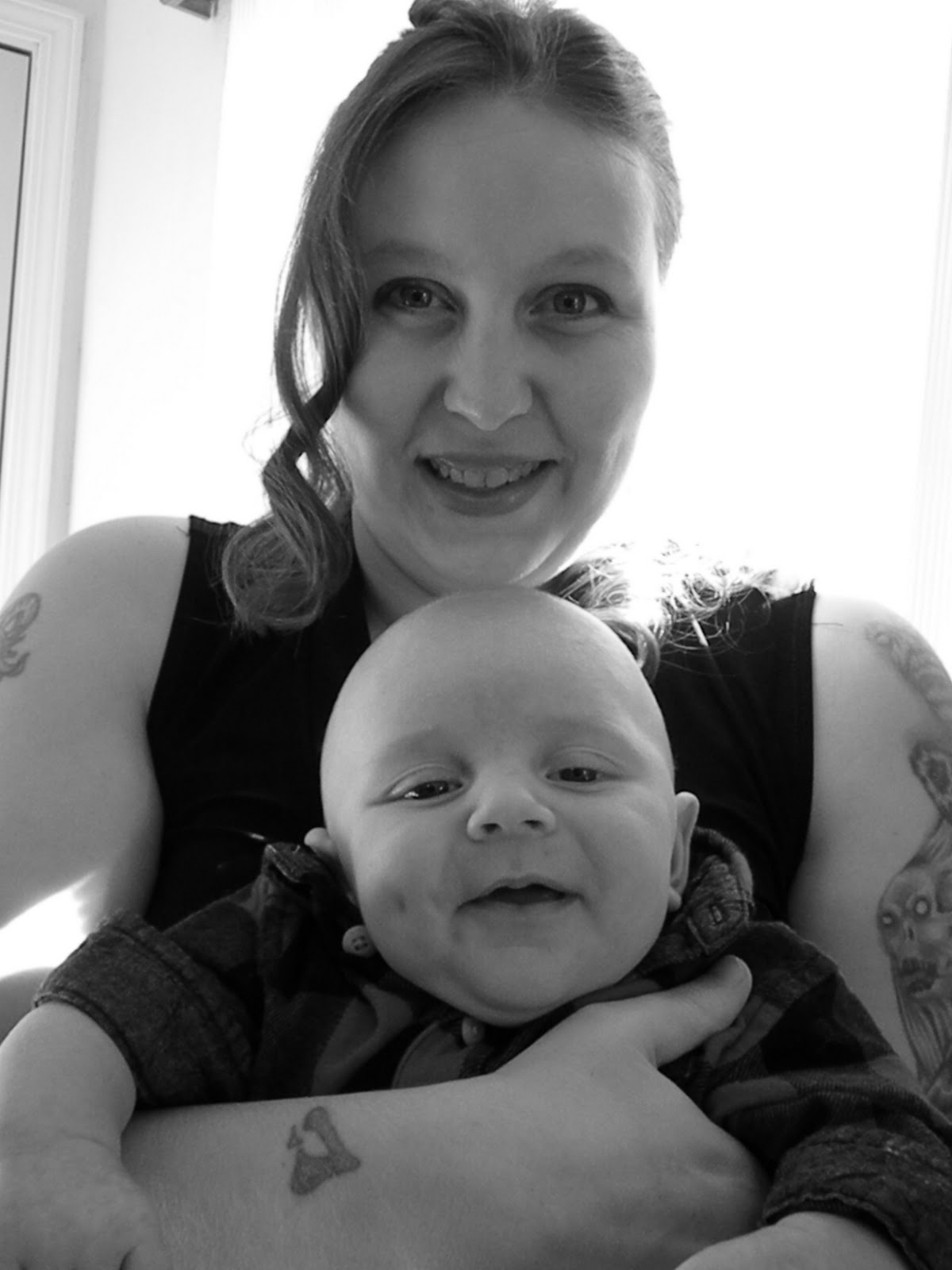
Mom and Son


In case you're wondering, yes that is a tattoo of the Tzimisce vampire Sascha Vykos from Vampire: the Masquerade. How cool is that?!?!?!?!

More 5E Goodness

So fresh posts that aren't part of the pre-programmed features haven't been as frequent lately due to a very busy work schedule that's been eating into my free time. With any luck things will slow down and I'll have a chance to work on some new content...part 2 of my Mutant Epoch Travelogue, for example!

Anyway, some free time on this Friday evening, and I thought I'd point out this transcript from the D&D Experience over on Enworld. It's some interesting reading, and helps to get a bit more info on what D&D 5th edition (D&D Next) is going to be like. Some of the bits I picked up include:

1. They implied all classes to appear in the core PHBs of prior editions will show up in the 5E PHB. That's roughly fifteen classes in all. If they keep the warlock in the core I'll be happy.

2. Monte loves his wizards. We all knew that though! I'm not one of those "linear fighters vs. quadratic wizards" people, though, if only because I rarely run games where this phenomenon pops up, and also because I've seen high level fighters in 3rd edition and their frankly terrifying. But either way, it sounds like they want to balance out wizard vs. fighter damage with "better overall average damage per round vs. occasional amazing damage"....which is pretty much how it's always been in D&D (until recently).

3. 15 minute character generation. Goooooood.

4. "Vancian" magic is back. Or rather, Pre-4E Vancian magic (because Dailies were kinda Vancian).

5. The fighter is taking a lot of work. It sounds like they are recognizing that the many active features of the fighter from 4E (and the other approaches in 3E and 2nd as well) are key to making the fighter just as fun.

6. They're really pushing for the idea of "preset/default design" as the core book, followed by "addiong on options" that allow for increased complexity.

So I'm really getting eager to see  the playtest doc for D&D Next when it comes out. I'm seriously hoping that this is a game that offers just enough of what each player wants to really, finally, settle the whole "edition war" nonsense....or at least throw some water on the fire, maybe give us enough time to ...you know... play the game for once!

Thursday, January 26, 2012

Tales of the Cannadad Dei: Life in the Sabiri Tribes


Life in the Sabiri Tribes


Sabiri are migratory, and settle in specific locations several times a year. Most tribes have a region they consider properly theirs, through which the roam. Such regions can span the length and breadth of the Sabiri lands, or only a portion of it. As a rule, the largest tribes tend to migrate over a larger range of territory out of necessity.

On the outside it appears inexplicable, patterns of nomadic movement that may at best seem to follow the waterways and paths of the great bison herds. To the insider it is a mixture of sacred determination; the waterways and bison are placed along a path preordained by ancestors long gone and the communion of venerable and helpful spirits.

Most tribal paths make at least one round a year through one of the sacred ceremonial centers that have turned in to great “tent cities.” Zen Hettar and Uvalin are two of the largest such sites, a communical gathering center where chieftains can convene to discuss news and events, games are held, the trading of brides is made, and warriors can display their prowess. Trading is very common, and though the Sabiri enjoy the commodity of coin they are as likely to barter for and with good as they are gold.

Sabiri tribes focus heavily on preparing for winter. The winters last for several months, starting early in the fall on some years and creeping in to mid spring if the season is especially bad. As hot and humid as summer gets, winter is atrociously cold and snow can blanket the land for months. Tribes prepare accordingly, insuring that thick pelts and stored food is readily on hand. In the deep south some tribes, less affected by the weather at the closest stretches of Helios, tend to be more relaxed about the seasonal changes, and these are fiercely defended territories.

Tribes are divided in to four main units. There is the individual family, which has a patriarch and his wives, as well as all relatives under his protection and dominion. A group of families (from as small as two to as large as several hundred) comprise the tribe proper. Several tribes under a charismatic warlord constitute a Kaskir, or nation. Multiple nations can assemble in a loose unity under a sabirath, or dominion. The dominions are centered around one of the chief ritual centers, which right now consist of Uvalin and Zen Hettar. Dominions rarely have a ruler, though the greatest chieftains may form a council. On rare occasion they may elect a warlord to power. Northward is Madalios, which is regarded as its own dominion, though the settled relatives of the Sabiri are regarded, like all who have given up the nomadic lifestyle, as a people of less worth.

Sabiri Merchants: The Askartin


There are a few tribes that have developed semi-sedentary or even given up the nomadic way of life. A cluster of such Sabiri dwell around the great communal centers at Uvalin and Zen Hettar, small families of Sabiri who claim the regional “city” itself as their tribal land. These Sabiri are part of a unique sect described as askartin, which literally translates in to goat merchant. The Sabiri see these specific families as providing a necessary service that benefits the more traditional Sabiri ways. The askartin are the smiths and traders who have learned to sustain themselves year round by way of trade and commerce with he nomadic tribes and the Espanean colonials. Indeed, most of the indigenous Sabiri population that has settled around Fartheren belongs to the askartin sect.

Askartin are much like their nomadic brethren, though regarded as somewhat less important in battle. The askartin see themselves as no less significant, however, and have advanced their love of horses from the nomadic way to a more sophisticated pastoral approach, raising horses in larger numbers and selling them to the nomads and Espaneans alike. The askartin skill take steeds for their own, and still train in ritual warfare, but they do not roam.

Askartin have not attempted to domesticate the bison, though they have taken to raising the butu goats in the region; thus, the name “goat merchant.”

Next: Warfare

Tuesday, January 24, 2012

Tales of the Cannadad Dei: Sabiri Tattoos


Sabiri Tattoos


Tattoos are vitally important to the Sabiri. The nomads long ago learned to imbue the inked and scarred marks with magical force, and in turn learned to attune their own bodies to these symbols etched on their own skin. Though Sabiri spell casters can and do employ written tomes, those warriors who dabble in magic prefer to use the spell tattoos, as they are easier to access in the fields of battle.

Despite the notoriety of spell tattoos, it is much more common for most members of a tribe to carry tattoos commemorating various deeds and actions, even if they do not contain magical power. A major victory (and sometimes a defeat) can be reflected within a tattoo. A marriage, alliance, a newfound brotherhood, or a symbol reflecting dedication to a specific cult or order is all celebratory with a new mark upon the flesh.

The process of making tattoos for the Sabiri who practice the art is complicated, and involves a sacred language of ideograms, in which each stroke or mark reflects a key proponent of the overall mark, but only in relation to how it is placed with the other symbols. It is a form of language, but not one that can be easily read without a trained eye.

Conventional marks are easily understood by most Sabiri; it is a special part of their greater language that they can understand. Tattoos imbued with magic are not so easy to grasp; the symbols used for magical language are a carefully guarded secret among the tattooist, and the tattoos themselves are said to reach deep in to the owner’s body, to tether to the soul, allowing the magic to flow freely between the symbol itself and its bearer.

Regardless of the nature and type of mage, most spells learned by that mage can and will ultimately end up as tattoos upon his or her body. Over time it becomes quite evident that the magic is a being of extreme power. These mages exhibit a strange sort of quintessence around others, which give away their nature as sorcerous beings. As such, these powerful tattoo mages will cover their own body from head to toe in obscuring garb, to avoid detection by simple visual observation of their many spell marks; thus the common saying among the Sabiri that “You know a warlock, for he the man who is always cold.”

Interestingly, because most older Sabiri women dress in heavy robes and dresses, the saying is a bit different. “You know a witch if you know a woman.” Sabiri are, indeed, a society divided by deep gender differences, and a male culture that has not a small amount of fear and superstition about the fairer sex.

Sabiri Tattoo Magic Feat (Pathfinder Version)


Prerequisites: Sabiri cultural background, Craft (tattoos) 4 ranks or better.

Effect: The Sabiri have learned the unique art of inscribing ritual spells on their bodies. Through the use of this feat, along with 100 GPs worth of tools and a special ink which comes from the blood of an enchanted creature (usually a gorgon), the Sabiri artist can spend one day (12 hours) placing the inscription for any spell in question upon the body of a person. All features of the ritual spell must already be in place; the recipient of the tattoo must already have learned the ritual spell, for example.

Once it is placed upon the character’s skin, then he can never lose or forget the spell; he knows it innately by virtue of the arcane or divine script tattooed upon his body. Characters can have up to eight imbued ritual tattoo on each of the following areas: head, arms, legs, neck, chest and back. A Break Enchantment spell will remove a tattoo to make room for another one.

If the tattooed character dies, it is possible to take the spell from his flesh. The character must make a Knowledge (arcana) check at a DC of 20+the spell’s level to grasp the weave of the spell tattoo. It is also possible to imbue it on one’s owns kin through the process described above if the caster also has this feat. Otherwise, the skill check allows the caster to flay the skin and convert the region of the tattoo into a scroll.

Tattoo artists among the Sabiri often charge enormous sums to foreigners for the privilege of an integrated tattoo rune. The base price is usually 1,000 GPs, plus maybe some task.


Next: Life in the Sabiri Tribes

Sunday, January 22, 2012

Tales of the Cannadad Dei: Arms and Armor of the Sabiri


Arms and Armor


It is not typical for nomadic cultures to have sophisticated steel weapons, but the Sabiri are surprisingly adept at metallurgy. Certain cultural “hot spots” like Uvalin and Zen Hettar support this trade and because of this Sabiri steel is a prized commodity.

Sabiri are fascinated by the construction of long-lasting weapons that are useful in mounted combat. Sabres, falchions, scimitars and other one-handed slashing blades designed for use from horseback are regarded as favored melee weapons. The women of the Sabiri have developed sophisticated knife and dagger practices apart from the men, though women on the path of Hnaka are as proficient with sabre or scimitar as as male.

Aside from close combat weapons, charging weapons such as lances and spears are highly valued, and in ranged combat the sabiri self bows are considered beautiful works of art, crafted in secret rites from the long bones such as the ribs and femurs of the immense amasa bison.

Lances, though valuable to the horse warriors, are actually rather prized, due to the lack of useful timber in the land to generate poles of sufficient size to manufacture the weapon. Most lances come from expeditions to the Kossarit Mountains or northward toward Madalios, where certain tribes specialize in the manufacture and trade of lances made from the wood of more mountainous regions.

Short spears and javelins are also very popular, and javelin sports are a common entertainment in Sabiri tribes, even more so than ritualistic dueling. A good javelin thrower can make a reputation for himself. Some women are allowed to participate in certain tribes, but it is generally frowned upon.

Sabiri women excel instead in close-quarters combat. The Shumariin assassins are famous for their deadly knife fighting skills, and warrior sects of women have taken up the scimitar and turned to duo-wielding styles of combat that are terrifying to behold. These blade dancers are a breed of dervish known for integrating a deadly dance with swordplay, a technique that fears Sabiri men who believe the blade dancers to be witches that mesmerize them in to obedient death by blade.

Armor, in contrast to the preferred garb worn by most sabiri on a day-to-day basis, can get quite complicated and bulky. Most of the time Sabiri wear soft leather garb that offers some modest protection, but in regular skirmishes they prefer to wear lacquered armor and cuirbolli worked in to fitted plates. Such armor is impractical from day to day, but it is considered a necessary addition to the warrior’s repertoire in times of real conflict. The cuirbolli and lacquered plat armor is preferred for its light weight material and ease of use. Such armor is also relatively quick to assemble and wear. Keeping with fashion traditions, most such armor is dyed or painted blacks and dark reds, though color variations creep in from tribe to tribe. Most individual families paint their symbolic crest upon the armor, which is derived from the same sacred language used for tattoos.

(left) A Sabiri woman in the markets of Fartheren


Next: Sabiri Tattoos

Friday, January 20, 2012

Tales of the Cannadad Dei: Dress and Garb of the Sabiri


Everyday Garb


The Sabiri dress with an economy of design; short vests, breeches and laced boots and moccasins are common, and garb is designed to be comfortable and not to chafe. The wilderlands of their domain are a warm region in the spring and summer months, followed by bitterly chill winters. The entire region is humid almost year round. This tends to promote garb that breathes freely, though tempered with garb which is functional.

Most Sabiri prefer the soft worked leather that comes from the local amasa bison which roam the region. This supple leather is naturally dark, due to the ebony pelts of the bison, and has the accidental side effect of looking rather ominous from an eastern viewpoint. Nonetheless, sales of amasa hides with the east is fairly brisk. The amasa are principally saved by the fact that the Sabiri rely on them and covet their herds. If the Espanean traders had their way, these beasts would have been driven to extinction by now, no doubt.

Espanean men tend to wear leather breeches and a harness for their tools and weapons. They sometimes wear a variant of chaps while diring, providing leather protection on their legs in combat; these same chaps are often worn at other times, designed for comfort first. In the winter they tend to wear heavier fur coats and hoods, stitched together by the women.

Many tribes enjoy unusual head dresses made of woven horse hair from the trimmed manes of their steeds. These head-dresses can get quite elaborate, and some of the men in the tribe will weave the horse hair with their own for unusual extended braids. Although the women fo the tribe (especially elders) are master weavers of the horse hair, the women themselves do not decorate themselves with the braided horse hair; it is another custom reserved for men. Women in Sabiri have instead adopted complicated lapidary designs for themselves.

Espanean women disdain long dresses and garb more common in the east except in the winter or as a sign of age. Elder matrons often settle with long fur skirts and coats, often worn year-round, and will wear decorative garb that stands out with evocative lapidary work. The younger women favor vests, light blouses, short skirts and breeches, sometimes with the utilitarian harnesses for equipment and weapons like the men do.

The Sabiri are a modest people, and it is considered taboo to appear overly “sexual” in Sabiri society. This manifests in the form of a disdain for eastern makeup and a preference for useful clothes over garb that accentuates the female form. Curiously, women who have adopted the warrior’s focus (the hnaka, below) tend also to eschew restrictive garb that doesn’t breathe well, so they are often dressed as lightly as the men save for their bustiere-like vests. Sabiri women dressed as warriors do not appear sexualized, however, despite showing off their extra skin, as they tend to emphasize their capabilities by additional tattoos and a plethora of visible armaments. This is how the women say, “do not touch, or you may die.” It works well.

Ritual Dress

Ritual dress is always more stylistic and designed for beauty and grace. Dance is a preferred social medium among tribes, and when two or more tribes come together they always throw a party. Ritual forms of dress are often quite elaborate; during such conflagrations the women of both tribes will exhibit atypical garb designed to show off the wealth of their immediate family and the tribe as a whole. Men will anoint themselves with artifacts of victory and war, and wear revealing garb to show off tattoos earned in battle. The most frightening members of a tribe are the ones who show no tattoos at all; the truly powerful shamans and sorcerers of the Sabiri prefer not to advertise their sacred tattoos at this time, lest they be compromised by an observant enemy.

Some Sabiri, especially around Fartheren and along the coast near Westgate among the Sendenar have taken to Espanean garb during these meets. It is at least partially due to acculturation from the foreign groups these Sabiri regularly interact with, and also due to the fact that the standard garb of the east is seen as so outwardly flamboyant that while it is scoffed at as a form of conventional wear, these Sabiri have accepted Espanean dress as suitable for gatherings and events.

Next: Arms and Armor of Sabiri

Thursday, January 19, 2012

Advanced Dungeons & Dragons Commemorative Editions, or "I just Got Internet Whiplash"

I would honestly regard this as bigger news than the 5th edition Dungeons & Dragons announcement...

First is the ENWorld article here.

Next is actual press anouncement here.

..aaaand here's the WotC page for the PHB.


I for one am amazed that they are doing this, and actually this really suggests to me that WotC is now officially "thinking outside the box" about what D&D is and who plays it (and who they want as their customers).

SO yeah, I'll be ordering these new prints of AD&D, and I think I see a brand new 1st edition campaign in the near future to enjoy them!