Showing posts sorted by relevance for query ad astra. Sort by date Show all posts

Saturday, November 26, 2011

Ad Astra: Regions of Space and Overview of Species


Regions of Space in Ad Astra


The galaxy of Ad Astra is represented by a large region of space defined by two zones: coreward (toward the galactic center) and spinward (the galactic periphery, the region where Earth is located). Within these regions are large areas called zones, each approximately 500 or more light years across. Zones are in turn broken in to sectors of 50x50x50 light years.

Region Summary


Spinward Regions of Space:

Rimward Zone The Terra-centered domain of space operated by the Human Federated Commonwealth

Freeworld Zone the human-dominated colonial expanses, loosely under HFC jurisdiction. Borders Pelegranen space and overlaps the Precursor territories.

Corporate Zones There are about a two dozen regions of human space specifically protected under HFC charters in which the local corporate interests have territorial control and complete legal jurisdiction. This was part of the civil conflict settlement.

Praektor Space The old-empire expanses once held by the crumbling Praektor empire. Much of this territory is under alien rule now.

Anageni Expanse A large, old, long-dominated region of space controlled by the Anageni, who function as a benevolent autocracy.

Zones in both Coreward and Spinward:

The Amber Zones A three-hundred plus light year region of space approaching the core of the galaxy that is quarantined. Once held the expanses of the now dead Byzanti Alliance. The charnel alliance was shattered two centuries ago, but the threat of it’s alien technologies and human dissidents live on, patrolled by HFC fleets.

Pelegranen Space The modest conquered territories of this warlike species.

The Founder Zone The Astratran Founders are heralded as the true sons of the space ways, having brought the technology of Wormholes to men and beyond. They are a benevolent, non-confrontational merchant species.

Metatranie Space The small but volatile empires of the Metatranie are luckily at war with each other far more often than with the Terrans.

Coreward Regions of Space:

The Dotari Region A quarantined region once held the the enigmatic Dotari, who progressed to a new stage of evolution millions of years ago, and are now trans-dimensional beings. Many encounters for simple four-dimensional species with these beings are fatal.

Grupnar Space Commonly known as the curmudgeons of the galaxy, this species holds sway over a unity of lesser species, and mistrusts terrans.

Harbinger Space This ancient region of space was once the playground of still-existant nearly cosmic entities which travel their routes throughout many galaxies via doomsday ships. This region has currently been quarantined since the return of on such Harbinger.

Shakaad Collective A region of multiple species with their own separate collective.

Kephran Empire A decadent humanoid empire discovered in 2592 which claims to have once ruled human space.

Species of the Ad Astra Campaign:

There are a bewildering variety of alien species throughout known space. The major species, that is, the major recent players in galactic politics, are described below. Each species has a known major affect on the current course of the interstellar community, either for better or for worse. Some species, such as the Farseers, are actually quite rare, and unlikely every to be encountered by most travelers. Others, like terrans and praektorians, seem to be everywhere and plentiful.

After the short list with brief intros, details on the abilities, profiles, and necessary character management data are provided.

Some of the most common known species include:

Name Quick Profile

Praektor Amphibious warriors once used by the Progenitors are soldiers

Grupnar mammalian-like “lizard-bears”, who rule their own region of space

Anageni quadrupedal, sensitive low-gravity dwellers, very scientific species

Cerr’K’Ta inimical species who adapt and advance by integrating others

Pelegranen warlike reptilian beings who are highly paranoid

Speakers squid-like psionic beings who serve the progenitors

Astratran Founders Tall, herd-minded explorers reminiscent of horses, very advanced

Dotari transdimensional beings who regard lesser beings as playthings

Metatranie powerful, primitive saurians, new to space-travel, and volatile

Hypolate Farseers evolved precursors, from Trikkus. Rare and curious people

Stick Men A trans-dimensional entity from another universe, a parasite

Gundari Wraiths Mysterious and deadly Byzantine allies, from quantum elsewhere

Byzanti Cyborgs Remnants of the machine intelligence of the Byzanti

T’Kazzt Rough terran allies, insectoid and very organized

Nommosi Thought nearly extinct, these ancient beings claim to predate all other species

Chael’Gaan A species brought near extinction by ancient war, spread thin and very violent

Golmak quantum beings from another universe, explorers and antiquarians.


Existing Traveller Species in Ad Astra

Characters in Ad Astra may be human. From Phase I onward, genetically enhanced humans become more common. Besides the other alien and simulant characters described in this setting, the referee is welcome to introduce Hivers, Vargr, Droyne and any other classic Traveller species in to the Ad Astra universe if he wishes. Foe example, you could easily assume that the Vargr are a recently uplifted species, although that means that they are not as widespread, nor do they have a homeworld. Conversely, you could assume that a precursor species did, in fact, uplift the Vargr long ago and transplant them to their homeworld and place them wherever you wish in the Ad Astra continuum.

Some suggestions for enhanced and uplifted species ideas follow, as well as where I would place default Traveller Species:

Vargr: The Ad Astra version of Vargr are colonial uplifted beings who have gathered in a series of colonies throughout the Freeworld Zone. Vargr were one of many uplifted species brought forth by humanity after reaching the stars.

Droyne: Droyne are indeed descended from an older and more advanced civilization, and are located in a remote region along the edges of Dotari Space.

Hivers: The hivers are as perplexing and mysterious in Ad Astra as in other universes. They are nestled in a region of space between The Rimward regions and Anageni space. The anageni, unsprisingly, get along fine with the hivers.

K’Kree: The herbivorous K’Kree are found on a small stretch of colonial worlds which they dominate in the Freeworld zones. They maintain their own regional government and are on very friendly terms with the terran freeworlders.

Aslan: The Aslan are fairly hostile to most outsiders, but maintain careful relations with their human neighbors in the Freeworld zone.

Human Variants: Human variants from core Traveller do not exist as such in Ad Astra, though you could use them as templates to extrapolate specific deviant or transgenic societies which have spun off from humanity over the centuries. In Ad Astra, no precursor race drew from primitive human stock to seed other worlds, and so there are no alien planets full of human-like species out there. When you find a world with humans on it, you know they all descend from earth within the last few centuries.

Some ideas for other potential species or transgenics follow. The core Traveller rules provide plenty of information on developing interesting new species.

Aquatic Xenoforms and Transgenic Oceanic Hybrids: A fairly humanoid aquatic being which is naturally adapted to or has been transgenically modified to survive on a water world would gain a +1 Dex when in water and have Athletics (swim) 0.

Avian Xenoform: An avian or winged xenoform with flight may come from a low gravity homeworld if it still maintains enough mass to fly yet is also sentient (distributed brain mass, or more compacted cranial capacity, perhaps.)

Insectoids: Lots of unusual races could be insectoid in appearance, although such species would have different respiratory processes if their mass is human sized or larger, unlike Terran insects.

One of the underlying themes of the campaign is that it is a big universe, and by Phase III, there are literally hundreds of intelligent species interacting in known space, and thousands of minor species yet undiscovered. The referee should encourage players to design unique races for unusual characters they wish to play by this stage, as well as creating his own!


All text copyright 2011 by Nicholas Torbin Bergquist, all rights reserved

Thursday, November 24, 2011

Ad Astra: Introduction and Future History

Source
Traveller: Ad AstraA Campaign Setting for Mongoose Publishing’s Traveller Role Playing Game


Ad Astra (“to the stars” in Latin) has been my private space opera for two decades now. I have linked my science fiction adventures together over the years, producing the fairly lengthy and tumultuous future history of the universe. Ad Astra is a universe which begins with a near-future world of dark conspiracies and alien visitations, turns in to a not-too-distant tale of expanding humanity and two-fisted tales of hard-science adventures on the frontier of space, and eventually expands to a galactic tale of space opera and far-future politics among powerful alien empires. The intent of the setting is to insure that you, as GM, can run it in any particular vein you like, linking adventures in different eras together over time, as a grand plot that transcends the generations slowly unfolds.


The historical timeline of Ad Astra allows for a grand overview of the progress of man spanning several hundred years. It provides some details on the overarching plots and themes that develop over time, especially the gradual expansion of man in to foreign space and humanity’s first contact scenarios with the greater universe. The theme of the Harbingers and their eventual threat is also important, as is the mystery of such beings as the Byzanti and the Gundari Wraiths.


I’ve run Ad Astra in multiple role playing systems. Ad Astra grew out of an explanding metaplot I would develop with each opportunity to run a new SF campaign. The system was usually the hot game of the hour. Traveller, Megatraveller, GURPS, Alternity, Hero System, Savage Worlds and Tri-Stat DX have all hosted Ad Astra as the underlying system, and I’ve provided some online details for a couple of them. Most recently Mongoose Publishing released a new and very polished edition of Traveller, and so it is my pleasure to bring Ad Astra back to the original system from which it was first conceived. The adaptation that follows will include specifics on how to use Traveller as the default Ad Astra game engine with a minimum of fuss. In fact, pretty much the entire body of rules for Traveller will work just fine as-is with Ad Asta; all you’ll need from this setting are some specific details and statistics to go with it all.

Traveller Conventions:Ad Astra employs all of the rules for characters, ships and worlds as outlined in Traveller. Transgenics are also common in Ad Astra and less restricted than in the standard Traveller universe. Psionics exist in the Ad Astra universe as a barely-understood force linked to the quantum flux. It is believed by many mystical agencies that psionics are the first step of a conventional physical being in to a larger, incorporeal universe. The Harbingers, Wraiths, and other species have all developed this potential to some extent, but mankind as a whole remains largely uninvolved with psionics until Phase III and beyond. Finally, simulants and anageni are all affected by transgenics to one extent or another, the specialized weird science focusing on genetic modification.

A Future History in Four Phases The history of mankind in space begins before Sputnik, and may indeed have begun before man had left the stone age. His future history goes on for many millennia, but the four phases of expansion in Ad Astra deal with a period from the twentieth century in to the twenty-sixth.


Protophase:
Dawn of the Interstellar Age
Mankind’s first encounters with the galaxy at large did not begin in space, but in fact dates back to many early occurrences of alien contact. First contact may actually have happened multiple times over countless millennia, but some famous known examples include the following:


In 1947, the first documented modern contact with aliens occurs when a Gundari slave ship crashes near Roswell. Survivors reveal the millennial practice of harvesting humans and other lesser species for Gundari thrall armies before escaping. The havoc caused by the surviving shape shifters leads to the formation of MJ-12, a covert government agency designed to respond to alien threats.


In 1997, Nommosi remnants stranded on Earth from a crash-landing in the Cretaceous era are awakened when one of their poly phasic artifacts are discovered and activated. The surviving Nommosi attempts to create a chrono-phasic wormhole to return to the past and stop the disastrous crash, but in so doing begins dragging that period in to the near future. Fortunate intervention stops the irreparable damage to past and future.


In 1998, As a side effect of the Nommosi awakening, stranded T’Kazzt criminals are motivated to seek escape, and attempt to convert human listening stations in to FTL transmitters to call for help. Federal agents intervene in conjunction with MJ-12. Variable periods in history have revealed trans-phasic incursions by beings moving through poly-dimensional wormholes, most notably the so-called “Stick Men,” who have been with humanity potentially for several thousand years. Likewise, there is a suspicion among mytho-historic scholars that apocalyptic accounts of floods and disasters in human legends suggest a period in which the Sol System might have come in to a near-contact with one of the Harbingers (near-contact because direct contact would have led to the harvesting and extermination of Earth).

Phase I: 2048-2150

First Contact and STL Expansion Period
Mankind has developed a sophisticated future society and begun development of the solar system. In this period, humanity experiences a period of future shock, which is slowed only by the outward expansion in to space over time.


2048 marks the time in which a period of continuous global conflicts and escalating warfare over diminishing fuel resources are almost completely eliminated due to the unexpected development of cheap, almost unlimited fuel through the manufacture and development of anti-matter. The Klausman-Zabrinski Particle Collider and highly effective magnetic bottling methods make the exploitation of total energy-to-mass conversion through anti-matter dirt cheap and accessible to all. In less than a decade, humanity is lifted from the brink of destruction in to a new renaissance.


In 2052, The nations of the world are united and commemorate the new era of peace with the launch of the Orpheus Project, a multi-national effort to promote the furtherance of space development with the first anti-matter interstellar space explorers. Orpheus I, II, and III are set to launch on completion in orbital stations in 2056, and begin their journeys to three likely star systems displaying possible terrestrial planets according to new advanced telescopic imaging stations established in the Kuiper Belt Research Stations. Daedalus III will reach Alpha Centauri, closest binary star system to Sol, in approximately 50 Earth years acceleration and deceleration time. It will be the first vessel to arrive. Orpheus II is sent to Wolf 359, and Orpheus I is sent to Tau Ceti. Each Orpheus vessel carries an experimental wormhole receiver gate with it to be assembled on arrival. The current wormhole project holds that a two-way connection is required to operate the wormhole by utilizing the two openings to force the hole open with a web of complex hyper dense particles. Again, particles made possible using new accelerator and bottling technology.


In 2076 the first functioning self sustainable two-way worm-hole is created in the Kuiper Belt Research Stations. Technology has superseded itself here, as the means of exploring worlds still to be reached by the Orpheus project can be done in spite of issues of relativity. The new system allows a ship to be fired, virtually, through an accelerator 200 km long through a worm-hole entry which is momentarily flung open by a massive burst of heavy exotic particles from adjacent interactive accelerators. The ship arrives at a destination where it can then utilize it’s onboard equipment to mine and manufacture a receiving end which can create the sustainable wormhole. Plans are immediately put in place to make use of the new Gateway-1. By 2082, multiple avenues of research are underway and the first explorer ships are out.


In 2079, a monumental discovery is made by Kurosawa Mining and Development in the ice fields of the Titan moon when they detect a large artificial object trapped in the moon’s ice flows. The first and earliest Dragoons (cybernetically enhanced humans) are brought in when the initial research teams are lost, and discover that the vessel is of alien origin and infested with unknown, hostile organisms that strike at the genetic structure of their targets and take control of enemy organisms. This is humanity’s first contact with the Cerr’K’Ta. Later, when the infestation is eliminated, what is left of the vessel leads to more mysteries, many not answered until centuries later. Unfortunately, Kurosawa does not share it’s discoveries with other members of the Commonwealth.


In 2082, the first fracturing of the Solar Commonwealth is experienced when the Jupiter Faction breaks away, due to an artificial intelligence which becomes motivated to become exclusive caretaker of it’s willing society. The rampant acceptance of neural networking and biotech advances which have lead to the creation of biomimetic powers in the human mind are blamed for this bizarre cultural revolution. This cultural revolution slows interstellar expansion as the First Stellar War is fought, but it leads to the first idea of the Slingshot drive, locally constructed accelerator stations which can open smaller wormholes to fire a ship to another region in the solar system, making local travel times much shorter.


2086, The first phase of the interstellar survey teams has unexpected results as a team stumbles on a Dotari Habitat. The Dotari lash out violently to the xenobiological intrusion, and then send armed forces to Sol, where they begin a systematic annihilation of wormhole capabilities. The existing warfare makes things worse as the first contact with a present alien species proves overwhelmingly hostile, and the xenophobic, poly dimensional Dotari and their manufactured subjects are too alien to rationalize with. The First Stellar War ends with the Dotari domination and subjugation of human space forces on all sides in 2092. Confident Terran space development has been stopped, the Dotari leave. Unknown to them, factions of the Solar Commonwealth have survived with Kuiper Station technology intact, by moving key wormhole capable vessels to other systems, including Alpha Centauri.


In 2087, after a close engagement with unknown hostiles monitoring the system the human remnants are saved by a Founder trade ship which aids them. With the assistance of the Astratan Founders, the Solar Commonwealth contingent returns to the Kuiper Belt of the Solar System. Confident that the Dotari are gone, a methodical plan to restore humanity to the stars begins. Aided by the Founders, who seek to aid those injured by the Dotari threat to gain new allies, the reconstruction will take approximately three decades before man’s presence in space is fully restored. During this time, a great deal of effort is placed on careful, methodical, and quiet interstellar survey teams seeking to assess the neighbors, both hostile and friendly, in the local region of space. This is the foundation of the Interstellar Survey Corps.


2106 is the year Orpheus III makes it’s arrival at Alpha Centauri, only to discover a civilization on the hospitable world which has collapsed, and evidence of much warfare and many subsequent visits from other species. A game of cat and mouse begins with a being known only as the Survivor, a member of a forgotten species which was trapped by the automated protection systems which were put in place to protect the system from further incursion, or warn off visitors. The tools of biotechnic warfare abound in the system, and it appears that many of the visitors sought the technology out as a means of using it for their own purposes. Orpheus III discovers the first direct evidence of sleek, faster-than-light ship remnants employing warp drive to fold space. It then seeks to establish contact with humanity and builds it’s return worm hole, after finding a message left behind by the visitors of the Commonwealth.


Phase II: 2175-2300

The FTL Outward Expansion
Phase II is considered to have officially begun with the christening of the Rendezvous I, the first self-sustaining, wormhole-equipped FTL ship. At just under 3 km in length, Rendezvous I was meant to be humanity’s first great fortress of the stars, a vessel capable of operating indefinitely with a crew of several thousand and room to hold whole colonies. As much a space station as a ship, Rendezvous I included dozens of research, survey, and exploratory vessels attached to it’s hull along with a dozen well armed warships utilizing newly developed weapons technology employing gravitic weaponry as well as anti-matter missiles. In the years preceding the build-up, alliances had been made with the Astratan, Anageni, and Grupnar as well as several minor species in predicaments much like humanity’s. From this unity emerges the Human Federated Commonwealth, and an alliance between multiple species called the Interstellar Union.


2176 marks the founding of the first full human colony in interstellar space on the uninhabited terrestrial world of the Betelgeuse system. Within a decade, under the Rendezvous project, twenty two worlds and moons are seeded with colonies and terra forming development stations. Dozens more are equipped with stations, and key locations are established with developing wormhole station facilities.


In 2199, the first Commonwealth Marine Defense forces are put to use in protection colonies from another Cerr’K’Ta threat.


By 2215, the HFC has laid claim to 100 star systems and colonies are spread far and wide in the safe zones established by the ISC teams of previous decades. Likewise, humanity’s allies in the Founder Worlds and Anageni space have helped to established Amber Zones, where unknown or risky civilizations are known to exist. The interstellar star charts are starting to look complicated. During this time, expansions of the original Rendezvous project are undertaken, and new self-sustaining colony ships are created. Among the controversial ship lines are the new Mars project vessels, battleships in space to serve as a threat deterrent against anticipated hostiles. The first Mars ship, the American Star, begins it’s tour of duty in 2212 along the Amber Zone borders. Later vessels include the Musashi, Meru, Churchill, Bradamante, and Challenger.


In 2221, under the command of Captain Harrison Hannibal, the American Star comes in to a brutal first contact experience with a fleet later later attributed to the Byzanti Alliance, and to the horror of the Commonwealth Navy it is discovered that the Gundari are a part of the alliance, and have harvested an army of biotech-modified human beings and other aliens for their thrall forces. Most frightening of the Byzanti forces is their callous disregard for the bodies of their thralls as anything other than expendable troops, and their absolute domination of their region of space. Praektorian military allies of the Byzanti forces complicate matters, as Praektorians are a diaspora encountered on many worlds, but regional Praektorians appear to serve a strong military presence to the Byzanti.


In 2230-2256, constant military conflict in the Amber Zone quickly escalates to war as Byzanti forces seek to attack human worlds. The first true interstellar conflict of the HFC begins, and a strong commitment to military defense is employed. Highlights of the war include a Byzanti assault in the Sol system in 2249 using nanotech weaponry, and the almost complete annihilation of the Praektorian homeworld in 2253 through orbital bombardment. The conflict will eventually lead to human control over much of what was once Byzanti territory, and the destruction of the Byzanti machine after HFC scientists unlock the secrets of the Alpha Centauri relic weapons, and develop a sophisticated nanotech virus that disables the byzanti thralls. The Byzanti surrender is followed by decades of ultimately unsuccessful disarmament and reformation, eventually given up in favor of regular patrols and limits on the use of arms and armament in space by the occupied Byzanti colonies.

Phase III:

The Future and Beyond
Many events are plotted and suggested for this period of the timeline, but await further extrapolation. Some interesting examples include:


2318, the first human contact with Harbinger space, and the new threat that results from this cosmic threat.


2446, in which The Slip Drive is first perfected, allowing for instantaneous space travel through the manipulation of cosmic strings. Unfortunately, the use of this mechanism involves an energy component greater than most galaxies produce. The mechanism for meeting this requirement involves exploding new quantum parallel universes out of the cosmic fuzz. By around 2500, this has attracted the attention of ominously powerful entities from completely different quantum realities, who realize the damage being done to the structure of the quantum universes in this manner.


2512 marks the first period in which a Harbinger assembly approaches settled human territories. This initiates the First Interstellar War of Territories, and proves very nearly to be the downfall of the entire Federated Commonwealth.

All text Copyright 2011 by Nicholas Torbin Bergquist, all rights reserved

Wednesday, November 23, 2011

New Feature! Ad Astra: A Traveller Setting


I started the Ad Astra campaign back in the early 80's....technically even earlier, as before I ever discovered RPGs I was an artistic kid (a skill that did not translate into adulthood) and drew a monumental number of "comic books" in my youth....I was constantly drawing comic adventures of Hannibal Harrigan, captain of the military and research ship "American Star" (which looked a bit like  a mile-long BSG Viper from the original series) and his never-ending fight against the predatory Praektor, the evil necro-marines under command of the vile Lord Belasco and many other bizarre tales. Then I discovered role playing games...and then I found Traveller, and my tales of space pulp adventure migrated to the world of gaming.

Anyway, over the years I built a weird sort of meta-plot arc that moved from campaign to campaign, albeit more slowly than my fantasy tales did. In time, I had run many games in several systems with the loose connection of being set on the same present and future Earth, charting its history over time. A few years ago I compiled this data into a rough campaign setting overview, which I recently adopted to Traveller. The whole of this setting's core material was printed in one of the recent PDFs of "The Sorcerer's Scrolls" (which I have since given up on; the name has been handed over to Jeremiah Griffin who wished to carry on the legacy).

With Ages of Lingusia winding down, I think its time to provide some SF fun via the blog....so over the next couple weeks I'll be serializing the assorted Ad Astra and other Traveller entries I have lying around; as I said before, most of this has seen print in TSS, but here you can get it in tasty bits for free. Look for episode one, tomorrow!

Tuesday, December 20, 2011

Ad Astra: Dragoons, Simulants and Loadouts

Source
Dragoons


Some dragoons are so far removed from the common human that they are closer to robots, and may even be designed as if they were such. For a more “human” dragoon, treat them as Marines with the following additional package ideas. The following Cybernetic enhancements are placed on a Dragoon to bring them up to FM standards. Most Dragoons are recruited from amongst desperate criminals, those who have experienced crippling and irreparable injuries, and others.
Ares Class Dragoon Infantry Unit:

UPP: AB7762

Skills: 3 terms Star marine career path

Special Abilities:

Bioware: Biomonitor Implant records physical condition, heart rate, temperature, toxicity, etc. Wafer Jack.

Armor: Dragoons have the equivalent protection of Powered Armor with an Armor rating of 14. This is a duralloy mod armor enhancement, and is part of their body.

Environmental Adaptation against extreme heat, extreme cold, vacuum, and water. The dragoon is unaffected by these extremes.

Nano-Regeneration allows for nanotech healing agents to repair damage (but not to armor), giving a +2 modifier to End checks for healing.

Enhanced Senses: Sonar, Radar, Radio Infrared, and hearing are all added or boosted.

Special Attack: Ares UR55 Particle Cannon The equivalent of a PGMP-12 or sometimes larger.

Size: The Dragoon is larger than normal,averaging 8-10 feet in height.

Owned: Federated Commonwealth Marines own the dragoon’s body and soul, literally. Dragoons really don’t muster out; a PC Dragoon which is forced out of service by failing a Survival roll, or at an appropriate Life Event, may declare it tries to go rogue, or become a drifter. It is then wanted and has the Federated Commonwealth as an enemy. Alternatively, a Dragoon which reaches officer rank 5 or better and which has at least 6 benefist for mustering out may expend those benefits to purchase its freedom.

Ageless: The treatment of what little organics remain in the Dragoons are such that they never worry about ageing effects. Dragoons never die of old age; usually just disease, cancer and in battle.

Outsider: The monstrous, mechanoid appearance and inability of the dragoon to interact normally with humans again, as well as being social and criminal outcasts in origin, forces all Dragoons to start with a Social Standing of 2. This can improve, especially if a Dragoon becomes an officer by commission, but they can never hold any noble rank no matter how high the social standing goes.

Limited Power Source: Dragoons use power from internal fusion plants, and rarely run out, but if this is ever compromised (such as on a called shot at maximum effect), there is A 1 in 6 chance the power plant will explode, taking the dragoon and a lot of turf with it. If the plant is shut off or removed, the dragoon is rendered inert, and emergency back-ups will kick in after 30 seconds, but provide only one hour of power for mobility. After the hour, it is inert, and a small battery keeps the biological part of the dragoon alive for 48 hours, after which it runs out and dies.

Marine Combat Gear
Powered Combat Armor

Through the various Phases of time in the Ad Astra setting, marine combat armor has evolved from armored vaccuum suits with nominal exosekeletal power-up to state of the art, high-tech mech suits which average about 10-16 feet in height and are as well armed and armored as most high-tech interstellar combat fighters (and more versatile, to boot).

Combat armor in Ad Astra is easily defined by the Powered Armor listings in the Traveller equipment rules.

Protophase Armor Options:

The best armor available during this period is Infantry Battle Suit dress. Towards the end of this period, Hard Armor becomes available.

Ares Class Standard Armored Vacc Suit


Periods: Phase I, II, III

A heavy combat vacc suit, designed with flexible polyweave duralloy armor plating, self-sealing mesh, a one week recycling life support system, and exoskeletal support. Some units, mostly for space-going missions, include zero-gee jet thrusters. During Phase I, these suits are defined as Hard Armor. By the end of Phase I and then on, use the Powered Armor listings (scout, battle, and heavy). All of these suits have the following extra features:

Environmental Adaptation resistant to pressure, vacuum, radiation, cold, heat, gasses, unless punctured or compromised.

Life Support One week of extended life support in a completely hostile environment. Goes to 1 month by phase II and six months by phase III.

Special Attack: Built-in shoulder or arm mounted mini-chain gun or mini-blow torch.
Ares Class Attachment Options:

Cerberus 50mm Recoil-free Heavy Assault Rifle

(Use ACR stats)

Built to serve as the standard heavy-assault weapon for Ares-armored infantry, this massive rifle fires magnetically launched, high-velocity slugs with no recoil, making it ideal for zero-gee combat missions.

Harpy 2200 Self-Guided Missile Shoulder Launcher

(Use the Rocket Launcher stats, TL 9)

A heavy mobile launch cannon loaded with homing missiles. This is a favored portable assault weapon among powered armor troopers.

Damocles Monofilament Assault Blade

Damage 3D6; Mass .5; Uses 300; Heft -; Cost 50,000 CR

Sometimes you find yourself in the trenches in man to man combat, and nothing cuts through duralloy like a monofilament assault blade. On a critical failure of 1 in an attack, the blade breaks! Monofilament blades are so effective that against standard (i.e. non energy-based) armor they treat armor protection as half normal value.


Simulants


Simulants are effectively genetically enhanced, test-tube grown humans, created from whole genetic cloth and tailored to the specific needs of a given job. Simulants, therefore, have a limited capacity for variation. There are about three hundred “types” from which the FM draws its best stock, and they leave intentional random mutational factors in the growth process to insure that there is a factor of individuality between the simulants. It is possible to have an army of true clones who all look alike, but the need to assert individuality in the face of such sameness is in the HFC charter.

Simulant Characters:

Simulants are tailored in the transgenic design process to be most functional in their profession. Ergo, you get a very narrow starting point spread for you attributes, and each stimulant type is engrained with certain specific skills that must be paid for with starting skill points at the minimum indicated levels. These stats will change as the stimulant goes through it’s career path, but the base ranges are as follows. Also, note that Simulants are specifically bred for the military; they automatically get to join one of the military careers for their first term. They can not actually leave their chosen field of service until they have served at least 3 terms, although they may attempt to switch to different military careers. A stimulant who fails a second or later enlistment attempt always gets submitted to the draft at that time, until his first three terms are completed. If a stimulant is forced to muster out for an injury, however, he is also then discharged from his duties and may resume a career as a free man.

Grunt Simulants

UPP: 888662

Support Simulants

UPP: 778883

Officer Simulants (gain +2 on commission rolls)

UPP: 777777

Pilot Simulants

UPP: 788785

Armor Simulants

UPP: 778773

Simulants of a unique or specialized nature may be custom designed, but most simulants in the Federated Navy have a common package of transgenic modifications, which always includes the Wafer Jack and Biomonitor Implant (see above on the Marines). A sample design focus follows:

“The Spacer” Space Combat Specialist:

Neural Comm Radio Link (radio implant)

Adaptation: Vacuum, Radiation, Extreme Cold. The spacer gets a +2 bonus on End checks against such forms of damage. Spacers can resist hard vacuum effects and hold their breath for 3xEnd minutes.

Subdermal Armor: Spacers have 1 point of armor for a nanoweave armored skin.

This simulant was born and bred for the extremes of space; each Spacer is treated with a nano fiber weave in their skin which hardens them to the rigors of outer space; they are capable of holding their breath for great lengths, and have been implanted with a radio link for communication.


All text copyright 2011 by Nicholas Torbin Bergquist, all rights reserved

Tuesday, August 15, 2017

Messing with FATE Core: Character Generation


After a very, very long time I am finally warming up to what FATE has to offer, specifically FATE Core, the generic edition of the game from Evil Hat. FATE is not an easy game system to understand, especially if you are used to a more traditional/old school approach to gaming, but it's a system which offers a ton of interesting potential for unique settings that are otherwise hard to do in more conventional game systems, is great for pickup games and collaborative designs, and most interestingly is designed around a core conceit of cinematic/storytelling conventions as key to the experience. Movie logic, if you will, is more important in a FATE game than verisimilitude in design.

Anyway, I recently got inspired to work more with FATE Core when I picked up a copy of the rules and then (many months later!) finally read them. Now I'm kind of hooked on the idea of running this. To try it out I worked out a character to get a sense of how the design works, what things such as aspects (and the associated Invokes and Compels mean) and how FATE Core handles a range of genres. Although it's got a genre Toolkit book out, the FATE Core rules seem pretty well able to handle this as written.

I based the first character design in a setting I ran many years ago for GURPS and then later retooled for Traveller. Ad Astra is a futuristic universe with lots of potential for crazy and unusual high-concept sci fi, so it feels like a good choice for some SF-based FATE gaming. I may revamp prior entries on it for an updated FATE version soon (once I'm done learning the system, anyway!)

To make the test character simple I aim for a pilot. Here's what FATE Core created....I'll talk about how in the notes afterward.


World Ad Astra
Name Tane “Solar Rider” Jones
Description  A rough and world-weary traveler with a scarred right eye, sandy blonde hair (usually short cropped), wears a dusky blue flight jacket from his old Human Commonwealth days.

Aspects
High Concept:     Freelance pilot of the IF Wildstar operating in Human Space (Freeworld Zone)
Trouble:               Driven to fight fascism and oppression wherever he sees it
Phase Aspects:    Don’t Tell Me the Odds
      Some of My Best Friends are Aliens
      Repay My Debts, No Matter the Cost
Skills
Great (+4): Pilot (starship)
Good (+3): Drive (vehicles), Shoot (energy weapons)
Fair (+2): Shoot (slug throwers), Resources, Provoke
Average (+1): Rapport, Physique, Notice, Fight

Extras
 The Independent Freighter Wildstar (Aspects could include: "Souped-Up Engine; Turbo-Lasers; Armor Plated Hull) 

Stunts (refresh 3)
Pedal to the Metal
Provoke Violence
Called Shot

Physical Stress  3              Mental Stress    2              Consequences  3

The Phase Trio Story:

Tane stumbled into freelance piloting while working for Exocorp on the terraformed moon world Eodus Prime. He was recruited by locals to help run guns to freedom fighters working against the oppressive corporation, which was backed by Kephran interests. While working to fuel freedom fighters he stumbled across two allies, including the Praektorian rogue Gossamer and the Anageni engineer Teski, who helped him repair his ship during a major firefight from a blockade (Don’t tell me the odds). Gossamer and Tane worked together on a ground operation to help extract guerilla fighters pinned down during the “Automated Offensive” of 2250, a major leap for Tane as he had a general loathing for most non-humanoid species until then (Some of My Best Friends are Aliens). A year later Tane was involved in the strike on Commodus Prison, where he helped free both Gossamer and Teski after they had been captured (Repay my debts, No Matter the Cost).

Design Notes:

FATE builds characters out of the following materials: Aspects, Skills, Stunts and Extras. The Aspects are essentially character descriptors, but the rules provide a lot of context for what these mean and how to make them work.

One Aspect needs to be the High Concept, which you could imagine is the "class+background+archetype" you might see in other games such as D&D. A "Tiefling Warlock Outlander" in D&D could also use that as the High Concept Aspect for a FATE game. In our sample, I went with "Freelance pilot of the IF Wildstar operating in Human Space (Freeworld Zone)." This says the following: he's a pilot, he's got a ship (more on that later), and he's known to operate in the zone, which if this were a collaborative character generation session would likely have been established by the GM in the initial setting discussion phase.

Next up you need a Trouble Aspect. This is the second of five aspects and it needs to be the one which will drive your character into interesting and plot-laden situations. The rules caution against limited trouble aspects....and I imagine a trouble aspect like "Is too awesome to describe adequately" should be vetoed unless the GM wants to read between the lines that the "PC is blinded by his own hubris and false sense of accomplishment." In our case I picked "Driven to fight fascism and oppression wherever he sees it," since that sounds like an easy way to drive conflict: when my dude Tane sees someone oppressed, some system failing the little guy, he is compelled to act.

The next three aspects are defined by creating the "Phase Trio" story, which is a narrative that talks about how he came to be who he is. It's designed in the base rules to create connections with other player characters, but if you have only one or two PCs, or are limited for time the rules provide direction on what to do in those cases as well. For my purposes I went ahead and imagined a couple other PCs in this process just to get a fully functioning Phase Trio story worked out. Each of the three remaining aspects need to reflect some element of the story as presented....this encourages players to get creative, especially if they want specific aspects for their design. I revamped my choices a couple times before settling on the ones I selected...the idea is to make them interesting for both invokes and compels.

These aspects need to show some versatility, because they will be subject to what are called "invokes" which are where you use the aspect to justify a helpful bonus as well as "compels" which are where you use the aspect against the PC in an interesting way (such as the GM saying, for example, "Tane, you are now in an alien bar where the Spulgrot are drinking nectar from the Humfly, which is kind of nerve-wracking since even though Humflies are allegedly non-sentient, they scream just like tortured babies and puppies when being drained by the chitinous spulgort. Would you like to accept a compel to see if you can really negotiate unbiased with the spulgort gangster in the bar while drinking his humfly?")

If you use an invoke, it costs a fate point. If you accept a compel, you gain a fate point. Fate points are limited resources, so essentially you are getting a chance to do something cool later on by accepting your limitation now. The player may also want to see the compel in action since it might lead to a more interesting story, or have consequences in the game that are still desirable....even if the means of getting there require accepting your character's failings.

This, needless to say, is interesting stuff.

Skills are a lot more straight-forward, and FATE Core provides a default skill set with advice on customizing. Each skill includes example Stunts, about which more in a minute. Skills for PCs are ranked from +5 to 0, with zero being untrained. There's a specific formula for skills at the start of char gen, witha "pyramid" of talent dictating what you get. It's a perfectly fine system....but you can tweak the allotment up or down if you are increasing (or decreasing) the number of skills relevant to the setting. The example character is based on the default expectation.

FATE Core's basic mechanical approach to all tasks is to roll four FATE dice, which are labelled with two "-" symbols, two blanks and two "+" symbols. Add the "+" and subtract the "-" and you have your die roll. Then, you add skill bonuses and a +2 bonus if invoking an aspect (you can also invoke an aspect to re-roll). If you exceed the target goal, which the GM sets from +1 to +8 then you are successful. Fail, and you get more interesting and unintended results.

Anyway, stunts are a way to pull off specific effects in the game, which in turn can affect skill checks or aspects depending on what is going on and what the stunt is. The examples in the book provide about 3 per skill, and give you a good idea of what the range is. You could conceivably use these as-is is with minimal or no adjustment for setting or genre. A new PC starts with 3 stunts, and you can get up to 5 if you are willing to reduce what is called your "refresh," which is how many fate points you start with (and regenerate). So the more stunts you can do....the fewer fate points you have to invoke with, and the more you need to accept compels to fill out your points.

In my example, I picked three "from the book" stunts for Tane Jones. Basically he can push his starship (or any vehicle) to the limits of its speed, he can piss off people easily, and he can take a called shot at a moment's notice like nobody's business.

Extras are a catch-all for literally all the extraneous trappings of a genre you can imagine. I've thrown the starship here, with suggested aspects, but I'm still absorbing this chapter so more to come. Needless to say, Extras are basically "characters" which you stat out according to whether they are actions, things, perks, NPCs, or "other." For example, magic, super powers, gadgets, weaponry, vehicles and more all fall under the Extras category.

In the end, character survival in FATE Core is calculated by physical and mental stress, which start at 2 and go up if you have certain skills (physique and will). Consequences are layered in 3, with each one getting progressively worse. You get a consequence with a major risk or failure, and these can be things ranging from "Madness induced by Cthulhu" to "sucking chest wound" and usually disappear after a designated period of time (sessions or even scenarios).

Anyway....more to come....I am quite intrigued at FATE Core and also appreciative that I am at last starting to grokk how this system works. FATE Core is far and away the best iteration of the system I have encountered, and makes much more sense then some other FATE-powered games I tried to delve in to.

FATE Core is PWYW at rpgnow.com, so if this sounds interesting, you should check it out!


Sunday, December 18, 2011

Ad Astra: The Federated Marines and Dragoon Cyborgs


The Federated Marines and the Dragoon Special Units


Once, during a Cerr’K’Taa invasion, a sweeper squad of federation marines arrived. They were inscrutable warriors, the ultimate killers. Armed to the teeth which high energy particle weapons, gravitic rifles, A-M tanks, and supported by a troop of Ares class Dragoons, it was hard to imagine any of them were human. And it turns out that most of them weren’t, had indeed never known a true mother or father in their life, just the cold steel walls of a birthing plant somewhere back in the core. Of course, real humans wouldn’t be so insane as to head out in to uncharted colonial space to protect and handful of colonists, researchers, and prospectors, would they?

The HFC is a thinly spread unity of human space, keeping a vast diversity of otherwise independent interstellar and planetary governments and corporations in contact and legal agreement with one another. While the HFC is, itself, funded primarily by the core worlds, it has a modest but impressive military. In the frontiers of space, the best military units are small, efficient, and deadly. They are capable of instigating peace by their mere presence, and are worthy of attracting the attention of all but the most obtuse enemies. To this end, the HFC has created the Interstellar Navy and the Federated Marines to enforce the law and keep the peace.

The Federated Marines are, as a group, a rough but disciplined bunch. Members are drawn from three sources:

1. Volunteers. There are, believe it or not, people who would find this sort of life tempting for any number of reasons. Many of the FM’s forces are drawn from backwater worlds with small, unsuccessful colonies that cannot afford to get away from whatever tepid hell-hole they grew up in. The FM takes anyone, even allied alien forces. Praektorians, example, make up fully 30% of all FM forces.

2. They make you from scratch. Simulants are a common practice in this era, genetically grown and bred human beings designed for specific tasks or duties. Simulants are a hardier, tougher, meaner lot than most regular humans, and the ones bred for the marines are crafted specifically to be killing machines. The rules for simulant characters will be discussed in more detail in a bit.

3. You are sentenced to a term with the FM. Federated Marines, and Dragoons especially, are sometimes former convicts who were given the option to serve a life sentence in the harshest patrolled zones of the HFC. Convict marines are often kept in special military units, and assigned to regions where they are monitored carefully. Some who excel and prove themselves in a magnanimous fashion are granted the right to move on to more regular duties, but they are never allowed to leave the FM until age prohibits them from functioning effectively.

The difference between Federated Marines and Dragoons is simple. FM’s slap on a suit and armor, have some cybernetic or gene-mods, and are ornery. Dragoons are ornery too, but that’s because less than 10-12% of their biological body is still present; the rest of the Dragoon has been supplanted by the most sophisticated killing machine body money can buy. Dragoons are effectively robots for purposes of character design, and very rough ones, at that. Many are former criminals, who have been further subjected to a barrage of psychotropic drugs, mental stimulants and pacifiers, and extreme conditioning procedures to make them functional, obeying forces. Dragoons scare the crap out of regular Marines, but they are the heavy artillery everyone has come to rely on. Without the Dragoons, the really big bad guys would be a bitch to deal with.

Characters of both military types are possible in any Ad Astra campaign. You should pick your choice of career and species first, and then come here to receive further guidance in the character creation process. To run Marine and Dragoon characters, follow the following guidelines in character design:

Federated Marine Characters:

All Federated Marines go through a rigorous training period. A suggested profile for a novice marine is as follows. Federated Marines are given the option to build upon and enhance their cybernetic modifications, though any deleterious effect on their psyche will lead to a halt order on further modifications until treatment is received.

The Marine career path is the best possible choice for a Federated Marine, and the details of that career will reflect a typical marine’s life path.

Federated Marines receive the following on starting their first term in the service:

Bioware: Biomonitor Implant records physical condition, heart rate, temperature, toxicity, etc. Augmentation - Wafer Jack


All text copyright 2011 by Nicholas Torbin Bergquist, all rights reserved

Monday, November 28, 2011

Ad Astra: Aliens I: Praektorians


Ad Astra: The Praektorians


A 7-9 foot tall humanoid, with rubbery grey-blue skin, alien musculature, and huge saucer like eyes on an ovoid head. Where a mouth should be is a mass of dangling, writhing tentacles probing for food and covering a proboscis-like mouth. Each muscled arm ends in three powerful digits which flex to project enormous bio metallic claws.

The Praektorian species is one of the earliest man encountered. Due to the fact that the Praektor were harvested over a period of millennia by the Harbinger species, Praektorians were spread throughout the Orion Arm of the galaxy and perhaps beyond. They were cultivated as shock troops and ground soldiers by the Harbingers, and often genetically enhanced and altered. It is not even clear if their original point of origin still exists, of was destroyed by the harbingers. There are no present unified Praektor civilizations, but rather a loose cultural grouping over many domains. Only a few territories are ruled by this species.

Praektorians are large bipeds, averaging 8 to 9 feet in height, and bulky, though their surprisingly light for their size. They are still amphibious, and hail from a dense, watery world. Many Praektorians were genetically modified to no longer require immersion in water to avoid skin damage, but some pure-strain Praektorians still require immersion at least once a day.

Praektorians are gray to black in skin color, and have large, oval heads ending in a may hidden by draping tentacles. They have multi-colored tattoo-like imagery on their foreheads, serving to signify the males and females. These symbols are always unique among groups, and appear to have hereditary ties.

Praektorian eyes are large, saucer-like, and dominate much of the head. They are photoreceptors, big plates that do not swivel, and are positioned so that the Praektorian has 360 degrees of vision. They do not focus on specific movements or details, however, and have a complicated visual center of their brain which draws attention to desired details through a singling-out effect, in which they learn to ignore and focus, rather than deal with a constant surrounding image.

Praektorians are well armed, equipped with a three fingered hand with pronounced retractable natural blades. These blades can be broken by stronger materials, but are bony and razor-sharp. When pushing through the hollow, bony tubes of their fingers, the blades force their hands to go rigid.

Praektorians are equipped with exoskeletons, covered by epidermal tissue, with all organs and important body functions safely contained within. This provides them with a natural armor, and a better than average resistance to damage.

Praektorians have webbed feet and sometimes webbed fingers. They also have strong webbing running between their arms and rib cages. They can swim and dive to incredible depths, some as deep as a quarter of a mile, resisting great pressure at such depths. They can hold their breath for 30 minutes or more, and the amphibious throwbacks can process oxygen from the water they are diving in.

Praektorian Characters:

Praektorians get a number of special advantages, and may optionally choose to be amphibious as well.

Tough: Praektorians are large and hardy, and get a +3 Str and +2 End modifier. Praektorians tend not to value traditional educational systems, however, preferring the school of hard knocks and so get a -3 modifier to Education.

Natural Weapon - Retractable Claws: These do STR X1 damage. Praektorian claws can be broken, but regenerate in 1D6 weeks. They are strong carbon-metal claws and can cut steel.

360 Degree Vision: They get a +1 modifier to vision-based checks as well as initiative. However, they are susceptible to sudden changes in light; if exposed to sudden, intense light they will be at a –2 until they make an Endurance check.

Bad Reputation: former shock troops of the Harbingers, and receive –2 penalty to Social Standing .

Natural Armor - Tough Hide: Praektorians have a tough rubbery hide that provides a 2 point armor bonus. They are also insulated from unusually cold temperatures.

Optional: Amphibious subspecies. Some Praektorians still retain their amphibious heritage. They get the Aquatic trait, but do not suffer a dexterity penalty. They do require immersion in water periodically to avoid taking Endurance damage (1 point per turn if out of water for more than 24 hours). Should an aquatic praetorian decide to undergo transgenic modification, he may remove his water restriction through gene therapy and enhancements, at a cost of 100,000 credits and 1D6 months therapy and recovery from the operation.

Career Paths: Praektorians are known for their military prowess. They may belong to any military career and get a +2 modifier for enlistment in to a military branch for their first career term only.


Sample Praektorian:

UPP: A79745

Skills: Melee (claws) 1, Melee (brawl) 1, Recon 1, Swimming 0


All text copyright 2011 by Nicholas Torbin Bergquist, all rights reserved

Wednesday, November 30, 2011

Ad Astra Aliens II: Anageni


Ad Astra: The Anageni


A peculiar being, with a body and four limbs but decidedly not “humanoid”. It moves about like a crab, often in different directions. It is comprised of a blue and orangish skin, fuzzy to the touch, and one side has a lumpy bump,a sort of head, with numerous marble-like protrusions serving as sensory nodes.

Seemingly androgynous, sparsely-detailed, and extremely slim humanoids, with double-jointed limbs and digits. They lack a centralized cerebellum, and instead have brain tissue laced throughout their body in tight cords around their fibrous, flexible yet strong skeletons. Anageni developed gravitic technology over a three thousand years ago, and only within the last nine centuries were they able to manipulate wormhole technology to open low-energy portals wide enough to cross through space time. The Anageni achieved mastery of their genome and the process of genetic manipulation long ago, and biogenetics are commonplace on their worlds. They also have mastered remote probing of parallel universes through subatomic wormholes. They have been studying Progenitor technology for centuries, and have a keen understanding seen in no other species. They communicate most efficiently by touch, exchanging streams of protein chains encrypted with a vast sum of information, but the xenological Anageni and diplomats among their kind have “grown” specialized sensory organs such as a mouth by which they might communicate with humans and other species relying on audio-visual sensation for interaction. The backs of Anageni are ridged with fine, hair-like filaments that are nerve-endings leading directly into their cerebral network, and are capable of detecting and interpreting light well into the microwave band as well as motion on such a level as to create a stunning, 1080 degree image in their minds of their environment, though efforts to understand how they actually “see” what they feel in their sensory network is beyond human imagination.

Anageni are Double-Jointed in all of their limbs and digits (both legs, both arms, seven fingers and toes on each foot and hand). Anageni actually prefer to move about on all fours, and while they don’t need to, will prefer to do so whenever possible.

Anageni have no “heads” to speak of, but instead have a sensory-stump roughly where the human mind tries to place a neck and head. This stump contains the longest of the sensory hairs, which are really tendrils for close probing, and an Anageni which is struck and injured in this area is as impaired as if blinded. A similar effect can be achieved with they are hit with a sudden, intense burst of microwave energy, which could permanently burn them if intense enough, besides the usual burn damage.

Anageni do have some of the finest sensory organs in known space, however, and as such, make all Awareness broad and specialized skill checks at -2, with regards to details about the light spectra being felt, distant movement, and difficult optical effects. Likewise, they are nearly impossible to surprise, and an attempt to do so must be done with a +3 modifier, unless special precautions are taken.

Anageni may take on specialized mutations, through genetic manipulation, but do so as a practical species, and are not in the habit of gratuitous self-provement without a reason, Often, an Anageni will alter himself as necessary for a specific task, only to reverse the change later when the necessary task is complete. This ease of change is due to the amazing flexibility of their bodies, their susceptibility to change, and the peculiar way in which they, long ago, modified their genome to work almost like an input/output processor. It is not hard for an Anageni to change himself as necessary.

For this reason, an Anageni at the start of play may spend 5 skill points to begin with a mutation package. Later on in the course of game play, they may pursue such changes as necessary.

Anageni are part of their own Stellar Community, and claim dozens of worlds as their own, and many more that are under their safe-keeping. They have a direct alliance with the Free world Corp, who negotiated a trade alliance with them a century ago, and with the GICH, whom they sympathize with. They have a tentative cooperation agreement with the Federated Commonwealth, and have resisted treaties or trade agreements with all other groups. The Anageni are not isolationist, however. Rather, they have a strong sense of libertarian values, and have cosntructed a spacefaring society and government which operates on such principles. There is a great deal of concern among the anageni that this system could be compromised if alien powers are given the opportunity.

Anageni Characters:

Anageni have some unusual options due to their transgenic habits as a species. Many anageni also modify themselves transgenically, adding bioware to their bodies (use the augments rules for some ideas in the main rulebook):

Extra Arms: Anageni have ful use of all four limbs, and are double jointed as well. This grants them Ambidexterity as well as a +2 Dex bonus. Furthermore, they may multitask, performing two non-combat actions at no penalty simultaneously if circumstances permit (for example, two limbs fixing a communications array on the left while the other cleans a weapon on the right). The first reaction of an anageni in combat does not reduce the initiative track by 1 (though subsequent reactions do).

Sensory Node: Anageni have a sensory node which is especially attuned to the following senses: stereoscopic sensory field on all levels: hearing, vision, smell, touch, as well as infravision, and magnetic field detection. Anageni may make observational checks normal humans could never do without instrumentation to help them out.

Not Too Tough: Anageni are physically weak and are at -1 Str and -2 End.

Scholarly: Anageni prize intelligence and education highly, and gain +1 in both Int and Edu.

Anageni are always modifying themselves through biomechanics and gene manipulation; many other unique or unusual augments can be purchased. To reflect this, Anageni who are rolling on their career paths may substitute any mustering out benefit rolls for a choice of 1 augment. They may also choose an augment in place of any attribute increase on a personal development skill, subject to referee approval.

Career Paths: Anageni value the sciences above all, and are very disdainful of the military (law enforcement positions are as close as anageni get to any sort of armed forces). As such, anageni get a +2 bonus for their first career in any Science career, but a -2 penalty to enlistment in any military branch outside of law enforcement, since they would be enlisting in a foreign agency’s armed forces.


Sample Anageni:

UPP: 659887

Skills: Athletics (any) 0, Science (any) 1, mechanical 1, Acrobatics 1


All text copyright 2011 by Nicholas Torbin Bergquist, all rights reserved


Monday, January 2, 2012

Deep Space Subsector 2


More Traveller that has seen print before, but which I felt deserved a place in the blog. These linked worlds have no map; you can insert them into whatever sector you need a collection of odd worlds to explore. These are not specifically part of the Ad Astra setting, but they could be.

Deep Space Subsector 2
There are many remote worlds in the Penumbra Sector of space, stretching out along the edge of the known Commonwealth. What follows is a smattering of planets from this region, in Deep Space Subsector 2, ready for the referee to drop down in to any particular region he needs to populate with a handful of exotic, remote worlds.

Regeren
X873500-1(C) Tmp 9
Regeren is a wasteworld, a relic planet that suffered a terminal meltdown to do as yet unknown causes approximately 2,000 years ago. It was founded by human colonials, possibly from a STL sleeper ship, almost 4,000 years ago. The Regeren culture was prolific and expansive, but something led to its downfall. Warfare is clearly evident, and they even seem to have dropped asteroid payloads on their own cities as weapons.

There is no active starport at Regeren, but there is a small scientific research expedition headed bu the Utopia Prime Exoarchaelogical Institute. The leader of this expedition if Prof. Carol Dranir, who is workinghard to uncover the myster of what happened to this TL 12 society before it was eradicated, and whether they did it to themselves or it was from an outside group.

There is a hidden class D starport manned by the Sathar Consortium in the region, and used by friendlies to the Sathar normally labeled pirates in Penumbra space.

Recently, the four communications relay beacons and satellites in orbit went offline, and Prof. Dranir needs them repaired/replaced, as well as info on what happened to them. Moreover, visitors arriving will receive a brief, strange burst of data from groundside that seems to have come from a relic structure; the data is encrypted using techniques common to Regeren’s military.

Vortex
C632314-C Tmp 3
Vortex is the appellation commonly used to describe what happens to crafts’ instrumentation when approaching this world….to most it’s like “slipping in to a vortex.” This anomalous amber-class world is presently being studied by the Starcom Science Institute out of Paridas for evidence of what is going on here, both on the planet and in the system. The head of the institute, Dr. Richard Chandler, is a congenial fellow who decries the corporate military presence to be found here in favor of the scientific endeavors. He believes that evidence of progenitor technology—the local phenomenon of the two-million year old species which affected so much of this sector and its neighbors so long ago—may be responsible for the anomalies, but so far the only direct evidence of progenitor presence is in the form of a vast dish-like object circling Vortex’s sun in its own trajectory near the Kuiper belt.

Recently, Dr. Chandler lost contact with his crew working on the alien artifact, and he needs someone to investigate.

Paridas
A210686-E Tmp 2
Capitol of this subsector and central station of activity for the TSA, the PSS and The Scout Service. Paridas is as close to normal as you will get in Deep Space Subsector 2. The planet serves as a principal waystation for local authorities as well as Commonwealth ships, and is the central hub in the region for interstellar communications and news. With multiple outlying gas giants, the system provides ample resources for ships relying on processed refueling, and it is heavily patrolled, insuring that most pirates and other raiders from beyond the rift do not bother the mercantile traffic in the region.

Than’kk
BA68763-B Tmp 8
A polity of Paridas, this world has a large migrant population of adapted humans as well as the local indigenes called the Athan’ka, which are a form of intelligent cetecaean. The population has thrived here for centuries, but most of its technological evolution has revolved around adapting to life on a water world.

Skaltin
D665671-A Tmp 6
Skaltin is the first gateway world in this region to the Penumbra Nebula expanse. Skaltin is a virtual lawless planet, populated by succeeding immigrant waves of various extremiss, revolutionaries and expatriates over the centuries. It has arranged for a nominal political position in the Penumbra Collective, allowing the PSS to maintain a base of activities here, but there is little actual authority in the region outside of the twelve “families” that keep the system running. There is a vigorous local economy centered around belt mining and fuel extraction from the three jovian-class planets in-system. The “twelve” like the PSS here mostly as a deterrent from rampant piracy. The local PSS commander is Commodore Alice Burns, a weary older woman who at once is horribly pessimistic, but secretly loves the challenge of this system.

Gassar
E100302-C Tmp 2
Gassar is a small indendent colony of rebels who believe that jovians (4) of the system show strong evidence of intelligence life brewing in their depths. The locals are cult-like in their observation and study of these beings, and have been trying to communicate with them for two decades. Gassar itself is a small barely habitable moon, and it is unclear how they sustain themselves with such meager facilities and limited contact. Their leader is Andon Poorman, a man wanted by the Terran Authority many sectors away for a veritual genocidal crime many decades ago.

The Sathar have a secret military installation here, and they are interested in the work going on at Gassar, so they provide funds and resources in exchange for the data the colony generates. It is a class C military outpost.


Tuesday, September 26, 2023

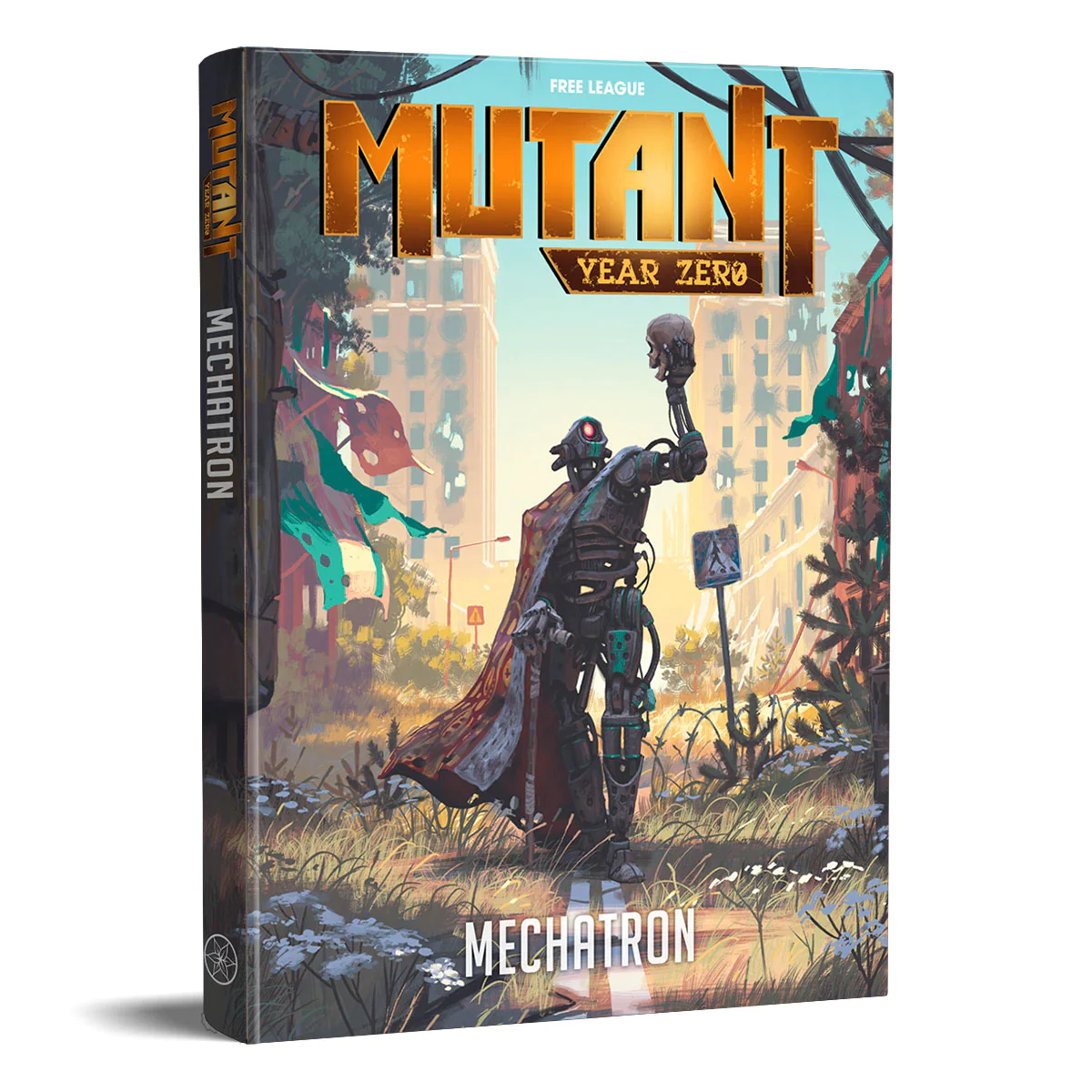
Mutant: Mechatron is Back in Print!

 Not only is Mutant: Mechatron back in print at a normal price at Free League Publishing, but a new book in the Mutant: Year Zero series is announced as well titled Mutant; Year Zero - Ad Astra. Mutants in space! 

It is possible that you are in the same camp I am and know why this is a moment for celebration, but if not, then know this tale: Several years ago in the before-times of the pandemic Mutant: Year Zero arrived on the scene with much surprise, and I was fortunate enough to grab it with all the cool bells and whistles back when Modiphius was distributing. Over time Modiphius and Free League parted ways (though recently that has changed again), and Free League books became tough to find, especially if you didn't back the Kickstarter. In short order I missed all three sequels (Genlab Alpha, Elysium and Mechatron). Last year one of the reasons I resumed collecting and then deep-diving into Free League books was due to a happy accident when my wife and I uncovered a trove of a gaming shop in Florida that had more gaming tomes than I had seen in years. Years! Among the many books I snagged there were all the books I was missing for the Mutant Year Zero lineup except one: Mechatron. Heck I even got the card deck....just not the book. 

It turned out it had a really limited print run for the Kickstarter and had never been reprinted. Mechatron was going for $400+ on Ebay auctions for the only three copies available anywhere (and I bet those sellers are wishing they had lowered the price just a bit now). I secured the PDF easily enough, but using the PDF is just not practical for me, I'm an old Gen X gamer, and my embrace of electronic books does not comport well with gaming tomes, it's just a problem with our generational model...we need that book in our hands to make the magic happen, plain and simple. 

So with this new announcement Free League has at last course corrected and is steering the Mutant Year Zero brand back on track. Celebration time! I have ordered my copy, time to wait patiently for it to arrive. 


Friday, January 6, 2012

Tales of the Cannadad Dei I: Sabiri, Gateway to the West


One thing I didn't do a lot of last year was provide actual content on the Realms of Chirak. Lots of Lingusia, Agraphar, Ad Astra and so forth, but nothing for this blog's namesake! That is about to change. Today I kick off a series of articles focusing on the Realms of Chirak, and the first few are going to focus on the Sabiri lands, a personal favorite of mine.

Since I've decided to go monogamous with my fantasy game system of choice this year, Pathfinder is my new hot-to-trot ruleset. Because of this, I will take time when possible to update Chirak references and details printed here to that system (or Legend...or both).

First, though, to get you up to speed I present the Sabiri entry from the Realms of Chirak Gazetteer:

Sabiri, Gateway to the West


Stoic nomadic plains culture which has been impervious to outside influence

Cultural Level: iron age

Population: approximately 2-3 hundred thousand

Government: loose clan-based tribal princes

Rulers: Zamad-Ruus in the north at Zen Hettar; various chieftains

Religions: ancestral worship, mixed with worship of Kobal and Amorgas.

Social Titles: few, usually a man is known for his deeds; merchant princes, warlords, heroes

Coinage: plenty of trade, no common coinage

Allies: The Sabiri trade with Pelegar, Madalios, Grelmaine, and Espanea

Enemies: The Sabiri regard everyone with suspicion, but especially Crystite and Helios.

The Sabiri people are nomadic pastoralists and traders. They are the primary people to bridge the gap between west and east for trade. The Sabiri are ruled by merchant princes who move in semi mobile communities of up to several thousand, and move in steady five to six year territorial circuits. They are reminiscent of the Hoagarit, but without the emphasis on warfare. The Sabiri worship Kobal, a spirit of the land which some believe is a demiurge with a shard of the Sagittarius stone. Kobal is known to roam the lands, looking much like a great, shaggy humanoid bison, somewhat like the bison that are herded and used for survival by the Sabiri. Besides Kobal, there is Amorgas, a quiet goddess of the Sabiri women, said to be the avatar of a woman who survived her sacrifice to Kobal when he became enamored with her.

The Sabiri people are a dusky, grey-skinned kin, human but with a nearly grey-white pallor to their skin tone, as if they are perpetually caked in a light dust or whitish clay. While both men and women enjoy piercing and tattoos for decoration, the women are prone to some extreme piercing with rings along their neck, ears, and other extremities.

Tattoos are a little more complicated, for a man with tattoos likely has magic. All native Sabiri sorcerers have a tattoo for each spell they have learned, and therefore a very heavily tattooed man can likely be considered a powerful sorcerer. Other tattoos of Sabiri society have powerful sorcery woven in to them, creating spell like effects that the wearer can invoke. A popular example is the Cult of the Asp, a society of assassins and mercenaries which are known for their serpent tattoos that can come to life on a command.

Westgate

The city of Westgate is a free port, loosely managed and governed by Espanea, which offers some protection for trade routes to and from the city. The governor of the city if an Espanean-appointed noble named Estobar Revan, and his garrison of troops is enough to insure he is not unseated. The local authority is a coalition of merchant princes, mostly of Sabiri descent from local clans in the western reaches of the Seas of Chirak. Westgate is cosmopolitan, and is the sole city to benefit from direct west-east trade routes. The local communities of Sabiri are the only permanent, non-nomadic people in the land.

Because Westgate is principally a trade port, Sabiri influence is actually somewhat subdued. The Sabiri are not a seagoing culture, and do not understand such things. The architecture of Westgate is a mix of Espanean and Masirian. The history of the city suggests it was originally founded seven centuries ago by Masirian merchants, then abandoned and repopulated by the Espaneans two centuries ago. It is the only city facing the West where you are still likely to meet Nithiadians trading with Espaneans and others; all traders are welcome here, and all trade is considered fair, regardless of politics.

Fartheren

Westernmost city once founded by the Sabiri as a center of trade and burial with a year-round population, Fartheren was conquered and made one of the Espanean colonies about two centuries ago. About a century ago, the Sabiri warlord Zvakattas struck out and destroyed most of the Espanean forts and colonies, but he met his end through betrayal at Fartheren and was entombed within the famous Necropolis of Fartheren, a vast city of the dead for the many ancient princes, kings, and warlords of the Sabiri people. This Necropolis is a famous locale throughout the region, well guarded and a very pricey location for prominent Sabiri princes to be interred. No monumental architecture (the famed ziggurats, which stand sometimes 100 feet or higher) has been built in about a century, however. Still, there are easily over two hundred such monuments in the vast city of the dead.

Other locations in Fartheren include the great markets, where the seasonal nomadic convergences gather, as well as the Tower of the Eternal Flame, a society of respected fire mages who worship the demon god Vargre. Near the center of town is the Governor's Palace of Espanea, where Governor Josen Salvos Grellacas still rules (although his position is secure mostly due to the support of the local Sabiri merchants). The chief justicar of the Espanean governor is the knight Arturo Palandro, A paladin of the Espanean crown.

Not far away, the immense octagonal, smoke filled temple of Kobal is built, a mysterious place of worship with feverishly dedicated priests who are as quick to strike out with punishment as to commit self flagellation. The leader of Kobal's sect in the city is a swarthy man called Vogol.

Still operating within Fartheren is the cult dedicated to the demon-spirit Boolion, called the Servants of the Shroud. Their numbers are small, but they pervade all walks of Fartheren society. Their secret leader is Zhomas the Irredeemable, who masquerades as a simple alchemist in the merchant quarter, but is in fact the cult leader and mastermind. His enforcers include Kuzraol the incubus, Gaerille the Merciless (a captain of the guard), and Lord Krevin'nar, of the Vitti tribe, an ally to both the Servants of the Shroud and the Arcanists.

Kadela

The ruined city of Kadela is avoided by most Sabiri, save those who trade with its dangerous inhabitants. The city was founded centuries ago by Masirian colonists who were driven out by the Sabiri warlords four centuries ago. It was later re-colonized by the Espaneans, who held it until it was sacked and destroyed by the forces of Zvakattas a century past. Since then, Kadela has become an enclave of hidden knowledge for the Arcanists, who discovered that the ancient library of the Masirians was still intact within the bowels of the city, and contained a great deal of forbidden magical knowledge. Now, the city is a refuge of teaching for the Arcanists, who are ruled by a dark woman of unknown descent called Middara Aegysaria. She is known to have summoned and bound at least three demons to her service, and is feared and respected by all Arcanists.

Uvalin

The City of the South is one of the few sacred gathering points of the Sabiri to be kept year round. This exclusively Sabiri city has a small continuous population which lives there and maintains its existence on the offerings of the visiting tribes which pass through. At any given time, two or three tribes will tend to be in the city, and as many as ten to fifteen thousand nomads may be in the area. Often, in the Summer these tribes gather for great war games, incredibly bloody sports of challenge in which different tribal warlords spar for the right to be called supreme warlord. No true warlord of the might of Zvakattas has come forth in a century, however.

As a true Sabiri city, Uvalin contains a great temple to Kobal, as well as a House of Judgment, where great crimes or concerns can be addressed before a selection of Ancestral Idols, each one a massive head carved of sacred stone and imbued with the spirits of great ancestors for divination. These heads are linked to the alignment charged planes, and can open portals to such planes, sometimes to engulf those who are presented before them and sweep them away to their fates in the planar realms. The heads are used to judge the truthfulness or character of the men who are presented before them, but the heads always require offerings. When activated without guidance, the heads will always seek to influence the soul of the man before them to become closer to the alignment of the judging idol, or to destroy that person if he or she is too dangerous to the ethos of the idol.

Zen Hettar

The northern Sabiri city of Zen Hettar is not unlike Uvalin in the south, but it is also a cultural interchange for the northern people of Madalios, who are ethnically related to the Sabiri, but have given up their nomadic ways. Zen Hettar is also currently ruled by the most prominent warlord of the nomads in the present, and man called Zamad'Ruus. Said by some to be the next great warlord, Zamad'Ruus seeks to conquer Madalios and destroy their infidel ways.

Madalios

Many smaller communities and two major cities comprise the more fertile, riverine lands of the Madalios people. Once Sabiri, the Madalios traded and interacted with the people to the north, in the crystite lands of Knos as well as the Zamedian elves of the mountains, and learned the ways of settled agriculture and civilization so elusive to the nomadic Sabiri. Over the last few centuries, they Madalios have settled in and given up the nomadic ways of their southern cousins, and accepted a regional rule of democracy by the men, who vote their leaders in to power, and then choose their warlords to run the armies which protect their lands from the Sabiri warlords to the south and the Crystite forces of the north. The current regent of Madalios is Ariman Daer, a strong young soldier who has displayed amazing tactical skill in repelling recent Sabiri incursions.

The Madalios people are peaceful, however, and seek only to defend themselves, preferring instead to dwell on their own means in their lush river valleys. Their two major cities, Diabaros and Kolmek, are heavily fortified and built atop the ruins of much older cities which date back to a culture which was forgotten and exterminated by the Crystite armies a thousand years ago.

The Madalians have also forsaken all religious faith for a peaceful coexistence with natural beliefs, and follow druidic beliefs to the exclusion of all others. They refuse to follow any other gods, and the reverence of the druids centers on the life-giving nature of their many rivers.


Next: the people of Sabiri