Saturday, April 18, 2015

D&D 5E Saturday Creature Factory: The Gargantuan Spider

Because giant spiders just aren't big enough, that’s why!

I used the giant spider in the MM as a base, but the gargantuan spider is simply a must-have for any high level game. When the spider as big as a Volkswagen no longer terrifies, try one bigger than a gas station instead!


CR 17 (18,000 XP)
Unaligned gargantuan beast
Initiative +2
DEFENSE
AC 17 (natural chitinous armor)
HP 300 (20D20+80)
OFFENSE
Speed 40 feet
Melee Attack – Bite +10 to hit (reach 15 feet, one creature) 8D10+12 piercing damage and the target must make a DC 18 CON save or take an additional 8D12 poison damage (half on a successful save). Targets bitten in this manner which are reduced to zero hit points begin to liquefy internally and roll disadvantage on death saves; if the target stabilizes he remains paralyzed for one hour afterward, even if hit points are brought back up to 1 or more.
Ranged Weapon Attack – Web-Blast (Recharge 5-6) +11 to hit (20 foot cone; all targets in area of effect); all targets in cone radius that are hit are also restrained. Targets in the area of effect can make a STR Save DC 19 to break free and move five feet. Any target moving into a webbed area is immediately restrained. Webbing is AC 10 and HP 30 (vulnerable to fire; immune to bludgeoning, poison and psychic).
Statistics
STR 22 (+6), DEX 14 (+2), CON 18 (+4), INT 5 (-3), WIS 12 (+1), CHA 4 (-3)
Skills: Stealth +7
Languages: none, though gargantuan spiders are cunning enough to grasp the meaning of some words
Senses: blindsight 60’, darkvision 60’, Perception +6 (passive 16)
TRAITS
Spider Climb – gargantuan spiders can climb like their brethren, though they often can’t find the surface space for proper purchase. Unlike their brethren they are unable to hang upside down due to their immense size and weight, so their spider climbing is limited to vertical surface only on which they can gain purchase.
Spider Senses – gargantuan spiders have web sense and web walker like regular giant spiders.

Gargantuan spiders haunt the darkest forests and deepest caverns. It is possible they are the long-lived survivors of giant spider kind grown immense with age, or they could be some natural denizen that was mutated by a mad wizard, planar magic, or weird interbreeding. Either way, they are terrifying.

Because of their size gargantuan spiders can’t hang upside down and they no longer spray strands of web but more of a “blanket” of webbing that hits an entire area….after which they pick and choose what they like to eat using their liquefying venom.


Friday, April 17, 2015

Star Wars Battlefront Trailer

I just want to say that it is a really good year to be a Star Wars fan:

Converting AD&D 1st Edition Monsters (such as from, say, the Creature Compendium) to D&D 5E


New Big Dragon Games' Creature Compendium is an amazing OSR book and one of many (Teratic Tome being a #2 on my list) that are really amazing resources for the modern classic gamer. But some of us run D&D 5E, so must we languish with our meager resources and ignore this OSR goodness? No! The conversion of classic monsters to 5E is actually pretty easy, and the rules for it are buried in code within the Dungeon Master's Guide itself.

The methodology I've worked up to convert AD&D monsters to 5th edition D&D is pretty straight forward, although a bit of handwavium and a steady application of holistic methodology is also involved.

So, here's the quick and dirty conversion guide:

Armor Class: take the creature's AD&D AC and subtract that # from 20. if it's a negative add it.

Hit Dice for Monsters: for monsters of most sorts take the hit die notation and convert it to a CR. Look up the CR on the 5E DMG chart on page 274. Write down the proficiency bonus, attack bonus, the desired hit points within the suggested range, spell save DC and average damage per round. If the Hit Die code includes a bonus then add 1 CR if it's a +1 or +2, and add 2 CRs to the formula if it's +3 or greater, but to the hit point total only (use the base hit die to determine CR for the rest). So, for example: HD 2 is CR 2. HD2+1 is CR 3 for hit points and CR 2 for all else. HD 2+4 is CR 4 for hit points and CR 2 for all else.

Hit Dice for Humanoids: treat the hit dice as actual hit dice, and assuming its a medium creature it has D8s. Figure out the average hit dice in this manner and then cross-reference with the hit point values on the chart to get the base CR and associated stats for the humanoid. This works best for monsters that are otherwise "humanoid" and would have normal hit dice and possibly also class levels. If you're not sure which option makes sense, compare both options for monsters and humanoids and go with the one that feels right.

Number of Attacks: turn this into multi-attack for the # of attacks indicated if more than one.

Damage/Attack: damage totals are much lower in AD&D than in 5E. Look at the damage average figured by CR in the prior step and compare to the damage output. My suggestion is to either tweak the existing damage totals until it averages something in the range of the expected CR, or to simply use a flat # based on the CR average, divided by # of attacks. Remember that the CR damage output is "total" so it would reflect the average damage of all normal attacks in the round.

A Formula for Damage: Figure the average damage out put for all per-round attacks of your monster (that he normally uses per round). Divide the average damage output by CR to get the multiplier; multiply the damage dice to figure actual damage output. Example: a dirt giant does 1D6+2 twice per round, so average damage is 11. It's CR 8 (by HD only) suggests average 5E damage output of 50-56. So divide 53 by 11 and you get 4.8 (round up) for 5. So each fist ought to do 5D6+10 damage now. Oi!

Poison/Energy Drain Conversion: any save or die poison effect should be converted to damage, and can be factored in to boost damage figures above. Any necrotic effect that involves energy drain should be converted into the "hit point maximum" drain that is standard for 5E, although if you really want to go hardcore just leave these as-is, using the CR-based DC for saves vs. poison or energy drain and failure = actual level loss, death, or what-not. Just warn your players in advance so they are ready with backup characters...

Magic Resistance: converting this is really simple (since there's one default type of MR in 5E) but since I don't think 5E's MR captures the full spirit of classic edition MR I suggest instead just going with the MR as defined by the monster (so, use percentiles and the rules in the monster stat block as-is, basically). If you do that, and it's especially tough on PCs compared to standard 5E MR, then consider adding 1-2 CRs for determining the XP value of the creature.

Size: this is a "eyeball it and convert" sort of thing. Most creatures will be small, medium or large but if you think a 25 foot tall monster is huge or gargantuan go ahead and apply that. This can be used to figure out actual 5E hit dice later.

Stats: these aren't too hard to figure out, by figuring out the modifier first and then applying a stat based on that. Alternatively just assume that the creature has a single "Save" stat equal to the CR attack bonus listed on page 274 (so for example a CR 4 creature would have a SAVE state of +5). For more nuanced results use these guidelines:

Strength: If it's clearly a large creature apply a STR modifier as seems fit (and use it to boost damage dealt if you like). If there is an existing bonus to damage for large STR use that to determine the modifier. For example, Fire Walkers in Creature Compendium have a +3 damage modifier +1 due to magic weapon) so they would be STR 14 (+2). Use good judgement....CC for example only provides a +2 STR damage modifier to dirt giant attacks, but that dirt giant in the picture looks more like a +5 modifier to me.

Once you have STR and DEX modifiers figured, you can use these #s plus proficiency or the average attack (whichever is better or more appropriate) for the monster.

Dexterity: if the creature is descriptively fast adjust as necessary, otherwise, assume at least a +1 or better modifier for each of the following: initiative bonus, ambush bonus (either to cause or avoid), any thief skills, any modifiers applied to ranged damage.

Constitution: this is easy, use the HD modifier if any. Add additional bonuses if the creature has poison resistance/immunity or other notable CON-friendly features.

Intelligence: convert directly using the AD&D intelligence chart for monsters (AD&D uses descriptors for INT, but there's a numerical equivalence to draw from). Or just apply a modifier as follows: Animal (-3), Semi (-2), Low (-1), Average (0), Very (+1), Highly (+2), Exeptional (+3), Genius (+4), Super-Genius (+5) (references from Creature Compendium).

Wisdom: set this to at least +2 or better if the creature has clerical or druidic magic. Add +1 for each point of MDA it has, if any.

Charisma: most floaty of all when it comes to monsters add a modifier based on your gut feeling, or at least +1 or more if it appears to have some form of bard-like magic. Set this at +2 or better if the creature has any charm/enchantment effects.

Skills: don't worry about these unless a specific skill-like trait is suggested in the monster description, then set it's rank at a level equal to the determined Stat modifier plus Proficiency bonus (or just use the SAVE modifier if using that simpler rule).

Movement: take the "inches" figure and multiply by 10 to get feet per move action. So a 3" move is 3X10 for 30 feet. This will work for most conversions....mostly.

Spell Conversion: surprisingly few spells in prior editions don't have some analog in 5E, I've found. For those that don't simply crib some notes from spell conversion in the back of the 5E DMG or substitute an appropriate different spell. For Spell save DC, remember to use the CR conversion above to figure the creature's average Spell Save DC modifier, or altenratively figure the spell caster stat (INT, WIS, CHA) from your calculation above and then apply the proficiency modifier by CR.

Converting Monster Special Abilities: converting the myriad special abilities of monsters in AD&D is the really hermeneutic part of the process. Many work fine as-is, while some need some holistic massaging to convert, usually by applying the 5E mechanical application of the effect (such as poison and energy drain which I singled out earlier). On pages 280-281 of the 5E DMG a list of creature abilities can point you to finding the equivalent effect for conversion. Ultimately my suggestion is to convert those traits which have consistent mechanics in 5E, and to use unique traits as close to original as possible in other cases.

Also, remember that judicious use of the advantage/disadvantage mechanic can solve a lot of modifier issues in conversion.

Psionics: 5E doesn't have psionics but some spells like detect thoughts can substitute for psionics if needed. Otherwise do like I did when I actually ran AD&D in the 80's and ignore....

Monster XP Value: The final CR of the creature, one all of the above have been determined, can be figured by applying the logic outlined on page 275 in the 5E DMG. Don't use the CR conversion on hit dice earlier....that's just to get the base stats rolling.

Optional - Figuring Actual Hit Dice: to figure the actual hit die value of your converted creature take the average hit points you determined in the HT to CR conversion at the start, then look on the 5E DMG to figure the correct 5E hit die type by size (if you're not 100% sure of the size just use your judement). Apply the CON modifier you determined (or default to any HD bonus in the stat block), take the average hit die plus CON modifier and divide the HP average by that amount to figure the actual hit dice. Example: A CC dirt giant has HD of 8+6. From this I look up his CR as 10 and get a HP range of 206-220, and I can set his CON as 22 (+6). So in 5E he's a large (11 foot tall) monster with D10 hit dice (5.5 average per roll). So 213 average hit points divided by 5.5 plus 6 for con for a total of 11.5 (round up on this). That works out to 19D10+114 for total hit dice! Which is normal for 5E, I assure you.

So with all of that, here's a sample conversion from the Creature Collection:

Dirt Giant (CC, page 30)
Large Giant TN
AC: 18
Hit Dice: (218) 19D10+114
Proficiency Base: +3
Move: 30 feet
STR 20 (+5), DEX 10 (0), CON 22 (+6), INT 9 (-1), WIS 10 (0), CHA 8 (-1)
Optional Save Stat: +6
Senses: blindsight; otherwise naturally blind. Perception +3 (passive 13)
Attacks:
Multiattack: two strikes per round with fists
Melee attack - hand gouges +8 attack (10 feet one target); (27) 5D6+10 bludgeoning damage.
Traits: 
Blindsense: Dirt giants are blind and detect movement through blindsight (see 5E MM) using a clicking sonar effect (think giant burrowing cordyceps zombies from The Last of Us). Silence spells can eliminate their blindsense creating an "invisibility effect".
CR: 10 (5,900 XP)

The dirt giant was an easy conversion. The next one is an example of holistic conversion in action:

Kam Warrior (CC, page 38)
Medium Humanoid TN
AC: 15
Hit Dice: (26) 4D8+8, then (13) 2D8+4 twice, then (7) 1D8+2 four times (total of (80) 12D8+24)
Proficiency Base: +2
Move: 30 feet
STR 14 (+1), DEX 11 (0), CON 14 (+2), INT 10 (0), WIS 10 (0), CHA 10 (0)
Optional Save Stat: +3
Senses: normal; Perception +2 (passive 12)
Attacks: 
Melee Attack - long sword +3 attack (one target, five feet); (5) 1D8+1 slashing damage
Traits:
Cloning: when a Kam warrior of 4 hit dice is reduced to zero hit points two kam warriors manifest on its next round as a bonus action as close as possible to where the kam warrior fell the prior round. Each of the new Kam warriors have the same stats but 2 hit dice. Each of these warriors, when reaching zero hit dice will split on the next round in the same manner into two 1 HD kam warriors. 1 HD kam warriors will die when reaching zero hit points. Each reductive iteration of the kam warrior has the same base stats and normal equipment of the original; only hit dice change. Magic gear does not replicate and stays with one clone at a time.
CR: 2 (450 XP) (I bumped it one because the damage output goes up each time you hack a Kam warrior down)

So....hopefully these guidelines, when applied to the monster design rules from the 5E DMG, will dramatically expand your choice of freaky denizens for delving. I strongly encourage you to pick up the Creature Compendium as well as the Teratic Tome as two great places to start with your OSRification of 5E!


Thursday, April 16, 2015

The Force Awakens Trailer #2

You've all seen this, right?


Consider me seriously stoked. Cautious optimism (I remember how great The Phantom Menace's trailer looked) but there's a lot to suggest that this could be really great.....

Player's Companion is now available in a POD format - Stars must be right

This is how the Old Ones build their evil cults. They do things like actually get an official D&D book into print on demand format for the starved masses who would really like to not have to make bootleg versions through Lulu (or just deal with PDFs). Pretty soon they'll be offering us PDF versions of the core rules in some easy to use format, and then they'll start hitting us up for minor sacrifices....nothing big at first, but gradually it'll work its way up to full-on humans.

Bad news, I'm telling you!

Anyway get it here now before the human sacrifices start! We must tell our Dark Masters to do more of this in the best way we can: by showering them in blood and money.


Wednesday, April 15, 2015

Print copies of Fifth Edition Foes, Book of Lost Spells and Quests of Doom I and II are in my hands


Just a note for those of you who were waiting to hear about final releases on this: all four books arrived Tuesday, and they look great with strong, solid binding, nice covers, and good thick pages designed to handle lots of use. If you were waiting to see these actually manifest before committing, now is the time!

Here's a run down on what each book offers:

Fifth Edition Foes: 259 pages of about 254 Fifth Edition Monsters, presumably many of which should look familiar to Tome of Horrors, Monstrosities and other Frog God product owners. Having these monsters in 5E versions makes conversion of other Frog God products much easier, and also means you can get the myriad monsters Frog God/Necromancer got special permission to remake back in the 3.0 D20 era, including some favorites of mine such as the Froghemoth and vegepygmies. No Orcus stat bar, alas. Either way, given the slow schedule of releases for official D&D 5E, having this book will prove invaluable to DMs everywhere.

Book of Lost Spells: 136 pages containing roughly over 700 spells. SEVEN HUNDRED. You could run a 5E game with this tome that never once sees the use of a PHB spell from your spell caster. And the amazing thing? Not many of these are spells that will cause your DM to go into spasms...too often. Many are very flavorful while not being game-breaking. "Story mode spells" if you will.

Quests of Doom I: 12 scenarios totaling 192 pages of various levels (a revision of a previous work for Pathfinder you may be familiar with). Includes various new monster and NPC stat blocks as well that you can recycle into your own games.

Quests of Doom II: an additional 6 scenarios in 100 pages (the rest of what didn't make it into volume I from the Pathfinder original). Only one Typo of Note so far (on the back cover, a bit groan-worthy but ah well).

As usual get these from Frog God here. If you order them directly PDF is free with the print version! I've had great success with them lately thanks to my habit of snatching up whatever coupons they fire my way each day, and I have to say that Frog God is one of the best online retailers I've ordered from.


Monday, April 13, 2015

D&D 5E: The Bagheera,a playable character race

A long time ago my wife came up with the vampiric pantherine bagheera (named after the Kipling panther) for a D&D 4E campaign. Below I present a 5E version for future use:

Bagheera
   A shifted demihuman species that was bred through magical means to attain primordial traits, including pantherine and batlike qualities. They are descended from an arcane culture of sorcerers and necromancers who imbued their creations with a vampiric lust for blood and magical longevity. The bloodthirsty and cannibalistic half-humans eventually turned on their masters and in turn became the masters of their realm, using humans as chattel until religious wars between zealous factions laid the civilization low and sent the survivors of the great war scattering across the known world.

Traits:
Attributes: +1 Dex, +1 Con
Speed: 35 feet; the long legs of the bageera let them sprint faster than normal.
Racial Abilities:
Predator’s Instincts: Bagheera have unusual hearing and a sort of sixth sense. Bagheera gain advantage on all perception checks rolled to avoid an ambush. 
Bloodthirst: Bagheera require the blood of other creatures for sustenance as food, and do not digest “normal” food normally, though they can sustain themselves on a carnivorous diet. A bagheera that can not feed on live blood or flesh in the course of one full day only recovers 1 hit die (instead of 1/2 his hit dice) at the end of an extended rest instead of a full recovery until such time as he feeds properly.
Sanguine Viciousness: When a bagheera deals damage to a target with zero hit points he may immediately spend one hit die as a bonus action. 
Vampiric Bite: Bagheera can bite, dealing 1D4 piercing damage and using their STR modifier for attack and damage. When biting in this manner the bageera immediately gains temporary hit points equal to the damage dealt. These temporary hit points disappear once used up or at the end of a short or long rest. Using this ability during the day counts as meeting the bagheera's bloodthirst requirement.


Saturday, April 11, 2015

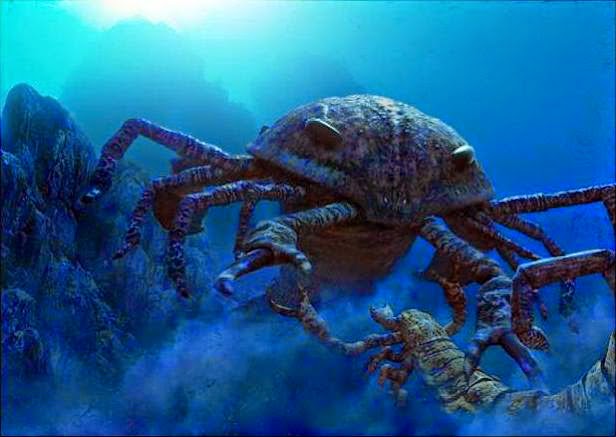
D&D 5E Saturday Creature Factory: Giant Sea Scorpion

Meet a primevil monster of the deep that occasionally likes to wade on land and snap up entire caravans in its claws....


Giant Sea Scorpion (Megalo-Eurypterid)

CR 13 (10,000 XP)
CE huge monstrosity
Initiative +1
DEFENSE
AC 18 (natural armor plates)
HP 250 (20D12+120)
Resistance: all non-magical or non-adamantine piercing, bludgeoning and slashing weapons.
Immunity: mind-affecting, charming or illusion magic have no effect on the creature (animal intelligence)
OFFENSE
Speed 30 feet on land, 60 feet in water (swimming)
Multiattack the sea scorpion may make two claw attacks and one tail stinger attack per round as an attack action.
Melee Attack – claws +11 attack (reach 15 ft; one target of huge or smaller size), 4D10+7 damage each and target is grabbed (DC 21 to escape!) on any round in which the target is already grabbed on the giant sea scorpion’s turn it deals automatic damage plus 4D10+7 additional damage to target.
Melee Attack – giant stinger +11 attack (reach 20 ft; one target), 4D12+7 damage and target must make a DC 20 save vs. Constitution or take an additional 4D12 poison damage.
Statistics
STR 24 (+7), DEX 12 (+1), CON 22 (+6), INT 1 (-5), WIS 7 (-2), CHA 6 (-2)
Languages: none
Senses: tremorsense 120’, Perception +2 (Passive 12)
TRAITS
Swimming: the giant sea scorpion is an agile swimmer and can move 60 feet per round in the water.
Muddy Camouflage: the giant sea scorpion with time can burrow into soft muddy earth along shorelines and remain very still. Atempts to detect the giant sea scorpion when it is disguised as such are Wisdom (perception) checks vs. DC 15, with disadvantage unless the prey is familiar with the terrain.
Limited Area of Attack: the giant sea scorpion can only strike targets in front of and to its sides. If a target can remain behind the creature it can remain out of its threatened area. The giant sea scorpion has to spend 15 feet of movement turning 90 degree in one direction on land (but not in the sea) as it is so large and bulky. As such, it must spend a full 30 feet of movement to turn around and attack targets behind it.

These are the apex predators of a forgotten era of time. The giant sea scorpion isn’t just an immense sea monster, it’s the king of all of the eurypterid class of primeval sea creatures, a relic of the Ordovician era that somehow has grown to be a large or larger than a house.

Despite its name the Sea Scorpion shares more in common with horseshoe crabs. It’s stinger is still deadly and just as likely to spear through a human sized target as it is to inject its painful paralytic poison. Its claws are large enough to sunder a horse. They are rarely found far from the muddy banks and shores of saltwater lakes and seas where they dwell. The giant sea scorpion is not an intelligent creature, and efforts to use it as a “watchdog” by mad wizards have usually proven disastrous.


The giant sea scorpion is otherwise a creature of instinct. It will glide effortlessly underwater looking for whatever prey happens in front of it. On land it will wallow on to shore and then conceal itself in muddy holes while laying ambush for any large prey that passes by.


Friday, April 10, 2015

GURPS Savage Space: Revisiting the Kokatik

As I continue my renewed obsession with GURPS, time to revisit the Kokatik from last year, this time statted out for GURPS Space. The kokatik are an aquatic species that is a significant rival of the Commonwealth of worlds, and its anthropomorphed cephalopod citizens are very suspicious of land-dwelling aliens.

Kokatik exploring Gamma Polaris
The Kokatik

Located rimward, toward the edge of known space and out toward the edge of the Milky Way, the kokatik have been exploring space and slowly colonizing worlds for nearly two thousand years. They are a species of amphibious beings, coming from their gaseous waterworld once in the Kunares star system that was once designated KOI-314c by humans. The kokatik are a hearty species that has adapted very well to both temperature and pressure extremes due to their warm gassy homeworld. Because of this adaptability they are able to colonize a wider range of worlds than humans can, and often find warm gaseous worlds within 1-3 Gees to be comfortable. Despite having the appearance of some sort of batrachian, the kokatik are a distinctly unique vertebrate species of something more closely resembling a cephalopod. The hardened shells of their ancestors turned into a sort of exoskeleton, which provides a web of internal support structure for high gravity and high pressure environments.

Kokatik are a slow, methodical species. They are not aggressive though they will employ deadly force if needed to resolve an issue, and they are more than capable of it, having developed some very sophisticated weaponry and maintaining an impressive stellar navy. Early contact with the kokatik, which actually took place with some anticipation due to the discovery of abandoned research stations on Gamma Polaris, revealed that the kokatik are suspicious and concerned about other species, and slow to earn trust. After contact was formally initiated and they were invited into the Federated Commonwealth more history came out and it was revealed that the kokatik had fought an extensive interstellar war early on in their spacefaring days, against an aggressor race called that fashan, a war which they won, bombing the fashan back to the stone age and quarantining their homeworld. Needless to say, the Federation Navy took note of this capability for such total salting-the-earth destruction against a declared foe.

Kokatik come off to humans as inscrutable and mistrusting, regarding other species with a persistent sense of caution.

Kokatik Alien Profile:

Kokatik are hydrocarbon-based lifeforms, so indigenous to worlds that Terrans will also find somewhat comfortable. The kokatik are perfectly at home in underwater environments. They can breathe in water environments and have a filtration system in their gill-like lungs which can filter necessary oxygen and other gasses even from more exotic liquids, but they have a secondary set of lungs that process air when out of water as well. Kokatik are still amphibious, and must remain immersed in water or other liquid with a fair amount of oxygenation for at least 1 hour per Terran standard cycle (day). Kokatik usually wear pressure suits with filtered water systems when moving about in human territory. Kokatik are also very hearty in high pressure atmospheres and very cold environments due to the deep sea environment of their home world. This adaptive advantage has given them a unique edge, including improved survival in both the bottom of the ocean and the depths of space. Finally, kokatik come off as cold, aloof and mistrusting of others, making their interaction with humans a difficult experience.

You can make a Kokatik character with the following template:

Kokatik Racial Package (57 points)
Attribute Modifiers: IQ+1 [10]

Secondary Characteristic Modifiers: Move-2 [-10]

Advantages: Amphibious [10], Doesn’t Breathe (trigger: water, common, -20%)[16], Nictitating Membrane 2 [2], Pressure Support 3 [15],  Dark Vision (can see colors) [30], Temperature Tolerance 6 (cold from -25 to 90 degrees for HT 10)[6]

Disadvantages: Dependency (water immersion, very common; daily)[-15], Intolerance -3 (all aliens)[-10], Callous [-5]

Skills: Swimming HT+3 [8]

Kokatik Explorer (sample NPC, 207 points):

Ras M’Lond, Senior Scout
Ras M’lond is a Kokatik scout who works for the Kunares Exploratory Survey Fleet, which is slowly mapping out the galaxy and paying close attention to the actions of the Commonwealth. He is at once repulsed by alien races not of the Kokatik biotype and also singularly obsessed with them, albeit in a creepy stalker-with-cameras kind of way, so he made a perfect candidate for the Exploratory Survey Fleet’s astrographic mapping initiative. His stats are based on the kokatik racial package above plus the GURPS Space Explorer template.

ST 12, DX 12, IQ 13, HT 12
HP 15, Will 12, Per 13, FP 15, Basic Speed 6, Basic Move 4
Advantages: amphibious, doesn’t breath (trigger: water, common), nictitating membrane 2, pressure support 3, dark vision (can see colors), temperature tolerance 6 (cold), danger sense, G-Experience 5
Disadvantages: dependency (water immersion, daily), intolerance -3 (all aliens), callous, loner 12-, workaholic, xenohilia 6- (loves aliens even if he doesn’t trust them)
Racial Skill: Swimming 15
Primary Skills: Cartography 13, Geography (terran worlds) 13, Navigation (sea) 15, Piloting (transitional space drive) 12, Vacc Suit 12
Secondary Skills: Biology (terran worlds) 11, Survival (desert) 13, Electronics Operation (sensor) 13
Background Skills: Computer Operation 13, First Aid 13, Swimming 12, Writing 12, Beam Weapon (rifle) 12

Protection: Kokatik Expedition Suit (works as the suit in Ultratech pg. 178, but provides a water moisturization to skin when worn; a human in this suit could drown if the settings aren’t corrected); DR 5, flexible

Armament: Blaster (Electron) Rifle (Damage 6D(5) burn, sur; ACC 10+2, ROF 3, Shots 10(3), Bulk -4, Recoil 1, Range 700/2100)

Wednesday, April 8, 2015

The World of Cenotaph in GURPS Space

Cenotaph in GURPS Space
Because I can, and because I've been exploring GURPS a lot again lately, I thought I'd stat it out using GURPS Space. There may be a lot more GURPS Space in these entries:


Cenotaph is currently a center of research on the relics of the largely intact Cenotaph civilization, and a study of the survivor species, which appear to be a mutational mix of megafauna and imported alien lifeforms that reside in "bands" of livable territory where the radiation and fallout of twenty centuries earlier have not sterilized the planet. Despite the surviving life, it is too risky to place an outpost on the planet and only temporary settlements for research of no more than a week with shielding are permitted right now. Researchers outside of the Academy regularly stay at the Orbital Station (called Portal) working under contract or doing private research on Cenotaph. The lone Eidolon Titus dwells in the largest ruin on the planet, the once-great city he calls Denosius.

The explorers and researchers on Cenotaph are welcome, but the lure of ancient yet intact technology brings all sorts of relic hunters to this corner of the galaxy. The very modest local presence of the Colonial Defense is understaffed and all told has thirty men and one local system cutter for defense. They don't really think they need it, though: the eidolon Titus has proven to be an effective one-man army against any threats to the system.

Cenotaph Statistics:
Orbital Radius: .99 AU around a G2 star (NGC 8876 "Holt's Respite" after the first scout surveyor to visit the system)
World Type: Standard (Garden; but damaged due to radiation/ancient warfare)
Diameter: 8,800 miles
Moons: two captured asteroids (C1 and C2)
Atmosphere: thin (.79 atm); the nuclear effect on the planet has damaged what was once an earth-normal atmosphere
Hydrographic Coverage: 56%
Climate: 300K (kelvins), normal (60 to 80 F average; up to -20 F at poles) - Cenotaph is on the verge of or possibly recovering from a runaway greenhouse effect that has since subsided, possibly due to atmospheric scrubbers that still function in certain ruined installations.
World density: 
Gravity: Normal (1.1 G) (This section in GURPS Space goes well beyond what we need for a high-action SF game so you can figure out density, mass and all that if you like from the imposed gravity...)
Dominant Terrains: Desert, irradiated
Settlement Type: Research Outpost
Population: Extremely Sparse (rugged animal life and one eidolon named Titus, plus "Portal," the orbital Academy Research Outpost of about 3,000); the planet is capable of sustaining more in the "habitable bands" but requires development.
Government: Academy policy (corporate); world unity (but special; limited to Academy outposts)
Control Rating: CR2 (free; limited to loose corporate/academic policy and procedures defined by the  Commonwealth Charter of Development Standards for Free Colonies; only LC0 and LC1 are banned)
Customs: strict Academy protocol for handling hazard worlds
Tech Level: the dead Cenotaph civilization was significantly more advanced than the Commonwealth today (13+). The outpost has access to Commonwealth normal (11) but trails due to remote location (10-delayed).
Spaceport: The Academy Research Outpost Station is Class II (frontier)
Installations: On Starport: colonial office, corporate office, private research center, patrol base; On Planet: private research center, nature preserve, government research center (this is classified), possible pirate base (cloaked)