First off Watch this:
Next up, here is Mike Pondsmith talking about the game, its legacy, and what is to come. Great to watch, and great to see Mike Pondsmith talk about one of the greatest contributions ever to grace tabletop RPGs that doesn't involve dungeons or dragons, hands down:
I don't have a lot on my radar, but I'd say that in the realm of video games, this one is on top. Going to be a long wait, but worth it.
Some of the early press releases seemed to imply that there would be an official revamp/revision of the tabletop edition of the game to precede or accompany the video game. I haven't seen or heard any more about that, hoping it's a Thing and not just reading into the press releases too much. Hmmmm.
Next: maybe Mike can license out Mekton?
Monday, January 14, 2013

The Colonization of Astrophikus

The Colonization of Astrophikus
Astrophikus was colonized by the first
humanoids about ten thousand years ago. To be fair, there were many humans and
demihumans already dwelling on Astrophikus at that time, though they were
dwelling in a state of barbarism and had no technology and culture to speak of.
The first civilized colonists to arrive on
Astrophikus speak of half-forgotten myths of a great exodus, and a lost world
from which they had fled after a cataclysm that left their original home a
devastated ruin. The colonists followed the will of their fabled god, the Golden Traveller Etah. Even
today Etah is strongly worshipped, and is the patron god of the empire of Ashetnur.
The Astrophikans all agree that their world
was once in the sky, a sister to Astrophikus, but it was destroyed. There is
some perceived truth to this; the great Haze, a vast swath of asteroids midway
between Lingusia and Astrophikus is claimed by many to have been the origin
world of the first colonists. A fairly unpopular movement amongst some
well-read activists claims that the ancient texts support the idea that the
home world of all Astrophikans was destroyed by ancient magic, and that some
suggest it, too, was a prison constructed to contain one of the ancient chaos
gods, one which escaped. Stories of the ancient entity Dalroth from Lingusia’s
pantheon have pointed to this dark god as the one which burst forth from the
mantle of their lost world, creating the Haze, though others more familiar with
the sacred texts of Lingusia (The Idean Codexes) point out that Dalroth existed
long before the time of destruction, and no references are ever made to his
imprisonment.
In any case, it was ten thousand years ago,
upon primitive orichalcum-driven spelljammers that the first Astrophikans
arrived on their new world. They found a world inhabited by primitives, for
whom even fire was often a new phenomenon, and tool use was no more complex
than stone and reed. These early travelers brought with them a fraction of the
glorious history, knowledge and magical power of their lost culture, but it was
enough to make themselves kings among the natives.
The sum total of the last ten thousand years
of history can be described as one of perpetual conflict and evolution. The
first colonists secluded themselves for a very long period from the natives,
though such exclusion eventually crumbled in some cases. Over time, the
Astrophikans learned that their new home was also a great source of orichalcum,
although it had apparently become a lost or forbidden art for a time, for it
was many thousands of years before the early empires developed enough
sophistication to once again mine for the mystical ore and at last turn to the
production of the stellar and planar spelljammers for trade and commerce with
other worlds and planes.
In ten millennia wars have been fought,
nations have risen and fallen with typical speed, and the Astrophikans slowly
recovered their lost knowledge of ancient sorcery. The natives grew and
learned, sometimes gifted with knowledge by the foreign powers, other times
subjugated. The mysteries of Astrophikus’s curious position in the solar system
and the importance of the many planetary alignments became the province of the
priests of the Star God, who grew up rapidly in their beliefs, taken from the
mysterious sacred obelisks, the largets of which is at the center of the
Vulmeadean capitol, Gyldarion. These obelisks, of which a dozen have been found
around the world, each tell of the tales of the Star God Draeggaron, and the
imprisoned entity Sulziddaran within the heart of the world. So it was that the
Temples
It was about three thousand years ago that
the civilizations of Astrophikus recovered all their lost knowledge of
spelljamming, and began to develop new ships in earnest. Over time, this
changed the landscape of the world from one of normally developing
civilizations, spreading outward and developing local resources to support
large rural populations around feudal townships and cities in to one of a
strangely different nature. Today, Astrophikus is dominated by vast, ancient
ruin-filled tracts of land, with immense city hubs from which most trade and
commerce comes from the plains. The merchant princes of the various empires are
the true force behind each city, for they are the lifeblood. Rural townships
spread out, though rarely for more than a hundred miles, providing some modest
resources locally, but the enriched citizens of the empire are given to a culture
of art, religion, philosophy and culture, as well as a talent for magic rarely
seen in most other realms. The merchant princes are extraordinarily proficient
at their trade, buying and selling commodities off world to amass vast wealth,
and bringing in the precious goods necessary for the opulent lifestyles of each
city of the various Astrophikan empires.
Outside of the “hub” of each city, beyond
the rural farmlands, is a no-man’s land of the barbarian kingdoms,
monster-ridden realms and isolated mining communities where vast complexes
dedicated to the extraction of orichalcum from the depths of the earth can be
found. Only the desperate and criminal tend to become miners, for life is short
in this profession. Nonetheless, the seemingly endless supply of orichalcum is
vital to the survival of the Astrophikan way, for without it as the only local
resource of true worth, the empires would lack the vital material necessary to
sustain the hulls of spelljamming vessels. Without orichalcum the empires would
collapse and anarchy would reign.
There are several strong empires in
Astrophikus today: Vulmeadea, Tanantsanu, and Ashetnur are three noted empires
on the super-continent. Each empire has its own ancient history, and maintains
careful military forces to prevent neighbors and barbarian kingdoms from
interfering with their city hubs.
Sunday, January 13, 2013
State of Contrast: How different RPG publishers framed 2012 going into 2013
Green Ronin recently posted its "2013" overview of things to come, and the hint that they are doing reasonably well (two new staff hires, plenty of products lined up for this year). It's in stark contrast with the more earnest but doomy Mongoose State of Mongoose I mentioned previously, which paints a bleak picture for the tabletop industry (or more specifically Mongoose's corner of it). So on the one hand Mongoose sees tabletop at an all time low, and while there's a dedicated fanbase for their RPG products, its not enough to keep them from doing more than shifting to a POD/online approach to their books. Functionally in my neck of the woods this will have no impact other than to make getting their books slightly harder if they don't put them into distribution....but so far I'm guessing the plans to do this are farther away, because my FLGS says it can order the latest batch of upcoming Legend books for me.
Meanwhile, Green Ronin is doing quite well, and I am pleased because it means I can continue to support Mutants & Masterminds and the Dragon Age RPG, as well as the eventual AGE System release they keep hinting at. Unlike Mongoose, Green Ronin is focused entirely on tabletop RPGs, and licensed RPGs in particular, as their bread and butter. GR is also good at keeping existing popular products (cough >Freeport< cough) in print and available for numerous systems. Lastly, GR puts out products at a slower, more methodical pace.....but their products always look great, and have fewer problems on average with editing issues and errata, in my experience.
I haven't seen Steve Jackson's Year-End recap yet, and I think he started this tradition a few years ago. I can predict it will talk about the glory of Ogre Deluxe, Munchkin, and have more off-comments about GURPS as a niche that is supported entirely by PDF product now, with vague suggestions that the game just doesn't sell well (despite the fact that not offering print products for a tabletop experience will by definition limit the audience to just those people who have accepted PDFs as a viable way to experience the game's content). I remain slightly bitter, of course, because when it comes to RPGs I still prefer print product for the table, and have not yet found electronic books to be useful at the game table (and indeed groups which were primarily electronic often ran into a sort of "laptop/tablet paralysis" when actually trying to game.)
Other publishers don't tend to chat as much, but Goodman Games did well last year according to their website, and I am inclined to believe it. DCC ended up not being a game I cared for....I think I'm getting a bit burned out and jaded at the entire revivalist/fetishist approach to the hobby's roots these days, due mainly to the fact that I have--wait for it!--played too much (been there, done that, it's lost its magic for me)....but it is absolutely a great game for what it does and there's a definite market for it. There's a lot more DCC on the horizon, and in contrast with, say, the open license for Legend there is also a lot more 3PP DCC material out there now, and to come. This is a damned good thing, I think. It also shows that the old school revivalism has a definite niche that is large enough to support a decent product in print and circulation (Frog God's Kickstarters have been proving this too, I think....just not in a way that makes their products accessible to a person like me who prefers to support his local FLGS).
Speaking of Frog God Games, they've got the Razor Coast Kickstarter going into 2013. I think that, even without a recap of 2012, the Frog God has done quite well, both for its S&W and Pathfinder support, and has some noteworthy Kickstarters to prove it. Razor Coast appears to be no exception. About the only thing stopping me from backing it is that it's set to end in ten days, and I need to be conservative with my cash right now as I just found out I'm moving in February. Still....if things go well, I'll invest if time permits. Otherwise I'll just have to hope that somehow, some way, there are extra copies afloat in the future. With Frog God it's hard, because they don't make the sort of books one can drop a twenty on....they're not targeting the kind of gamer I was back in the early 80's (i.e. younger gamers), they're targeting the old collectors with money (like me now). Still, it's hard to properly justify such a lavish purchase these days. Unlike most forty-somethings, I have a brand new kid here and now commanding my time and money; your average guy my age or olrder usually has a kid or two who's already flown the coop, so that's just a unique spot I'm in, and the average Frog God follower has probably got the time and money to spare.
I'm not really going anywhere with this, other than to provide a few contrasting examples with the doom and gloom of Mongoose and the anticipated "GURPS is niche" feel of SJG's annual reports. Honestly, sometime your product (like GURPS) is just plain-old niche, and maybe this is where it was destined to end up. And for Mongoose....maybe their issue has more to do with Mongoose's long-running reputation in the industry for quality control issues, and bottom lining the cost and appearance of their product. Or maybe the print RPGs at Mongoose just don't bring the money in like their miniature games do. Either way, It seems like maybe the industry isn't contracting...it's just changing. Again.

Meanwhile, Green Ronin is doing quite well, and I am pleased because it means I can continue to support Mutants & Masterminds and the Dragon Age RPG, as well as the eventual AGE System release they keep hinting at. Unlike Mongoose, Green Ronin is focused entirely on tabletop RPGs, and licensed RPGs in particular, as their bread and butter. GR is also good at keeping existing popular products (cough >Freeport< cough) in print and available for numerous systems. Lastly, GR puts out products at a slower, more methodical pace.....but their products always look great, and have fewer problems on average with editing issues and errata, in my experience.
I haven't seen Steve Jackson's Year-End recap yet, and I think he started this tradition a few years ago. I can predict it will talk about the glory of Ogre Deluxe, Munchkin, and have more off-comments about GURPS as a niche that is supported entirely by PDF product now, with vague suggestions that the game just doesn't sell well (despite the fact that not offering print products for a tabletop experience will by definition limit the audience to just those people who have accepted PDFs as a viable way to experience the game's content). I remain slightly bitter, of course, because when it comes to RPGs I still prefer print product for the table, and have not yet found electronic books to be useful at the game table (and indeed groups which were primarily electronic often ran into a sort of "laptop/tablet paralysis" when actually trying to game.)
Other publishers don't tend to chat as much, but Goodman Games did well last year according to their website, and I am inclined to believe it. DCC ended up not being a game I cared for....I think I'm getting a bit burned out and jaded at the entire revivalist/fetishist approach to the hobby's roots these days, due mainly to the fact that I have--wait for it!--played too much (been there, done that, it's lost its magic for me)....but it is absolutely a great game for what it does and there's a definite market for it. There's a lot more DCC on the horizon, and in contrast with, say, the open license for Legend there is also a lot more 3PP DCC material out there now, and to come. This is a damned good thing, I think. It also shows that the old school revivalism has a definite niche that is large enough to support a decent product in print and circulation (Frog God's Kickstarters have been proving this too, I think....just not in a way that makes their products accessible to a person like me who prefers to support his local FLGS).
Speaking of Frog God Games, they've got the Razor Coast Kickstarter going into 2013. I think that, even without a recap of 2012, the Frog God has done quite well, both for its S&W and Pathfinder support, and has some noteworthy Kickstarters to prove it. Razor Coast appears to be no exception. About the only thing stopping me from backing it is that it's set to end in ten days, and I need to be conservative with my cash right now as I just found out I'm moving in February. Still....if things go well, I'll invest if time permits. Otherwise I'll just have to hope that somehow, some way, there are extra copies afloat in the future. With Frog God it's hard, because they don't make the sort of books one can drop a twenty on....they're not targeting the kind of gamer I was back in the early 80's (i.e. younger gamers), they're targeting the old collectors with money (like me now). Still, it's hard to properly justify such a lavish purchase these days. Unlike most forty-somethings, I have a brand new kid here and now commanding my time and money; your average guy my age or olrder usually has a kid or two who's already flown the coop, so that's just a unique spot I'm in, and the average Frog God follower has probably got the time and money to spare.
I'm not really going anywhere with this, other than to provide a few contrasting examples with the doom and gloom of Mongoose and the anticipated "GURPS is niche" feel of SJG's annual reports. Honestly, sometime your product (like GURPS) is just plain-old niche, and maybe this is where it was destined to end up. And for Mongoose....maybe their issue has more to do with Mongoose's long-running reputation in the industry for quality control issues, and bottom lining the cost and appearance of their product. Or maybe the print RPGs at Mongoose just don't bring the money in like their miniature games do. Either way, It seems like maybe the industry isn't contracting...it's just changing. Again.

Friday, January 11, 2013
The Wednesday Group!
Ben Klein of Active Imagination took some photos Wednesday night which he posted on Facebook. Here, then, is the Wednesday Game group, in the midst of our ongoing Realms of Chirak campaign....yes, that's me behind the GM screen (and wall of Coke Zero, which Jason brings a ton of to every game):
 |
| From the GM (me, center) to my right: Mark, Jason, Brien, Jeff, Sean, ah...Mary? (Sorry, she's new and I don't remember her name!) and Dima (sleeping after a long work day from Starbucks...) |
Astrophikus - Stellar Cartography

The Stellar Cartography of Chaos Space around Astrophikus
Because of the elaborate and advanced use of
flying ships called Spelljammers, Astrophikus is a rare interplanetary
civilization. The various kingdoms and empires of the world are all reliant on
this interplanetary and planar travel, creating an unusual local enconomy in
which the planet’s greatest empires depend largely on imports and exports for
their continued subsistence.
Spelljamming vessels are designed to travel
through the planar realms, and from the planar realms they can reach other
distant points of existence in the material realm. Spelljammers are capable of
traversing the Ether
Sea
In the realm of chaos space there are
several other worlds that are regularly traded with, including Hyskortius, called the “Winking Eye” by
some, a curious water world with no land, as well as the vast inner world of
Lingusia, a great disc-like construction with twenty times the land mass of
Astrophikus. Lingusia is known to be a prison as well, much like Astrophikus,
though it harbors twelve ancient entities called the Krakens. Lingusia, unlike
Astrophikus, has no orichalcum of its own, and its civlizations lack
space-faring capability. Nonetheless the Astrophikans allow for travel to and
from this immense world (around which the sun and Astrophikus itself revolve)
for trade of more conventional goods, although they are usually limited to
those cities which are open to the presence of flying magical vessels from
strange lands (Octzel and Naminthia are most well known for their appreciation
of ether merchants.)
Because Astrophikus and the sun both revolve
around the great disk world of Lingusia, this creates some unusual astronomical alignments and
conjunctions. All of these phenomona are given special mystical properties
around which great ceremonies are held. When Lingusia, the Sun, and the moon
Metaros reach a conjunction, for example, that is considered a time of great
prosperity and all warfare must cease for one year, during which even criminals
are excused of their crimes by the Vulmeadean Empire, for example.

Wednesday, January 9, 2013
Fate Core - An interesting contrast in RPG kickstarters
I'm backing Deluxe Tunnels & Trolls right now, which is about double its goal after only a few days running. I've been eyeballing some other kickstarters, such as the Frog God's Razor Coast books for Pathfinder, which once again I'd honestly like to back but can't justify the impressive price tag for. Of course there are projects peripherally related to tabletop gaming like Pathfinder Online, which looks like it will be failing unless a secret cabal of stinking rich Pathfinder addicts who also happen to want a fantasy Eve-like to play in manifest out of the blue. Then I noticed this one:
Holy cow! Admittedly their target goal was $3,000 so they had a modest initial expectation and cost on this project, but now it's at $240K and growing. I think I'm going to back it, and I'm not even sure I like fate, because at least I can get a copy of the core game for a paltry $30, which is a pretty good deal and FATE is sort of the in-thing these days, it seems.
Anyway, it is interesting that the engine for a good percentage of indie titles out there has legs like this. I do wonder if FATE's appeal stems from new growth in the hobby, or if its because the system appeals to a different more story-gamer post-90's breed of non-D&D gamer. Something to ponder, I suppose...
Holy cow! Admittedly their target goal was $3,000 so they had a modest initial expectation and cost on this project, but now it's at $240K and growing. I think I'm going to back it, and I'm not even sure I like fate, because at least I can get a copy of the core game for a paltry $30, which is a pretty good deal and FATE is sort of the in-thing these days, it seems.
Anyway, it is interesting that the engine for a good percentage of indie titles out there has legs like this. I do wonder if FATE's appeal stems from new growth in the hobby, or if its because the system appeals to a different more story-gamer post-90's breed of non-D&D gamer. Something to ponder, I suppose...
Tuesday, January 8, 2013
Astrophikus: Principia Geographica Mythologica

One of the occasionally visited realms that manifested during one of my Spelljammer campaigns in the early nineties, Astrophikus likes to keep popping up in current campaigns ever since, a strange fantasy realm which is inextricably tied to the weird realm of fantasy wildspace. Astrophikus has appeared in 2nd, 3rd, 4th edition and pathfinder campaigns. It may make an appearance again soon in my planned 5E playtest. I'll be throwing some data on this into the blog in the coming weeks for fun...
Astrophikus: Principia Geographica Mythologica
"The Jewel of Chaos"
Astrophikus is a small world, perhaps half
the size of the Earth. It exists in a region dubbed by Spelljamming explorers
as “chaos space,” a solar system where it is said that the power of the
Primordial Chaos God ruptured the fabric of space-time, as it attempted to
reclaim the vastness of the material plane in to its crawling chaos. It has often been dubbed "The Jewel of Chaos" for the small but lush world is regarded as a paradise by those who have traversed the empty realms of the ether and the phlogiston for far too long.
Astrophikus operates like a fairly dense but
otherwise normal world. It is spherical, and has normal gravity, despite its
smaller size. The world has modest oceans, one at each polar cap, and several
large lakes and a single inland sea, though less than 40% of the world’s
surface is covered in water. The world has temperate extremes across the globe,
with strong, humid equatorial regions rife with growth, leading out to vast
cold deserts in the inland regions furthest from or most protected by the
coastal regions. At the poles much of the water is locked in ice caps;
likewise, many of the largest mountains stretch out in to the thinnest regions
of atmosphere, where ancient glaciers remain forever locked in ice.
Astrophikus has a thick crust and deep
mantle, beneath which the mythology of the land claims lies one of the more
terrifying progeny of chaos, the destroyer god Sulziddaran. Indeed, most of the scholars of Astrophikus assert
that this world is, in fact a vast prison designed to contain the dreaded god,
forced in to perpetual slumber by his prison-keeper, the baleful elder god Draeggaron, usually called the Star God. Astrophikus is notorious for
its terrifying earthquakes and volcanic events, and these are usually
attributed to the restless movements of the slumbering Sulziddaran.
Astrophikus has two small, curiously shaped
moons. The mythology of the moons is complex, a strange tale of dark power, in
which the moons were once a single whole. Each moon contains the ruins of a
vast city that was once said to be a single great metropolis from which
Dreaggaros and his minions held watch over their charge, the entombed chaos god
below.
As the story goes, Draeggaros’s lesser
seraph minions grew complacent, and in time they lost sight of their overall
purpose, for Draeggaros himself had passed on the the Astral Sea and moved in
to the outer realms of thought, only occasionally being called back to his
realm through great sacrifice or need. This complacency led to corruption from
within, and a dark cult of infernal beliefs insinuated itself within the city
of the seraphs.
Over a period of eons the cult expanded and
turned in to a terrible conflict that wracked the Great City
Thousands of years later, the myths of the
two moons are known to all. The dark moon, called Ternikos, is a vast graveyard of undead and infernal devils. The
powerful and evil entity called Halistrak the Lich Lord is the ruler of this
realm, or at least portends to be. The other moon is called Metaros, and its ruins are filled with
weird and ancient mysteries, mad angels and other strangeness. Rumors suggest
that somewhere deep in the heart of this moon Metatron still dwells, where he
was instructed to continue vigilant watch over the prison world below.
Current belief on Astrophikus suggests that
the two moons, which can fall in to alignment once every century, will bring
terrible doom, earthquakes and bad luck during this period if a valued living
sacrifice is not offered to the god Draeggaros, to call him back from the Outer
Realms to impose his will upon the world and set things aright.Though it has
been many thousands of years since at least one of the major cities of
Astrophikus failed to offer sacrifice, the stories do tell of a terrible
cataclysm two thousand years ago, in which the planet suffered a year of
quakes, floods, plague and famine the likes of which none could imagine. As
such, all of the kingdoms of the world today invoke regular sacrifices to call
upon the protection of Draeggaros during lunar alignments.

Monday, January 7, 2013
The Pathfinder Online Horse Race
I've been having fun watching this one. I have no stake in it--their design goal is a big step away from the sort of game concientous "casual" carebears like me want to participate in...i.e. fantasy Eve is not a selling point for me--but I still like the concept of Pathfinder and pretty much anyone succeeding at what they attempt. I admit to being skeptical of their business model....their manpower....their goals...and even why this game is called Pathfinder, a game which bears little actual resemblance to the thing PFO is described as setting out to be. But anyway....seven days left!
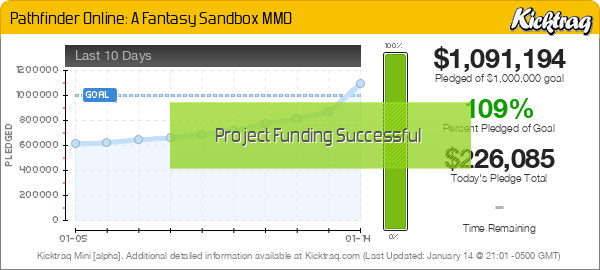
One bit I find interesting is that they've announced they are using the Unity Engine to design Pathfinder Online. This is an engine which I was unfamiliar with until literally a few days ago, after buying my Nexus 7 Tablet. It turns out a lot of Android/iOS and indie games are designed using Unity (including two recent new faves of mine, Dead Trigger and Shadowgun), which is a weird sort of deal, because it seems to me its a decent enough engine to design games that need to look good on small screens with tablet-level processing power, but not so sure it's going to look as good as...say...the next generation or two of MMOs that are going to be coming out between now and the prospective 2015 release date for PFO.
One bit I find interesting is that they've announced they are using the Unity Engine to design Pathfinder Online. This is an engine which I was unfamiliar with until literally a few days ago, after buying my Nexus 7 Tablet. It turns out a lot of Android/iOS and indie games are designed using Unity (including two recent new faves of mine, Dead Trigger and Shadowgun), which is a weird sort of deal, because it seems to me its a decent enough engine to design games that need to look good on small screens with tablet-level processing power, but not so sure it's going to look as good as...say...the next generation or two of MMOs that are going to be coming out between now and the prospective 2015 release date for PFO.
Saturday, January 5, 2013
Tunnels & Trolls Deluxe is Funded!
I actually pledged last night at the $60 level, and as of this morning T&T Deluxe has passed its funding goal, so it's all gravy and cake from here on out!
I'm really looking forward to this next iteration of T&T, which is sounding a lot like it could very well encompass the totality of T&T as all its fans imagine it, and add more cool stuff in on top of it. Ken St. Andre drops hints and bits to those of us over at Trollhalla about its direction and design, which of course only wets the appetite for the final product.
T&T Deluxe, along with Legends of Dawn and the colorvision edition of the Castles & Crusades PHB marks my third delve into Kickstarter. I can see how this phenomenon gets addictive...it's like buying a tiny stake in a creative venture, and to contribute to those creators that I know and respect (or, in the case of Legends of Dawn, just impressed me sufficiently) is a lot of fun.
Although I love T&T myself, and have been playing it since I discovered the 5th edition boxed set around 1982ish at Wargames West, I do have an ulterior motive to my love for this game: I have kept every module, solitaire, edition and variant (from MSPE to Monsters! Monsters!) in a special box, and plan to hand it all over to my son in about 8-9 years, should he look like he's following in his dad's footsteps. T&T is an ideal game to introduce new and younger gamers to, not just a fine system for the old school grognards out there.
Friday, January 4, 2013
Legends of Dawn Kickstarter

When it comes to Kickstarters I like to back stuff that meets the following criteria:
1. They look like they can deliver
2. The description of the product does not involve aerial baked goods
3. The group in question appears to know what they are doing, and demonstrates it in their video and presentation
Unlike another fairly famous Kickstarter effort for a fantasy game, Aurofinity and Dreamatrix appear to have a near-finished product ready for delivery (thus KS seems to be a promotional tool more than anything), they are not describing lofty goals, they do indeed appear to know what they are doing, and demonstrate a nice looking product that is comprehensible. They are also catching me in a weird mood these days, as I've got this thing for isometric RPGs again, and since Baldur's Gate Enhanced hasn't been released for Android yet....I need something to sate my ceaseless thirst for tiny adventurers traversing monster-riddled landscapes, and Legends of Dawn looks like it can deliver!
Anyway, they say February, so I'll letcha know if it happens. I backed at the basic level, and it looks like they ought to make their $25K goal (I'll be surprised if they don't).
Subscribe to:
Posts (Atom)