Monday, March 5, 2012
Some Halo 4 Stuff
There's video footage and discussion here on Videogame Writers, but I thought it was interesting for a few odd reasons:
1. I like that they plan to have some story focus on the "why" of the eternal multiplayer combat of the Halo universe. Up to now, one could only assume more or less that all multiplayer events and arenas for the most part were purely for the game, or if they had a story context it was all "pre Reach."
2. Every single person in this video on the design team looks tired and worn out. Lots of coffee in various shots, I couldn't help but notice. I bet 343 are working their assess off around the clock to make the December 2012 deadline.
3. Spartan IVs? I like!
And....well.....that's it. I am sure the new game will tie heavily into the novels being written by Greg Bear, which I really need to get around to reading soon.
Okay, back to your regularly scheduled tabletop blog!

Steam Box? Also: The fine art of focused storytelling vs. the problem with sandboxes; or, Metro 2033 vs. Dead Island

First off, this story has me interested: apparently there's more than a little reason to believe that Valve is looking at a dedicated PC design with console features. At first I was thinking, "whatever, I've got my PC at home already," but I concede a few ideas sprung up which make the concept more tantalizing. Notably:
More games that normally only see life on consoles could come to a dedicated "Steam Box," as the design intent behind a console (dedicated architecture) would hopefully lure some of these console-only designers over to offering up ports on a Steam Box. And no I am not a PC elitist who likes to bitch about "console babies." There are plenty of console-only games out there I'd love to be able to play without buying a Wii or PS3. Unfortunately it probably won't help with the 1st party releases designed to sell systems (Gears of War, Halo...the two I care about in this case) but maybe games that normally never see life on the PC would get a chance this way. Maybe. (And also probably a flood of console shovelware too, I am sure...)
It would open up my Steam account to a console that is optimized for sitting on my comfy sofa couch in front of my 55 inch screen TV. Admittedly, I can hook my PC up to my big screen TV right now and play games, but I've found that this experience is not at satisfying as simply playing with the Xbox on the big screen (and don't even try to get any real work done this way!) So for the sake of design and convenience, why not.
It might have a chance of dethroning Microsoft and Sony from their console pillars. I'd like to see that just for the hell of it.
 |
| In Mother Russia, Pip Boy Wear You! |
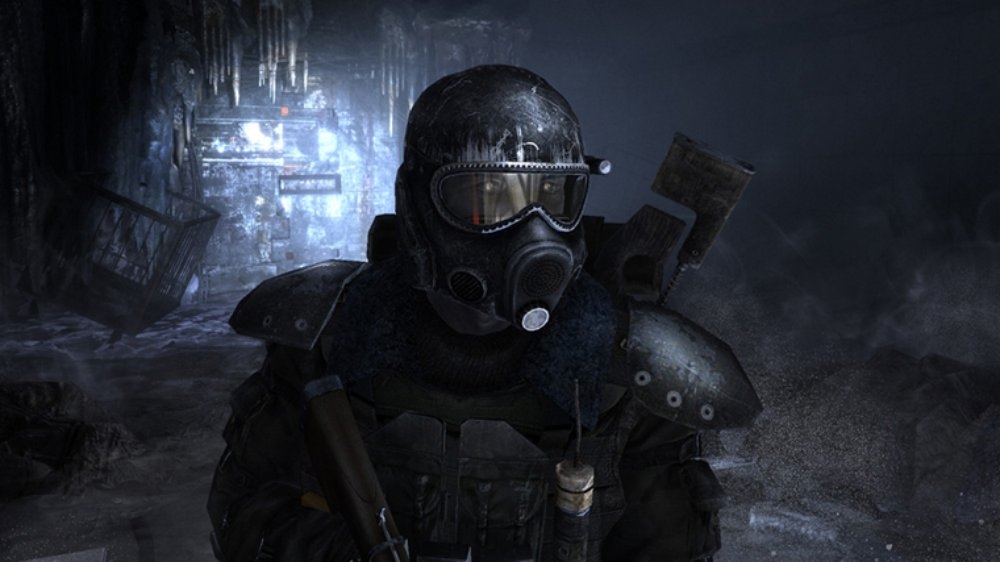
Okay! So anyway, as of today I am at last 92% finished (according the the little meter) in Dead Island. By the time this sees print I should be done with it and probably experiencing the agony of poor design that is allegedly found in the Ryder White DLC. We'll see. I also finished Metro 2033 this weekend, even with a baby sitting on my knee staring intensely at the screen while I blew up dark one amoebas (and crying ceaselessly if I tried to put him down; I have no idea why this kid was so fascinated at watching Metro 2033, a game I felt rather nervous about playing with him even being in the same room. Hmmmm definitely my child, though)
Dead Island and Metro 2033 are both amazing games. Both have some weaknesses, but their strengths overcome those, for the most part. Moreover, I look forward to the sequels, because unless suits and marketing start meddling in these games the sequels should only get better. But it was interesting to realize that Metro 2033 was ultimately a more satisfying experience, albeit frustrating at times, if only because it was semi-linear (providing linear levels, but with a modest range of options in how to complete each level) and as a result Metro 2033 was able to focus heavily on mood, atmosphere and integrated story telling. When I got to the end of Metro 2033 I felt like I had experienced a meaningful and coherent story arc.
Although I won't be done with Dead Island until tonight, I have to say that the game's efforts at atmosphere and immersion, while excellent, nonetheless began to wear on me toward the end. The game did mix it up....just when I was starting to think that the second act in the city would never, ever end, suddenly I'm in the Jungle, and then I'm in a research facility, and next thing I know I'm exploring ancient Maori cults on the island. Despite this, and perhaps because of the finsl prison level, I still felt like the game's sole purpose was to exhaust the hell out of me while keeping me in a perpetual state of mild confusion. I think it's because while the game's efforts at creating a sort of sandbox zombie apocalypse environment for me to explore are impressive to experience, I absorbed almost all of that ambience and got my fill of it in the first 12-15 hours of the game, before I'd even penetrated the second act. So by the time I reached the fourth act, I had lost any connection to the "setting immersion" element it had early on, and was no firmly wrapped up in the "gameplay element" which honestly gets a bit redundant. See zombies. Kick them down, hack them up, move to next group, click on quest goal, repeat.
 |
| Also, Dead Island could have benefited from not having constant, unending respawns MMO-style... |
It doesn't help that Dead Island's ability to tell a story is a shoddy mess. The vast plethora of side quests are, while appropriately narrated, almost entirely disconnected from the player character and consist almost exclusively of fetch quests, occasional escort quests, and periodic "clean up" quests, all thematically at odds with the ragtag gang of four that the story is supposedly about. Of the four possible player characters, only the asian gal really strikes me as a "do-gooder," the other three are hard-as-nails amoral survivors with personal agendas that never really get directly addressed throughout the storyline. Worse yet, whenever the game does have a major cutscene or story event, apparently Dead Island was designed under the expectation that at all times you would have all four characters represented, so these storylines are jarring when you see all four protagonists engaging in discourse about a situation or taking action, then the cutscene ends and its back to just you in a solo run or maybe one or two other co-opers.
Despite the lack of coherence in the storyline, and despite the fact that every damned side quest in the game is an annoying and irrelevant sidetrek that only the most lawful good of paladins would bother with ordinarily, Dead Island does have a story, and its a rather interesting one when taken as a whole; the problem is that the developers of this game clearly are not used to the optimal way to stitch together a coherent plotline in a sandbox environment. I'm no authority on the GTA series of games, but it does seem to me that Rockstar has this sort of approach down to a science. Just play Red Dead Redemption for an example of how to do this very well. In fact, for a full-on zombie experience with coherent storytelling get the Undead Nightmare DLC for some wild west zombie action, too...
So in the end, Metro 2033 was much shorter than Dead Island, but was rewarded with a more focused and coherent storyline and an experience that never got old because it used its set pieces and interesting bits to great effect. Dead Island in turns has felt like someone did not edit a film, and instead released several dozens' of hours of raw footage through which I have been methodically watching, at once fascinated, bored, energized and irritated with occasional brilliant moments shining through.
 |
| Carmen Sandiego, Where Are You?!?!?!? |
Isomular: A Planetary Romance Campaign Setting Using True20
I've had Isomular...or what I completed of it, in the can now for many years. I wrote the original back in 2003 or thereabouts for use with the Expanded Psionics Handbook with 3.5 D&D, and then quickly adapted it to True20. I've toyed with using Isomular as a GURPS, 4E, Traveller and BRP setting at different times, but ultimately because its a weird mix of space fantasy, psionics and high tech meets swords & sandals it was easier to keep it in a system that focused on genre blending, and so True20 remains my favorite iteration. Anyway, For March I present you with everything I wrote on this particular weird world....

Isomular
The Land of the Whispering Kingdoms
A Planetary Romance Campaign Setting
Isomular is a campaign world firmly rooted in the Planetary Romance genre of science fiction and sword & sorcery. Tales of Barsoom from Edgar Rice Burroughs, the travails of Howard’s Almuric, The Krishna tales of Sprague de Camp and the adventures of Thongor by Lin Carter are all tales in this classic vein. The big thing to remember about planetary romances is that they readily abuse science, freely mix weird science gadgets and concepts with high fantasy swords & magic, and the heroes are usually the pretty ones in the midst of a barbaric land of hideous monsters, vile villains and nubile damsels in distress. Isomular is all about that!
The following adaptation should give you everything you need to run adventures in the Land of the Whispering kingdoms using the True20 rules. All standard rules apply with no modifications, except as noted. This is a genre-subversive setting, and oen can readily blend a mix of fantasy, SF and adventure together to make it work best.
The History of Isomular: The Native Viewpoint
If you ask a native of Isomular where his land and world is, he will tell you, “At the center of the universe.” How might he know this, you ask him? “Because the Architect deemed it so.” Isomular is a world of strong will and unyielding belief. Behind it all is the shadow of the being called the Architect, a man who is like a god, yet whose philosophy is so profound that it necessarily commands the people of the world to accept a near-magical belief in their own inner strength.
Isomular was colonized by the races of men long ago when the Architect, a being of immeasurable power, transported the chosen few of humankind to this world, that it might live and prosper. When the Architect brought his flock forth on the wings of the great Coral Ark, it fell in to the sea and the people waded ashore in the regions now known as Kalashtam and Zymvaj. Amongst the diaspora of man were the many races they had become, including the true humans, the Engineers, the half giants and the now supremely rare true giants. The Bael, Empathics, and Eldaran were known by different names then, but such are the names they are known by now.
These first men washed ashore to a land already occupied by the myrmidons, Isomulii, and other strange species, none even remotely human. Isomular, as it would come to be called, was inhabited by many unusual beings.
In those early days, men were struggling to survive, and there was a time that the Isomulii and other dominant races took pity on man and let him occupy their cities. In this time, the myrmidons were servants of the superior species, and humanity realized that the Isomulii had decided upon this destiny for the strange primates that joined them. Meanwhile, the remnants of the Coral Ark still rested like a great projection of white bone out in the sea, and the Architect brooded upon the fate of man. He at last determined that it would be necessary for his children to take ownership of Isomular.
This early era was a period of bloodshed and warfare, as humanity revolted against the Isomulii empire and, with the aid of the myrmidons and other thrall races, cast out the insectoid overlords. The Isomulii were unprepared and fell in a century of conflict, their surviving kin driven in to the jungles, deserts, and wastelands of the world. This happened two thousand years ago, according to the record halls of the Archivists.
With humanity in control of the great and ancient cities of Isomular, there was a short period of peace and prosperity during which the people sought the enigmatic dictates of the Architect to guide them, and looked to their new alliance with the myrmidons to keep the clockwork architecture of the ancient Isomulii engines running. For a time there was peace, but inevitably it would not last.
First, the Architect fell silent in the third century since man’s arrival. One day, the Disciples of the Architect returned from their villages on the atoll near the Reefs of the Architect, with word that he had fallen silent, and spoke no more. Unable to determine what had happened or why, humanity suddenly found itself without a voice of leadership. Initially, they looked to the disciples for guidance. The disciples were the first of the Eldaran, the enigmatic servants of inner light who were born to serve the Architect. Unfortunately, in this early era, men who grew unhappy with the will of the Eldaran turned on them, and humanity descended in to conflict and war.
A dark age fell upon the land, as the diaspora of men turned on one another. First the giants and many half giants marched north, to seek out their own kingdoms in the strange wilderland of Isomular. Then the Engineers, stout and short, descended in to the depths of the stony caverns which laced the world’s mountains. The Eldaran slipped in to obscurity, as they became a secretive order, to preserve what knowledge of the Architect they could during this barbaric time. The Bael as a people migrated southward, and the maenad thrived among men, relishing this time of high emotion. After another three centuries, the races of men had dispersed across the two continents. Humanity in the most populated central region founded the four great kingdoms that would come to be called Zymvaj, Kalashtam, Hadrushar and Eremach. The first great king to unite any of the lands came in the ninth century, an Empathic named Tonaras Zar. He founded the first Kalashtam Empire, and conquered his neighbors, bringing about a local unity that lasted more than a century.
Eventually, the kingdoms of humanity became stable and consistent forces, and the world moved out of the traditional Dark Age. The Order of the Archivists was founded, dedicated to historical research and the sometimes forgotten teachings of the Architect. The Eldaran, behind the scenes, began to teach the lost arts of inner strength, the will of psionics, to others outside of their secret culture. During this time, many monasteries were founded, each dedicated to a specific philosophy or doctrine of belief. By this time, the memory of the architect was steeped in mysticism and religion, and the faithful were developing complicated religious teachings based on what little the people remembered of the revered savior.
It was in the thirteenth century of man that the first of the Others arrived. Terrible portals to the beyond, the land that would be called the Astral, were ripped open to pour forth armies of the evil beings called shedahai. Driven by dark masters called the Annunaki, the shedahai were an army sent through strange dimensions to find and destroy the diaspora of man. Their dark masters were the huntsmen of a great evil, who had invested cosmic levels of power in seeing to the destruction of all humanity. A terrible war erupted, and for a time, the kingdoms of men were stricken with terrible losses against an unpredictable foe.
During this time, an Eldaran called Vedderik Non journeyed to the Reef of the Architect, to invade the ancient halls of the Coral Ark and seek out answers to this inexplicable enemy. His discoveries were shocking, and when he returned, he spoke as the new voice of the Architect, whom he had awakened. Vedderik Non became the first of the Voices, special servants of the Architect who were his direct vessels, avatars of the savior. Through Vedderik, the lost arts of planar travel and astral conduits were given to the monastic orders of the psions who had taken up arms, and the fight was taken to the shedahai’s planar homes. There, these psychic warriors discovered that the shedahai were true slaves of the Annunaki, and they fought with the shedahai at last to free them from the yoke of tyrrany. The shedahai who were grateful for this aid, and willing to make peace with humanity broke away from their hostile kin, who sued for peace only long enough to rally. The more peaceful group came to be called the kazavai, and they remained tentative allies of the men of Isomular.
It is now one thousand nine hundred years since men were saved by the Architect and transported to Isomular. Many mysteries of this land remain undiscovered, and many questions have yet to be answered. The fifteenth voice of the Architect has just taken up the mantle, a young human named Astenar Gadarik. The kingdom of Kalashtam is the seat of power and trade among the four great kingdoms and the many lesser ones.
Next: A Map of Isomular Plus The Secret History

The Land of the Whispering Kingdoms
A Planetary Romance Campaign Setting
Isomular is a campaign world firmly rooted in the Planetary Romance genre of science fiction and sword & sorcery. Tales of Barsoom from Edgar Rice Burroughs, the travails of Howard’s Almuric, The Krishna tales of Sprague de Camp and the adventures of Thongor by Lin Carter are all tales in this classic vein. The big thing to remember about planetary romances is that they readily abuse science, freely mix weird science gadgets and concepts with high fantasy swords & magic, and the heroes are usually the pretty ones in the midst of a barbaric land of hideous monsters, vile villains and nubile damsels in distress. Isomular is all about that!
The following adaptation should give you everything you need to run adventures in the Land of the Whispering kingdoms using the True20 rules. All standard rules apply with no modifications, except as noted. This is a genre-subversive setting, and oen can readily blend a mix of fantasy, SF and adventure together to make it work best.
The History of Isomular: The Native Viewpoint
If you ask a native of Isomular where his land and world is, he will tell you, “At the center of the universe.” How might he know this, you ask him? “Because the Architect deemed it so.” Isomular is a world of strong will and unyielding belief. Behind it all is the shadow of the being called the Architect, a man who is like a god, yet whose philosophy is so profound that it necessarily commands the people of the world to accept a near-magical belief in their own inner strength.
Isomular was colonized by the races of men long ago when the Architect, a being of immeasurable power, transported the chosen few of humankind to this world, that it might live and prosper. When the Architect brought his flock forth on the wings of the great Coral Ark, it fell in to the sea and the people waded ashore in the regions now known as Kalashtam and Zymvaj. Amongst the diaspora of man were the many races they had become, including the true humans, the Engineers, the half giants and the now supremely rare true giants. The Bael, Empathics, and Eldaran were known by different names then, but such are the names they are known by now.
These first men washed ashore to a land already occupied by the myrmidons, Isomulii, and other strange species, none even remotely human. Isomular, as it would come to be called, was inhabited by many unusual beings.
In those early days, men were struggling to survive, and there was a time that the Isomulii and other dominant races took pity on man and let him occupy their cities. In this time, the myrmidons were servants of the superior species, and humanity realized that the Isomulii had decided upon this destiny for the strange primates that joined them. Meanwhile, the remnants of the Coral Ark still rested like a great projection of white bone out in the sea, and the Architect brooded upon the fate of man. He at last determined that it would be necessary for his children to take ownership of Isomular.
This early era was a period of bloodshed and warfare, as humanity revolted against the Isomulii empire and, with the aid of the myrmidons and other thrall races, cast out the insectoid overlords. The Isomulii were unprepared and fell in a century of conflict, their surviving kin driven in to the jungles, deserts, and wastelands of the world. This happened two thousand years ago, according to the record halls of the Archivists.
With humanity in control of the great and ancient cities of Isomular, there was a short period of peace and prosperity during which the people sought the enigmatic dictates of the Architect to guide them, and looked to their new alliance with the myrmidons to keep the clockwork architecture of the ancient Isomulii engines running. For a time there was peace, but inevitably it would not last.
First, the Architect fell silent in the third century since man’s arrival. One day, the Disciples of the Architect returned from their villages on the atoll near the Reefs of the Architect, with word that he had fallen silent, and spoke no more. Unable to determine what had happened or why, humanity suddenly found itself without a voice of leadership. Initially, they looked to the disciples for guidance. The disciples were the first of the Eldaran, the enigmatic servants of inner light who were born to serve the Architect. Unfortunately, in this early era, men who grew unhappy with the will of the Eldaran turned on them, and humanity descended in to conflict and war.
A dark age fell upon the land, as the diaspora of men turned on one another. First the giants and many half giants marched north, to seek out their own kingdoms in the strange wilderland of Isomular. Then the Engineers, stout and short, descended in to the depths of the stony caverns which laced the world’s mountains. The Eldaran slipped in to obscurity, as they became a secretive order, to preserve what knowledge of the Architect they could during this barbaric time. The Bael as a people migrated southward, and the maenad thrived among men, relishing this time of high emotion. After another three centuries, the races of men had dispersed across the two continents. Humanity in the most populated central region founded the four great kingdoms that would come to be called Zymvaj, Kalashtam, Hadrushar and Eremach. The first great king to unite any of the lands came in the ninth century, an Empathic named Tonaras Zar. He founded the first Kalashtam Empire, and conquered his neighbors, bringing about a local unity that lasted more than a century.
Eventually, the kingdoms of humanity became stable and consistent forces, and the world moved out of the traditional Dark Age. The Order of the Archivists was founded, dedicated to historical research and the sometimes forgotten teachings of the Architect. The Eldaran, behind the scenes, began to teach the lost arts of inner strength, the will of psionics, to others outside of their secret culture. During this time, many monasteries were founded, each dedicated to a specific philosophy or doctrine of belief. By this time, the memory of the architect was steeped in mysticism and religion, and the faithful were developing complicated religious teachings based on what little the people remembered of the revered savior.
It was in the thirteenth century of man that the first of the Others arrived. Terrible portals to the beyond, the land that would be called the Astral, were ripped open to pour forth armies of the evil beings called shedahai. Driven by dark masters called the Annunaki, the shedahai were an army sent through strange dimensions to find and destroy the diaspora of man. Their dark masters were the huntsmen of a great evil, who had invested cosmic levels of power in seeing to the destruction of all humanity. A terrible war erupted, and for a time, the kingdoms of men were stricken with terrible losses against an unpredictable foe.
During this time, an Eldaran called Vedderik Non journeyed to the Reef of the Architect, to invade the ancient halls of the Coral Ark and seek out answers to this inexplicable enemy. His discoveries were shocking, and when he returned, he spoke as the new voice of the Architect, whom he had awakened. Vedderik Non became the first of the Voices, special servants of the Architect who were his direct vessels, avatars of the savior. Through Vedderik, the lost arts of planar travel and astral conduits were given to the monastic orders of the psions who had taken up arms, and the fight was taken to the shedahai’s planar homes. There, these psychic warriors discovered that the shedahai were true slaves of the Annunaki, and they fought with the shedahai at last to free them from the yoke of tyrrany. The shedahai who were grateful for this aid, and willing to make peace with humanity broke away from their hostile kin, who sued for peace only long enough to rally. The more peaceful group came to be called the kazavai, and they remained tentative allies of the men of Isomular.
It is now one thousand nine hundred years since men were saved by the Architect and transported to Isomular. Many mysteries of this land remain undiscovered, and many questions have yet to be answered. The fifteenth voice of the Architect has just taken up the mantle, a young human named Astenar Gadarik. The kingdom of Kalashtam is the seat of power and trade among the four great kingdoms and the many lesser ones.
Next: A Map of Isomular Plus The Secret History
Friday, March 2, 2012
2221 - After the Nemesis Cataclysm: The Second Story Arc

For the life of me I can't find the precis on the first story arc (although it is briefly summarized at the start of this) but there's some fun stuff in here for the second story arc, so I figured I might as well include it:
Campaign: Post-Apocalypse 2221 – Story Arc 2
Premise: The PCs have just finished rescuing (or so they believe) the new Chief Administrator of New Eden from certain death at the hands of what appeared to be a surviving cybernetically enhanced assassin, perhaps sent by the Jovians.
Shortly after affecting the rescue, the PCs discover that they have lost all communications with New Eden, and an investigation reveals that the air waves are simply dead....the air waves are silent, except for one sudden anomaly a comm officer might discover: a curious radio station broadcasting from a location calling itself the “White Mountain Getaway,” with the following message intermixed between stations:
“Welcome to the White Mountain Getaway Station, last bastion of civilization in the greater Southwest Territories. Remember that you can always come on up to the White Mountain resort to get away from all your worries. For all of you listeners out there who can't make it, here's some soothing music to sooth your aching souls. I'm Diana, your DJ, and here's a rare classic from 2094 by the cyberpunk bank 01011001...”
Other than this broadcast, and an occasional mysterious and inexplicable “screeching” data burs of encrypted data from some mysterious location in the north, the air waves remain dead.
Encounter Events:
The “Grish”
These are humanoid reptile men. They are led by one who calls himself “Gorm.” A study of their DNA reveals that someone has spliced (heavily) from human and gila monster DNA, to the point where it is difficult to tell which was the base species and which was the receptor species. There are six in the group, looking to trade (they mostly have food stuffs and salvaged metal worked in to simple tools and weapons). They have some local knowledge for sale as well, and speak reasonably good “spanglish.” They can mention that they know where Castle Warren is. They have a single solar-powered radio that they were given by a “shiny metal man” a year ago, and use it to listen to the radio station from White Mountain. They have never been there....Gorm says that all his kind who have gone that way are believed to have died, though none have a conclusive story as to how (but ghosts play a part). Finally, he knows of “Castle Warren” in the mountains and will mention it.
Tom Saw
This eccentric fellow lives in the wilderness and trades with both the cannibals and the apache. He is a shiny, metal-skinned man (thus not edible) and runs a small farm all by himself, from which he grows crops and sells them. Though he looks like an android with plastic-metal dermal protection, he is in fact a human replicant, with the working tissues of a real human inside the protective polymer shell. Tom Saw doesn't know who or what he was in his prior life....he has vague memories of working on a star ship, for example, but he seems to have forgotten most everything else about his old life. He is very helpful, and can offer up lots of produce and other goods to the PCs. He has no weaponry of any kind, but he says he doesn't need it....he hides in an old bunker when danger approaches. He does have lots of kerosene on hand, though, and a solar array for power. He also raises animals, including classic sheep, pigs and horses as well as one domesticated “grand cabbage” (one of the purple-cauliflower monsters) which it turns out provides edible honey-like pollen when it blooms.
Castle Warren and Professor Edmund Warren
The mysterious castle Warren is known by many locals, but few understand its occupant or his goals. Warren is a throwback, a transgenic survivor of the old age, who through telemerase resequencing treatments managed to extend his own life by centuries. He looks about 50, now, but he is well over 200 years of age.
Warren survived the apocalypse by hiding within one of a number of special bunkers created during the months leading up to the catastrophic bombardment, in which the greatest minds of the 22nd century were put in to hibernation, along with the materials necessary to aid in rebuilding society when they awakened after the cataclysm began to recede. Unfortunately, Bunker Phoenix-119 was right in the path of the “stitching” event that led to massive regional bombardment by the meteor debris field dragged by Nemesis. Of all those who were ensconced within the bunker, only a handful survived the devastating shockwaves that collapsed the vast bulk of the complex. Years later, self-repairing robots inside the complex at last reawakened and managed to revive Professor Warren and two others, including the physicist Victor Thane and Patricia Wells, the senior head of transgenic engineering at the New World Medical Institute. According to Warren, the latter two quickly left to parts unknown, seeing the complex as a total loss.
Warren stayed on. With the help of “Jack” a solitary advanced repairbot and two sentry drones he began salvaging whatever he could, then migrated to the nearby new mountain ranges (which were pushed up from tectonic shift caused by the bombardment). There he established his “castle,” which as of the current date now contains a working telescope, radio observatory and partially working particle relay equipment tied in to the rebuilt remnants of the subterranean Supercollider that he has used several additional repair drones to reconstruct beneath the earth.
Warren has now managed to observe a number of interesting details. One such detail is that the Seed Pods around the world seem to be communicating, but they are using high speed burst transmissions that are heavily encrypted and broadcasting on a very low end of frequency ranges in tiny amounts. They are also, he has observed, communicating through some sort of high-energy particle wave. He has a massive particle detector recovered beneath the earth that was orignally used for dark matter reasearch. This complex was, until recently, transmitting evidence of what the doctor now believes to be faster-than-light particles being transmitted in bursts by the Seed Pods. This complex recently went silent, and he doesn't know why. He'll likely want the PCs to go down below to see if they can fix it....although he sent a repair droid to do the work, it also has never been heard from again.
Warren thinks that a recent, increasing array of FTL bursts suggests a communcication is being carried out with parts unknown, and he is worried he's missing out on the data necessary to piece together what's happening. If the PCs do as he asks, then they will have to find the entrance to Phoenix Bunker, had on down, and see if they can “fix” the problem...
Warren will not tell PCs about one of the things he WAS doing: he had successfully captured and deactivated a Seed Pod using hibernation stasis equipment from the bunker and has been trying to replicate its communications abilities, to see if he can communicate with the xenoforms in control of these devices (if indeed they aren't the xenoforms themselves). He thinks that the terraforming process is well underway, and stage two is: colonization!
The Phoenix Bunker
This bunker is actually more intact than one would imagine, but hundreds of stasis hibernation pods failed for some reason early on. Much of the gear within this complex was lost in a cave-in around the storage compartments, but Prof. Warren has managed to gather a great deal of it. Some notable locations in the bunker are described below:
Hibernation Chambers (many dead people here after stasis pods failed...careful search may reveal that the failure was....deliberate!)
Command Center (The bunker AI is still functional here, but has been cut off from all other activities in the complex. If it gets restored, it can inform the PCs that all bunker controls have been relayed to Warren's castle complex)
Storage Pods (most collapsed, although drones have recovered much here)
Supercollider Array (28 miles of tunnels; cleared and restored by drones)
Medical Bay (still works, but over-run by a strange group of subterranean mutants who use its facilities; Patricia Wells is held hostage here)
Particle Detector (elevator system leads to this location 4 miles deep; the detector is offline right now, sabotaged by Victor Thane, who has returned to stop what he sees as Warren's madness in attempting to communicate with the Nemesis Xenoforms)
Some Wandering Encounters:
1. cannibal hunter tribe
2. apache hunters looking for game
3. a fleet of immense flying manta-like creatures pass overhead; will attack flying vessels
4. a strange field of grass that dissolves rubber and metal
5. a “dead” Seed Pod. It appears to be inactive, until PCs get too close...it then opens up, and releases what appears to be a cloud of spores. PCs who are caught in the cloud begin to mutate!
6. The sky lights up in a fiery array that looks like the atmosphere itself had caught fire. This lasts for approximately half an hour, and dark clouds of sooty smoke descends to blanket the land. Shortly thereafter a curious, stringy substance of whispy material begins to blanket the region, sticking to everything it touches; petroleum-based liquids will dissolve it, but water seems to feed it. Anything it sticks to it also bonds to. Shortly thereafter, it begins to drain the vitreous liquids from its hosts, pulsing and growing new seed pods......these eventually hatch in to spidery xenoforms that are extremely aggressive, attacking everything in sight!
7. The remains of what appeared to be a large, active survivor city, now completely abandoned by everything except one mad, gimped robot and a small group of Gish who are scouring the city for supplies. The place was called Sinagua and it was full of 2,000 people only a year ago, survivors PCs may know. They also find working radios tuned only to the White Mountain station...
8. Vast pools of what appear at first to be oil, and indeed turns out to be such, but long, ropy tentacles will try to drag nearby creatures and vehicles in to the substance. Beneath is an immense creature that actually creates petroleum as a byproduct, with roots digging deep in to the mantle of the planet.
9. A hilltop along which several dozen survivors have been killed and staked to crosses. On closer inspection, it is evident that each victim had evidence of mutation or enhancement. Not a mile away is a small community of “pure strains” who follow the mad reverend Smith, who preaches that the mutations are demons trying to enter the world through human flesh. They have a plan to destroy Seed Pods, and claim to have already destroyed one (with a metallic carapace to show for it). Turns out the reverend in his younger days found one that was inactive....perhaps damaged on impact....and took claim for its destruction.
10. UFOs are spotted! On the horizon, bright objects moving in a random, impossibly fast pattern fly about. Approaching the area where they seem to be centered reveals nothing, but curious distortion-effects in the region are truly inexplicable, until one or more party members passes through one intentionally or by accident...revealing that these distortions are some sort of timewarp....it turns out the UFOs are from a future civilization of hominid that has returned to earth via wormhole to study the past...
Wednesday, February 29, 2012
2221 - After the Nemesis Cataclysm: Spacer Campaigns

Spacer Campaigns: The Jovian Expanses and Outliers
There are as many mysteries in space as there are on Earth. Here are a few:
The Jovian Expanses
This is a collection of loosely organized Free Colonies with a strong neo-libertarian bent. The region is dominated by three primary colonies, being Europa, Ganymede and Saturn’s Titan, while dozens of smaller colonies and hundreds of mining and development facilities can be found throughout the greater region. The need for cooperation and resource management has insured that the otherwise loosely allied colonies of the Jovian Expanses remain cooperative and not hostile; the only real “police force” in the region recognized by all the Expanses as a proper authority is that of the Europan-based Expanse Investigations Offices. The EIO serves primarily to address issues of piracy and sabotage among the many independent corporate agencies and private parties of the predominantly libertarian domain of the Expanses, and works on a per-contract basis; for a colony to gain the advantage of the EIO it must be willing to pay the necessary insurance to provide funding and support for the organization. In turn, the government of Europa out of Galileo City provide supplemental dollar-matching funding, in exchange for more favorable contracts with the outliers and free colonies. So far, this has worked, much to the detriment of the inner-system socialist Solar Collective.
Europa
The principle governing colony world in this region is Jupiter’s moon Europa, where the vast ice-floating city of Galileo can be found. Galileo was founded early on in the advancement to space, and it became a center of outer-system exploration due to its unique position, providing water resources from Europa’s buried ocean while also providing extensive research on the nature of its vast oceans.
Europa was discovered early on to hold ocean’s full of microbiotic life, but no advanced lifeforms had evolved there at the time of discovery. In the century and a half since, rapid advances in bioengineering led to the development of engineered lifeforms specifically designed to populate the waters of Europa and to serve as a specialized developmental ecosystem, as well as a food source. The runaway success of this project has led to Europa being the third most “terraformed” body in the solar system, after Mars and Europa. The rapidly developing aquatic ecosystem is contributing greatly toward a more oxygen-saturated planetary atmosphere, although the likelihood that the moon will ever hold onto a thicker shell of atmosphere remains improbable. At present, humans can only venture onto the surface of the moon in suits; lethal radiation due to lack of atmospheric shielding otherwise prevents the moon’s surface from being hospitable.
The bulk of the “floating city” is beneath the ice. The vast construct and its outliers were part of a massive works project that began well before the death of Old Earth and continued to this day. The first fully sentient and self-aware quantum AI, calling itself Simon Marius, serves as the functional administrator and arbiter of the city, providing a relatively safe environment and responsive body of governance that the Europans have come to accept. Unlike most futuristic “AI doom” predictions, Marius continued to function in a manner that was mutually beneficial to himself and his creators.
Ganymede
The second most important colony world in the Jovian Expanse, Ganymede provides much-needed mined water resources as well as silicate and other resources. Much of the human-inhabited region is underground in the somewhat more stable planetary geology, to take advantage of natural rock as a shelter from the extensive radiation in the region. Ganymede has become a center of activity for starship construction and development, a feature that predates the collapse of Old Earth, and it has several orbital shipyards that provide new and much improved designs for outer-system starships; it actually makes a fair amount of money selling hulls to the inner colonies of the Solar Collective, as well. This prosperity and independence has made Ganymede the center of trade and commerce in the region for industrial construction and manufacturing, while its sister colony Europa provides food and water resources.
Ganymede’s center of trade and commerce is the orbital station Commerce. Ground-side, its dominant industrial city is Tether, which is not coincidentally linked to Commerce by a Space Elevator, the largest and most effective of its kind; only the old Space Lifts of Earth were regarded as more impressive, and virtually all of those have long since decayed and collapsed, catastrophically.
Other Moons of Jupiter
Not all Jovian moons are suited to colonization, and some are only approached by local mobile fleets for brief resource mining operations. Still others have developed extensive habitats about them, and are now part of the regular trade lanes of activity. A quick summary follows:
Amalthea (Inner) Satellites: the inner satellites closest to Jupiter are dangerous and only independent miners (commonly called belters) tend to be crazy enough to look for precious metals and other resources on Metis, Adrastea, Amalthea and Thebe.
Plot Point: There is a story that there’s a permanent colony on Amalthea, the ellipsoid inner moon that skirts the edge of the Jovian rings. This otherwise hostile moon is said to have contained a secret, an ancient monument of extraterrestrial origin, according to the self-proclaimed space prophet (and madman) Johnias Whinn. Thirty years ago he, a former eccentric billionaire, left his position as CEO of the SysStar Corporation and poured his resources into an investigation of the moon after strange stories surfaced from local belters who claimed they had found extraterrestrial artifacts. Although no independent observation has corroborated this, Whinn nonetheless claimed to have found something, and built a terradome on the planet’s surface, protected by an orbital defense platform manned by an AI called Searcher. Contact with the colony was lost ten years ago when a major impact presumably disabled or destroyed it and its orbital watchdog platform, but no one really knows. Remnants of his group, called the Searchers, still exist in odd pockets, including on Saturn’s Iapetus, where they seek evidence that the entire moon is actually a constructed vessel.
The Main Group: This group of moons includes Ganymede and Europa, as well as Callisto and Io. Io is an aggressively difficult moon to colonize, and most of the activities that go on are temporary operations staged from orbital platforms. Callisto, in contrast, suffers less from Jupiter’s magnetosphere and lacks any interior volcanism; dozens of small interdependent colonies exist on its surface and work in tandem to provide resources to one another. The local mining is mostly at the surface level, and three primary orbital platforms serve as the tether to the rest of the universe and the local colonies. Most of the colonies are a mix of subterranean and surface development, with the surface shielding less aggressive than at other inner system and main group colonies.
Plot Point: There’s currently something of a revolution going on in the many interdependent colonies of Callisto, where generations of regional interaction have led to several movements to develop a unified local government. Currently there are dozens of political parties lobbying for votes in the first round of elections, and the most outstanding party leader is one Clarence Durnham, leader of the Independence Party, which is strongly anti-outsider and also anti-AI. This has led to concern from neighbors Europa and Ganymede, who feel that such an isolationist party could be costly to the rest of the Expanse.
The Irregular Satellites: With so many irregular minor satellites in eccentric outer system orbits, its hard to even begin to keep track of the many colonies, private interests and other mysterious agencies out there, struggling to survive or otherwise looking for easily mined resources. As often as one finds an active colony or mining op you will just as likely stumble across an abandoned or defunct ruin. It’s a wilderness of survival.
Saturnian Space and Titan
Saturn is the edge of the outliers, the vast and untamed region of outer system activity that does not recognize the authority of any inner system powers, and engages in trade only with certain Jovian Expanse members. The only local authority of note is in the Diaspora of Titan, centered on the mining city of Herschel, which is managed by a benevolent AI called Devon. The Titan colonists are fiercely independent, and corporate and private influences are dominant in the Saturnian system, with absolutely no central authority or body of law outside of the all-mighty contractual agreement. What few disputes arise are often resolved in the free courts of Herschel, a loose civil protection system that moderates contractual obligations and rights. This movement toward total Capitolist Free Enterprise and the envelopment of personal and commercial rights into contractual obligations began during the dark years immediately following the destruction of Old Earth; in this period, the risk of death by asphyxiation due to lack of replenishable resources for air, water, food and other resources (never mind fuel) led to a rise in regional influence by corporate structures that quickly moved in to fill the void that was left with the destruction of Earth’s governance. It has steamrolled since then, and has rapidly become a cut-throat way of life in the region that even the quasi-unified libertarian colonies of Jupiter find disturbing in the way humans are regarded as commodities.
Enceladus
Aside from Titan, Saturn’s second most populous moon is Enceladus, where active regular mining groups produce much needed water and other resources for the region. This is also the moon with the largest concentration of shipyards. It is dominated by Cronos, the megacorporation that first founded the initial mining colonies and was given main privileges during the Old Earth years to administer local government. Cronos was a major factor in the contract-based rule of governance in the Saturnian region.
Iapetus
Iapetus is another moon on which numerous colonies can be found, including its largest which is Engelier City, built in the Engelier crater. There is a regional mystery, clouded by the efforts of local corporate powers, suggesting that evidence of extraterrestrial architecture related to Iapetus’ 1,300 km long equatorial ridge have surfaced. To date no one takes such claims seriously as groups like the Searchers appear to be fanatical and easily misled into believing natural formations are actually artificial, but some researchers feel there is evidence of writing found in petroglyphs along the ancient and mysterious ridge, and a few dedicated scholars (including Hans Orman of the Solar Collective) have made the study of this moon their life’s work, spending years at a time in the rough outlying colonies searching for clues, be they geologic or extraterrestrial as to the origin of Iapetus’s mysterious Equatorial Ridge and so-called writing.

Tuesday, February 28, 2012
Speaking of Three Months! Guess who's 3 Months Old???
Yep, Marcus turned 3 months this weekend! Yay. Dad proud.


Three Whole Months!
That's how long it took me to try and stay system-monogamous with Pathfinder....but I've fallen off the wagon and am going to start up a new 4E bi-weekly (or maybe weekly, we'll see) game soon.
A few reasons:
1. 5E's announcement has actually diverted all the attention of the Edition War gang away from bashing 4E to bashing Monte Cook's blogs and polls. This has effectively left 4E as "just another old edition" which I rather like.
2. I have my quibbles with 4E, and I really hope all the stuff I have issues with goes away in 5E and it also keeps all the stuff I like, but sticking with Pathfinder for a while has once again reminded me very much of just how much I dislike the 3rd edition approach to D&D. It's not that 3.X is bad, but it goes out of its way to make the process of simply enjoying a game for those with limited time too difficult to manage. I absolutely adore how 4E made the DM's job easier, and I really need that right now to be able to keep enjoying fantasy gaming. Traveller is good this way, too. So is The Mutant Epoch, for the record, and I still plan to run that soon.
3. Part of the problem is my new job. I've always noticed that there's a massive inverse ratio between "time I have to dick around designing stuff for scenarios" and "time I spend working my ass off." Right now, and for the forseeable future, I am in ass-worked-off mode. So in order to enjoy gaming, I need a system that lets me enjoy a night of gaming with minimum prep time (without also feeling like I'm cheesing it and basically providing a suboptimal experience; I can do 3.X ad hoc, but the experience is always shallower and less satisfying for it). 4E is one of several systems that handle minimal prep time really, really well.
4. I kinda miss the tactical combat that has clean, smartly designed rules that don't require constant rulebook flipping. Yeah I'm looking at you 3rd/Pathfinder. Regardless of the minis issue, 4E's streamlined combat mechanics are somehow more involved and interesting than 3rd edition's rules, while simultaneously being simpler and easier to moderate. Except for all the status markers, but we're all used to that now.
Okay, got that off my chest!
Monday, February 27, 2012
2221 - After the Nemesis Cataclysm: Plots and Locations

Plot and Setting Point: New Eden
The Colony of New Eden
The first colony, established about fifty miles from the seemingly successful native city of Needles and close to the Hoover Dam collapse point along the new Great lake, is established as the frontline center for research and investigation in to New Earth. Once the New Eden project is complete, then the formal re-colonization of Earth will commence.
Some of the mysteries New Eden must face:
• Learning to communicate with and educate the natives
• Discovering how to deal with the incredibly hostile alien seed life
• The revelation that more than one alien seed race is intelligent
The Survivor City of Fenx
The successful survivor city of Fenx is organized by a council of elders, who are the wisest survivors of the region. It is populated by many resourceful people who work in a cooperative egalitarian society. The organization called the Recorders is centered here, where relics of the lost civilizations are gathered and studied.
Fenx has a bunch of stuff to deal with:
• The threat of the skullkin, raiders, zombie hybrids and other menaces
• Finding the sacred relics of old that the recorders need to help restore society
• The appearance of men from space, who seem less interested in working with the men of Fenx than in changing them forever
• Survival! Always vital
Fenx Details:
Rulership: A governing council and appointed “Administrator” usually referred to as The Boss. His name is Molten. He's an affable fellow, a large, heavy-set but muscular man who offsets his gruff attitude with a dark sense of humor. He is very focused on keeping the peace with Fenx; he came here a decade ago from the town of Agua Prieta down south, where he saw the entire hierarchy of the town descend in to anarchy and tear the place apart.
The Sheriff: Constable Paul Hearse is the appointed sheriff of Fenx. He's a Wandering Gun, who impressed Molten and the council a few years ago when he rode in to town on a working solar car and drove off the then-powerful Knockers gang of wasteland wanderers. Hearse is a bit of a mystery....he's old, very old, and some think he's a First Gen Survivor, with Old Blood (the term to refer to someone who survived the apocalypse first hand, or is directly descended from someone who did, and who inherited anti-aging longevity genetic enhancements). He's a bit of a mystery, and could be a useful ally. He's very protective of Fenx, and between Hearse and Molten this is one of the reason that Fenx has prospered so well for the last decade.
Doctor Tom Rhymer
The Scrapyard-- Jerold runs it
Gun Shop--Hearse runs a gun shop. He can make bullets and shotguns.
Cages--There are prison cages. One has a small terror claw. Another has a melting mutant thing.
(The following are just short notes for ideas I implemented or planned to implement in the campaign)
Plot Points for the Post Apocalyptic Wasteland:
Southland Mine – Site of many ancient derelict robots, submerged in lava fields
The Superstition Pass Community
Being Plagued by screamers
Close to the Autogang territory
The Superstition Mountains Resort Community
Threatened by Slimer Mutants
A small community of about 50 people who took up residence here in a community surprisingly intact, nestled in a small northern vale that protected the resort from destruction
Leader: Turus the Bright
The Purple Vale
The Cauliflower Bug Mushroom Monster Fields
The Bull Cauliflower monster
Mysterious towers and “hill” at the center of the valley
The Jovian Crash
The remains of a cybernetic Jovian Pilot
A Neural Plug found on site
Broken Rail Gun
Northside of the Purple Valley
Evidence the shuttle crash was dragged down here by the giant cauliflowers
The cauliflowers “bloom” in to trees during rain (called agoros)
Creeper Spines
Encountered in Valley 2 where the ship actually crashed.
The Crash Valley
Fire swept area of crash, evidence of remains hauled off by creatures, footprints of cannibals nearby, and hidden remnants of trail of the captor and the woman.
The path leads up in to eastern mountains where the admin was hauled off by the renegade cyber soldier. Bodies of cannibals rammed on fence posts warn the local savages away from the cyber soldier's turf.
Path is littered with explosive motion sensing trap mines along the way.
Also, fine young savage named Jon Grinning Bear; hunting for his sister (named Fawn).
Cannibal Tribe called the Eaters of the Dead
New chief admin Tabitha Haft
Next: Spacer Campaign Ideas
Friday, February 24, 2012
2221 - After the Nemesis Cataclysm: Flora and Fauna of New Earth

Flora and Fauna of New Earth:
“Zombie” Hybrids
Not all humans who succumb to the DNA altering gene viruses of the Seed Pods come out “normal” In the end. A large number of altered humans from what may have been an early experiment by the alien machines were turned for all practical purposes in to violent, nearly unkillable mutant zombies. There is a belief that the virus altered the biology of the affected humans such that their body achieved a sort of “collective independence” in function and neurology. Effectively, you could cut off a limb, even a head, of one of these beings and each piece kept on living.
The zombie hybrids are a major threat to most normal communities of humans. The transmit viral protein strands through their saliva, which can infect and alter prey, turning the new host in to another zombie. They seem to be immortal, living pretty much until killed and eaten, although some unusual indigenous and alien diseases can have strange effects on the altered morphology of the zombies.
Thrashers
Thrashers are vicious alien lifeforms introduced by the Progenitor. Thrashers look like grass, initially, except the blades of grass (average 3-5 feet in height) are part of a bristly network of appendages attached to a much larger form beneath. Thrashers are plant-like; they bloom, spreading seed pods, which are caught by other thrashers. A small percentage of thrashers live long enough to grow large and dangerous. The largest of the thrashers can be a terrible threat to everything around.
Thrashers can move, by flexing their large, flat body, rolling up in to a ball (tentacle/grass blades out) and roll and pull themselves to their destination. It’s remarkable and terrifying to see one in action all at once.
Terror Jaws
The terror jaws are another alien introduction, therapods reminiscent of dinosaurs, but with a four-hinged jaw structure that also has surprisingly fine manipulation skills, Terror Jaws appear in a variety of shapes and forms, with the smallest being no larger than dogs, and the largest dwarfing Old Earth skyscrapers. It is not at all clear to Solar Collective researchers how the largest of these beasts can even support their own weight, and efforts to perform a biopsy to discover something about the physical properties of the largest beings.
Terror Jaws are smart animals, and pack hunters. They tend to feed off of indigenous Terran prey, and are also fond of several alien herbivores that were introduced by the Seed Pods. They are not a theat as long as they are not hungry and do not sense danger, but if provoked they can be deadly in close combat.
Skull Collectors
This particularly terrifying creature is some sort of weird hybrid symbiont which seems to voraciously absorb victims in to its own mass, adding them to the collective consciousness of the alien host organism. Many skull collectors alter their human victims, lengthening their necks, so that their distorted heads, which have grown numerous odd sensory nodes. Thus, skull collectors appear to have a number of tentacle heads with skull-like, polyp-laden heads attached to the ends of the hideous limbs.
Skull collectors live on the DNA and integrated body mass of all other living Terran and alien animals They are highly territorial as well, and appear to reproduce asexually, quickly shedding their newborns and forcing them away less they be re-absorbed in to their mass again. It is this inherent territoriality that prevents skull collectors from a ceaseless advancement in growth and threat to local humans and animals.
Other Creatures in Brief:
Reavers
Mentally unstable survivors with adverse mutations….failures
Harvesters
Strange an immense gathering beetles migrating from south to north
Pincers
Large horned beetle-like creatures that are prime hunters
Wasteland Scavengers
Rabble of all sorts who have degenerated to barbarism
Bandits and Raiders
Professional criminals who prey on the efforts of others
Black Plague
A name given to the victims of this black-creeping tar like substance which covers victims and takes control of their bodies, in order to spread itself to more hosts.
Thumpers
Giant beetle-like monstrosities that can be heard for miles using chemicals to detonate the ground in search of mineral veins which they absorb.
Sky Whales
Strange ovoid balloon-like creatures which attack with numerous dangling tentacles. They live in the upper atmosphere, mostly, and are a flight hazard.
Skullkin
Monstrous wolf-like beasts with exoskeletons and a terrifying howl. They are fierce predators.
Watchers
The mysterious sentient alien beings appearing near the Grand Canyon. They are four-armed and two legged, with long lean carpaced bodies, light blue skin, and wedged heads. They are tool users apparently, and it is uncertain where they have come from, but they are genetically distinct. May be new products of the Seed Pods.
Next: Plots and Locations
Wednesday, February 22, 2012
2221 - After the Nemesis Cataclysm: Weaponry of the Solar Collective

Weapons of the Solar Collective
In Space, big guns can puncture spaceship hulls pretty effectively. Most space-born weapons tend to carry a light load with minimal risk of hull puncturing. On Earth it’s not the same deal. Most explorers, researchers, colonists and CDF forces preparing to venture to one of the new Earth colonies go through a rigorous routine involving muscle development using spin gravity to acclimate the spacers to life in 1 Gee. Then they learn how to use high-energy kinetic impact weapons: slug throwers.
Advanced weapons are all fair game, but plasma weapons are highly experimental and disintegrator weapons emit lethal radiation and a shielded suit must be worn for “safe” use. Laser weapons are fairly common and actually pretty useful on PA Earth, since the only people wearing proper reflec armor designed to thwart lasers are the colonists themselves. The most common hand weapon, however, is the less lethal electrolaser stun weaponry (stun pistol and rifle) which are remarkably simple yet sophisticated tasers. Neural weaponry is also fairly common and emp rifles are usually carried in squads of zero-gee units.
The simplest and most effective weaponry remains the slug thrower, a technology that is easier to maintain in the rough natural environment of Earth than more sophisticated and energy-intensive weaponry.
Armor is less sophisticated. Although the need for protective suits in space has helped develop some armor technology, there has never been a need to mass-produce such suits. As a result, complex body armor is rare among the colonists; light and heavy armor suits are available, but power assist armor is usually only found among the spacer colonies and rarely employed on the ground. Heavy power assist armor is extremely pricey and exists in the domain of the spacer militaries only at this time.
As it turns out, warfare either for sport or necessity was still a big thing on Old Earth, and as a result an alarming percentage of extremely durable, radiation-resistant, chemically resistant hazmat-style military combat suits still exist and are even in circulation among the survivors of PA Earth as a valuable commodity. Such a suit, even a partial suit, can be nearly impervious to the hand-made archaic melee and ranged weapons of survivors, and so is extremely valuable. The only thing that keeps it from being even MORE common is the predilection for such armor to be in the presence of derelict military bases, long abandoned by humans, but still managed by insane military robots. So there you go.
The really impressive Old Earth military armor can still be found in working order. These old-world Dragoon-Class Power Suits (Heavy Powered Assault Armor) are extremely rare and working suits must be found; they can’t be purchased at the start of play. Those who do own them are usually reluctant to give them up for obvious reasons. The old Dragoon-Class suits were powered by portable nuclear cores, which if breached could go critical and release lethal level doses of radiation in their immediate vicinity. The half-life of these cores is usually two or more centuries, and there are no Earth-side production facilities in place to replace them (that anyone knows of).
CDF Standard Gear
The Colonial Defense Force of the Solar Collective arms its field troops as follows; characters in the CDF automatically get one of the following packages (choose one):
Planetside Defense:
Armor: Light Assault Armor or Adaptive Mesh and a light helmet
Weapons: heavy pistol and assault rifle or stun pistol and stun rifle.
Melee: knife or baton (or both)
Heavy Weapons Specialist:
Armor: Assault Armor or Light Power Assault Armor and a heavy helmet
Weapons: Heavy pistol and assault rifle with undercarriage grenade launcher
Melee: vibro-knife
Security Defense:
Armor: Assault Armor and heavy helmet
Weapons: stun pistol or stun rifle, heavy pistol
Melee: stun lance and baton
Space Defense:
Armor: Vacuum-Sealed light power-assault armor
Weapons: laser pistol, laser rifle or electromagnetic pulse rifle, or plasma rifle
Melee: superfine knife or zap glove.
Next: New Eden
Subscribe to:
Posts (Atom)